ART
BEAUTÉ ET BIEN-ÊTRE
ARTISANAT
CULTURE ET HISTOIRE
DIVERTISSEMENT
ENVIRONNEMENT
NOURRITURE ET BOISSONS
INGÉNIERIE INVERSE
SCIENCES
SPORTS
TECHNOLOGIE
TECHNOLOGIE PORTABLE
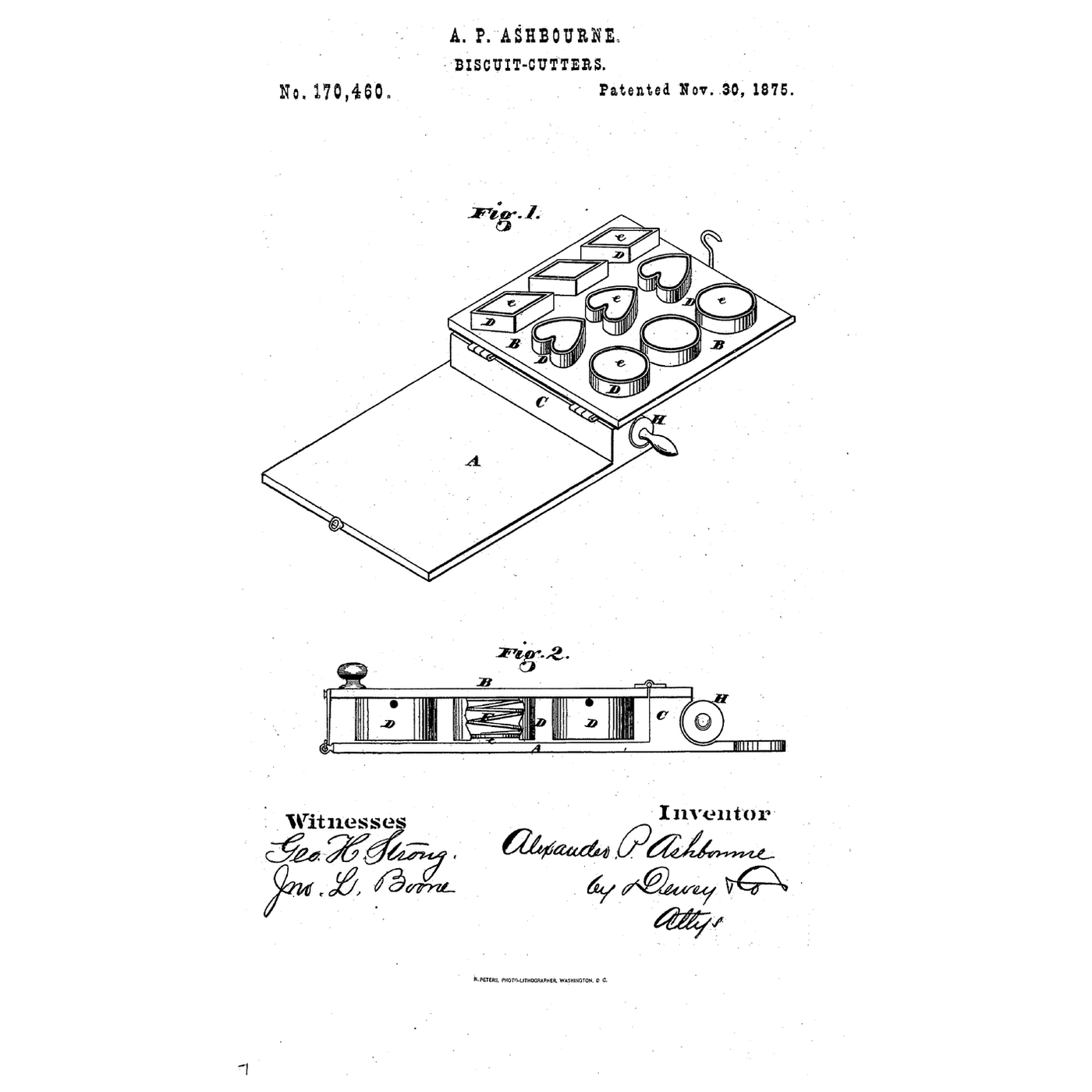


The Biscuit-Cutter Board: A Hinged Lid of Cutters, One Press for All
Biscuits cut one at a time are slow and uneven, and the scraps between them are rolled out again and again.
Alexander P. Ashbourne of Oakland, California, received US 170,460, dated 30 November 1875 (filed 11 May 1875), for a biscuit-cutter: "a molding-board, having hinged to one side or end a cover, which is provided with the desired shaped cutters upon its lower side", each with a plate on a spring, so that "as many cakes or biscuits will be formed instantaneously as there are cutters".
This rung computes how much of a sheet round cutters can use and how re-rolling adds up, then cuts and weighs a batch.
Débutant
About 1 hour
Consignes
1
1
Packing and re-rolling
Packing and re-rolling
Chargement du notebook Jupyter…
2
2
Where the dough is made
Where the dough is made
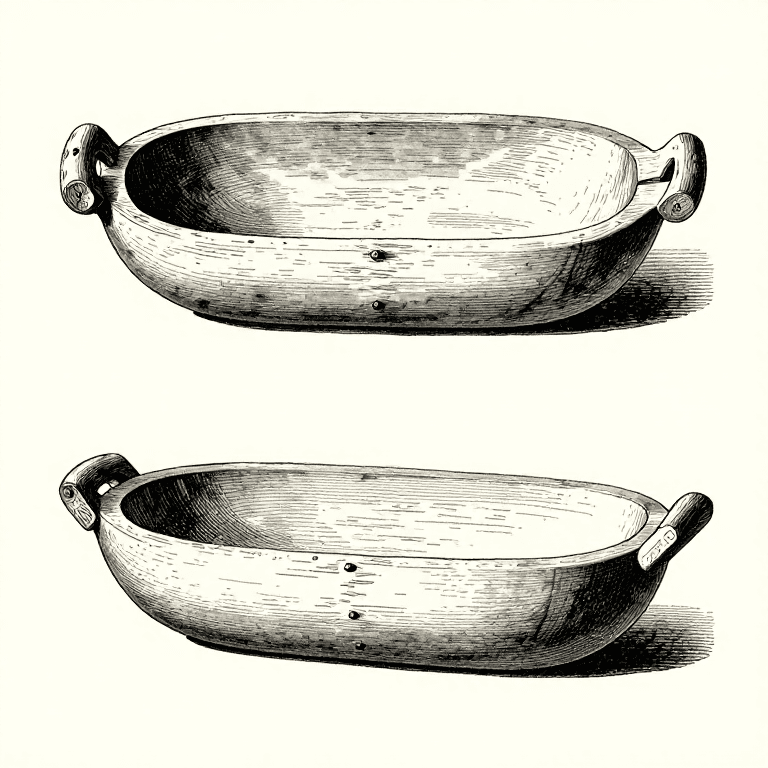
The embedded blueprint carves a trough for mixing dough; Ashbourne's board is where it is rolled and cut.
3
3
Read US 170,460
Read US 170,460
"My invention relates to a novel domestic utensil, which I term a biscuit or cake cutter; and it consists of a molding-board, having hinged to one side or end a cover, which is provided with the desired shaped cutters upon its lower side. These cutters have plates inside and springs, which allow the plates to recede when the cutters are pressed down upon the material, but which forces them out when the cover is lifted."
The cutters "may be made of metal, and in any fancy shape desired." "When the cover is shut down upon the paste upon the molding-board it will be seen that as many cakes or biscuits will be formed instantaneously as there are cutters."
The back of the cross-bar and the board are made concave "so that the rolling-pin H will fit into the concavities sufficiently to be held in place when not in use."
4
4
Cut, re-roll and weigh
Cut, re-roll and weigh
Make a biscuit dough, weigh it, and roll it to an even sheet. Cut rounds in a square grid, lift them out, and weigh them. Gather the scraps, re-roll, cut again and weigh; repeat once more.
Work out the share of dough used after each roll and compare it with the notebook's square-grid line. Then try cutting in offset rows, each row shifted half a cutter, and see how close you get to the hexagonal line.
Matériaux pour cette étape :
 Farine500 g
 Eau1 pièce
 Huile de cuisson1 pièce
Outils nécessaires :
 Emporte-pièce à biscuits
 Rouleau à pâtisserie
 Balance de cuisine numérique
 Règle
Règle5
5
Biscuits that stick, tear or come out tough
Biscuits that stick, tear or come out tough
Biscuit cutting troubleshooting.
Flow
Loading...
6
6
History and honest limits
History and honest limits
**Alexander P. Ashbourne** of Oakland, Alameda County, California, filed US 170,460 on 11 May 1875; it is dated 30 November 1875.
**Honest limits.** The packing figures are exact for circles on an endless sheet; a real sheet has edges, and re-rolled dough is never quite the same dough. The loose share is an example. Your weights are the measurement.
Matériaux
3- 500 gEspace réservé
- 1 pièceEspace réservé
- 1 pièceEspace réservé
Outils requis
4- Espace réservé
- Espace réservé
- Espace réservé
- Espace réservé
Blueprints liés
Ces blueprints partagent des connaissances — techniques, matériaux ou principes


CC0 Domaine public
Ce blueprint est publié sous CC0. Vous êtes libre de copier, modifier, distribuer et utiliser ce travail pour tout usage, sans demander la permission.
Soutenez le Maker en achetant des produits via son Blueprint où il perçoit une Commission Maker définie par les Vendeurs, ou créez une nouvelle itération de ce Blueprint et incluez-le comme connexion dans votre propre Blueprint pour partager les revenus.