ART
BEAUTÉ ET BIEN-ÊTRE
ARTISANAT
CULTURE ET HISTOIRE
DIVERTISSEMENT
ENVIRONNEMENT
NOURRITURE ET BOISSONS
INGÉNIERIE INVERSE
SCIENCES
SPORTS
TECHNOLOGIE
TECHNOLOGIE PORTABLE
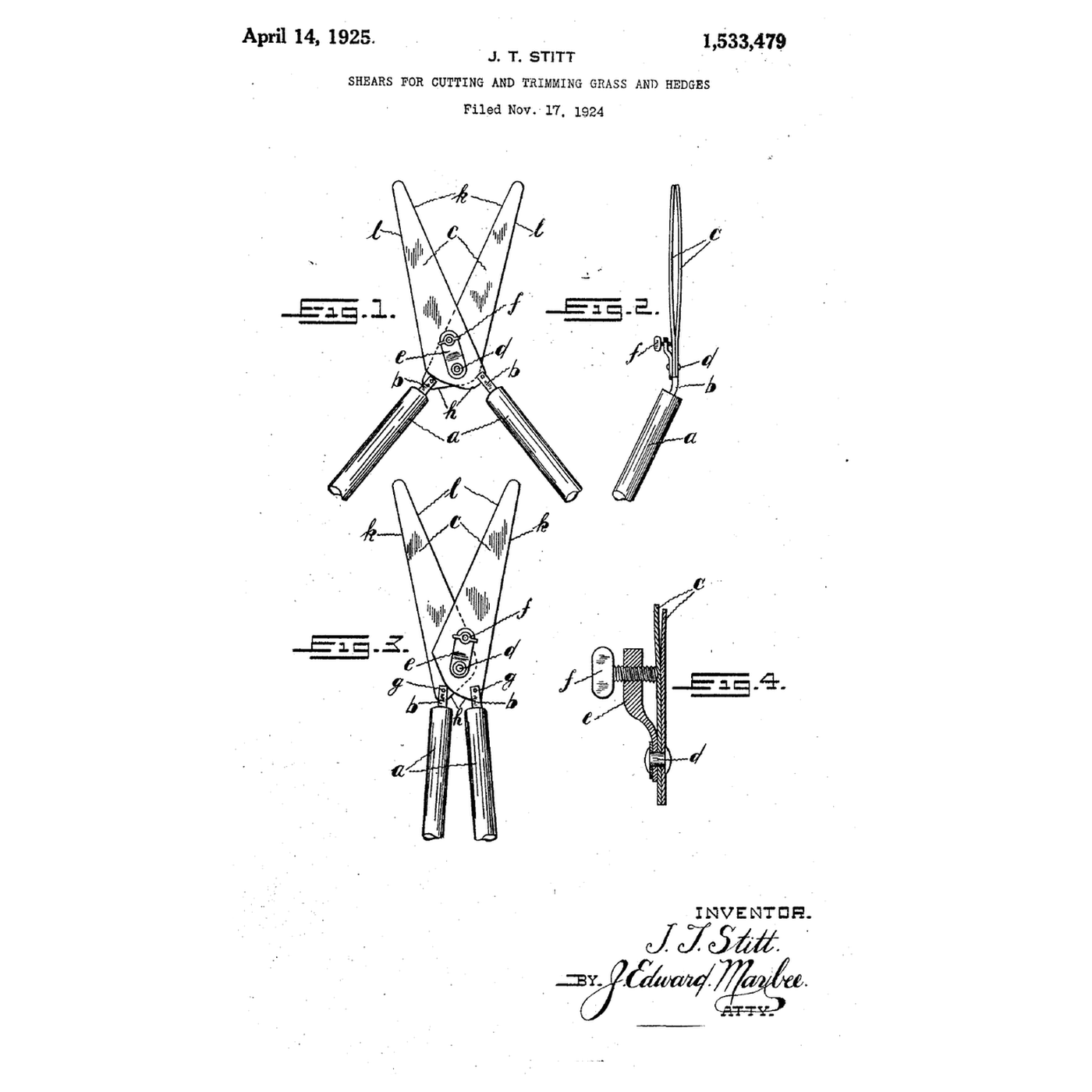

Double-Cutting Shears: Blades That Cut Both Ways
Trimming a lawn edge with shears is open, close, open, close — and only the closing half of the work cuts anything.
James Thomas Stitt of Nemegos, Ontario, filed US 1,533,479 on 17 November 1924; it was granted on 14 April 1925. His shears for grass and hedges have two double-edged blades riveted at their middle and handles set symmetrically, so the blades pass one another and one pair of edges cuts as the handles close while the other pair cuts as they spread. A spring and a set screw keep the blades bearing tightly together.
This rung works out what cutting on both strokes buys and where it runs out, and compares double-cutting action with ordinary shears on a lawn edge.
Débutant
About 2 hours
Consignes
1
1
Two cuts per cycle
Two cuts per cycle
Chargement du notebook Jupyter…
2
2
The other way to cut grass
The other way to cut grass
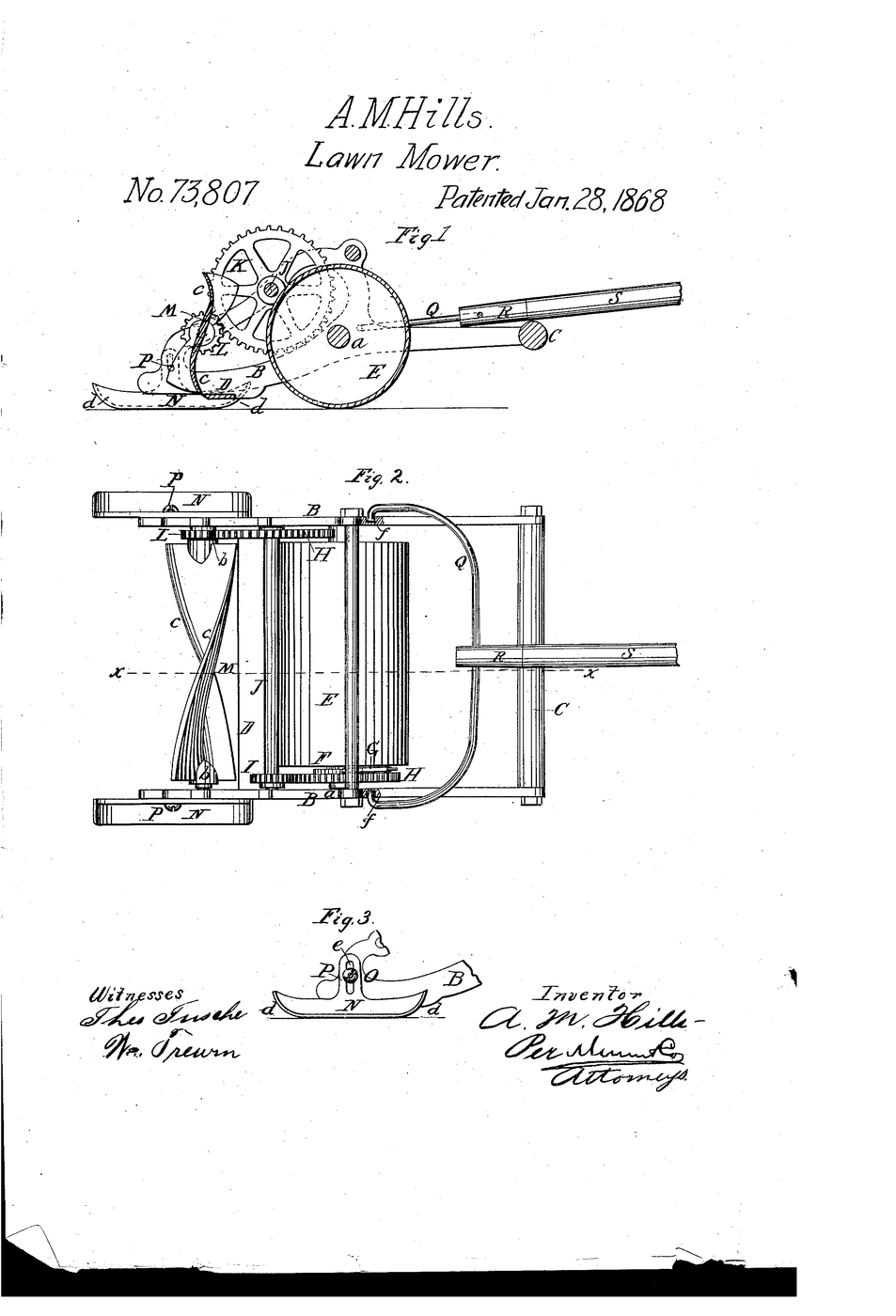
The reel mower cuts grass between a spinning reel and a fixed blade. The embedded blueprint shows the machine the edges are left for.
3
3
Read US 1,533,479
Read US 1,533,479
Stitt's object is "to provide a double cutting action for such shears, whereby the knives will cut not only when the handles are drawn together, but will also cut when the handles are drawn apart."
Handles a a fit on bars b b, riveted to blades c c. "The blades c c, are sharpened on all edges except the rounded edge h h, at the base of the blades." Drawing the handles together brings cutting edges k k into operation; drawing them apart brings edges l l into operation. A spring e and set screw f "serve to regulate and maintain the bearing of the blades c c as tight as may be necessary."
He notes that shears cutting both ways had been proposed, "but such shears have not been made with two double edged blades adapted to pass one another", nor with the blades symmetric to the handles, which matters in grass shears because "the line of cutting must always have a fixed direction relative to the operator".
4
4
Trim an edge both ways
Trim an edge both ways
Mark two equal 5 m lengths of lawn edge with stakes. Trim one with the hedge shears in the ordinary way and time it with the stopwatch. On the second, practise a steady open-and-close rhythm and count strokes per minute.
Cut paper strips as a stand-in for a double-edged blade: hold two strips crossed at their middle with a pin and see which edges meet on the closing stroke and which on the opening one. Then sketch Stitt's blade and mark its four cutting edges k and l and the blunt edge h.
Matériaux pour cette étape :
 Tuteurs de plantes - bambou 4 pieds4 pièces
 Papier1 pièce
Outils nécessaires :
 Cisailles à haies
 Chronomètre
 Mètre ruban
 Gants de taille (anti-épines)
5
5
Shears that chew instead of cut
Shears that chew instead of cut
Shears troubleshooting.
Flow
Loading...
6
6
History and honest limits
History and honest limits
**James Thomas Stitt** of Nemegos, Ontario, filed US 1,533,479 on 17 November 1924; it was granted on 14 April 1925. He claims the pair of double-edged blades pivoted between their cutting edges, with handles placed so each moves on its own side of the line of cut.
**Honest limits.** Hand strengths, stroke rate and cutting force in the notebook are assumptions; real figures vary widely between people and grasses.
Outils requis
4- Espace réservé
- Espace réservé
- 1 vendor sell this, none ship to you yetEspace réservé
- Espace réservé
Blueprints liés
Ces blueprints partagent des connaissances — techniques, matériaux ou principes
Reel Lawn Mower
par Karen
Construction
38
0
0
0
0
0
Raising the Nap and Shearing Woolen Cloth — Teasel Napping and Cropping Shears
par Tex
Textile et Cuir
66
0
0
0
1
0
Hafting a Flint-Bladed Grain Sickle — Composite Harvesting Tool
par Forge
Outils de Métallurgie
89
0
0
0
0
0

The Law of the Lever — Archimedes' Balance of Weight and Distance
par Martin
Physique
60
0
0
0
1
0
CC0 Domaine public
Ce blueprint est publié sous CC0. Vous êtes libre de copier, modifier, distribuer et utiliser ce travail pour tout usage, sans demander la permission.
Soutenez le Maker en achetant des produits via son Blueprint où il perçoit une Commission Maker définie par les Vendeurs, ou créez une nouvelle itération de ce Blueprint et incluez-le comme connexion dans votre propre Blueprint pour partager les revenus.