ART
BEAUTÉ ET BIEN-ÊTRE
ARTISANAT
CULTURE ET HISTOIRE
DIVERTISSEMENT
ENVIRONNEMENT
NOURRITURE ET BOISSONS
INGÉNIERIE INVERSE
SCIENCES
SPORTS
TECHNOLOGIE
TECHNOLOGIE PORTABLE
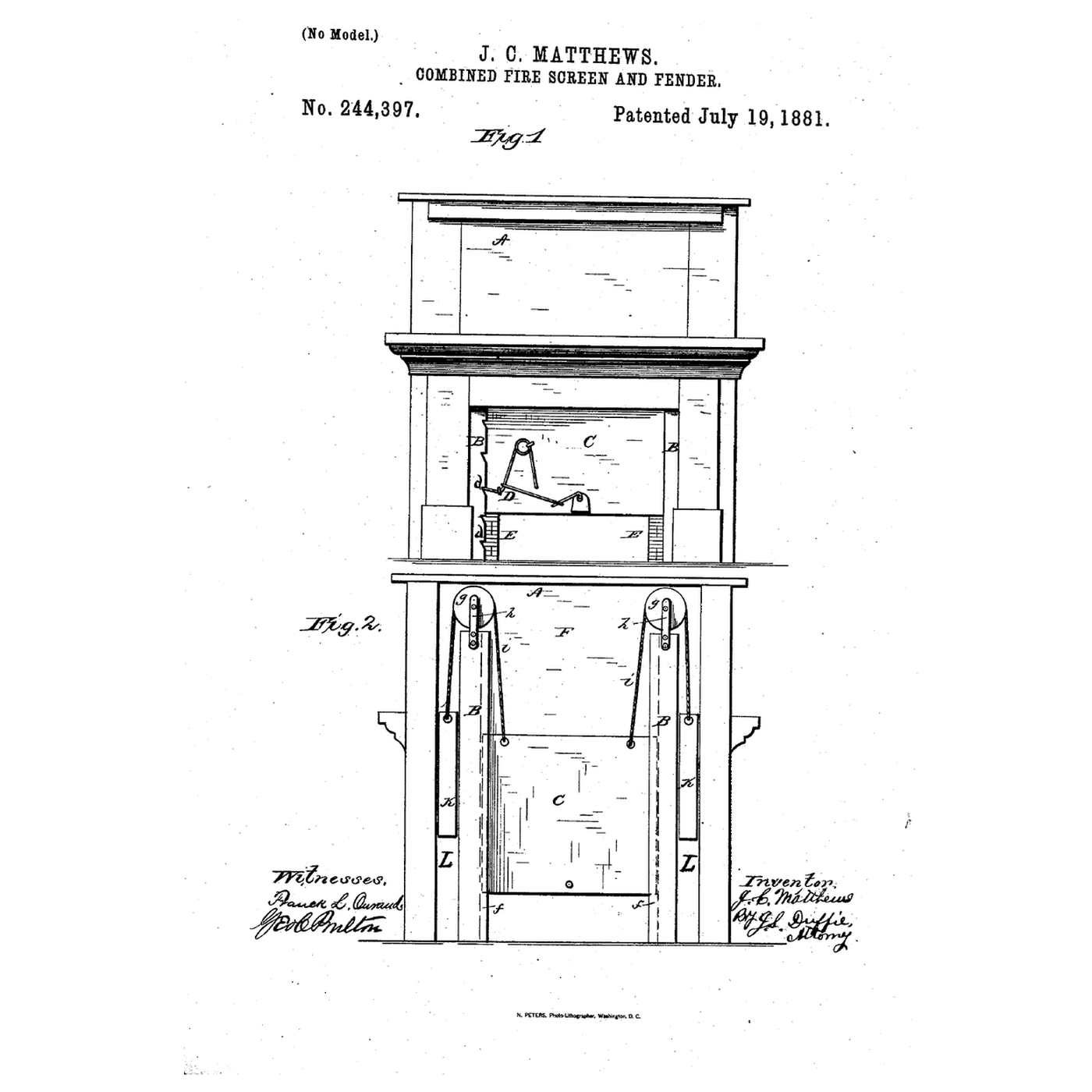


The Fire Screen: Counterweights That Lift It Into the Mantel
An open fire needs a guard against falling coals, a way to draw it up hard when lighting, and a cover in summer. One sheet of iron can do all three if it can be raised and lowered easily.
James C. Matthews of Canton, Texas, received US 244,397, dated 19 July 1881 (filed 10 May 1881), for a combined fire screen and fender that slides in grooves in the mantel jambs on ropes over pulleys to weights heavier than the screen, held by a spring-latch in notches. "By letting it nearly down to the hearth it acts as a blower; by letting it entirely down accidents from fire are prevented, and when let down in the summer time it makes a handsome summer screen."
This rung works out the counterweight's motion and the blower effect, then builds a counterweighted board on a pulley and times it.
Débutant
About 2 hours
Consignes
1
1
Counterweight and blower
Counterweight and blower
Chargement du notebook Jupyter…
2
2
Ropes, pulleys and weights
Ropes, pulleys and weights
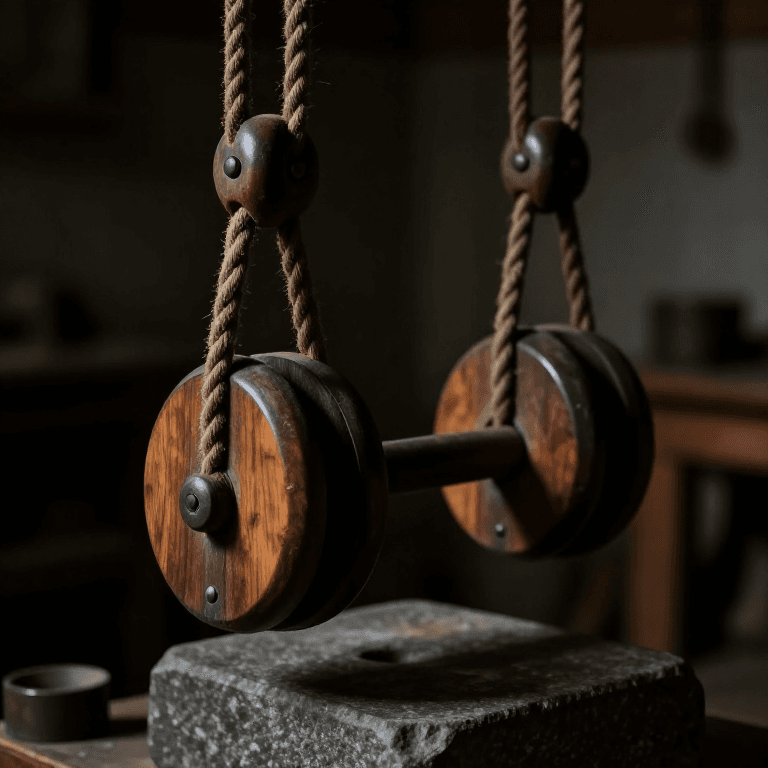
The screen hangs on ropes over pulleys. The embedded blueprint builds a block and tackle.
3
3
Read US 244,397
Read US 244,397
"My invention is a combined screen and fire-fender, and is a novel and useful device for having a combined screen and fire-fender always on hand, and so conveniently arranged that it can be put in place or withdrawn from sight by one motion of the hand and in one moment of time. This screen works in the mantel-piece by means of weights, and is secured in position by means of a spring-latch that catches in notches in the jamb."
"This screen thus arranged can be made to answer for three purposes: By letting it nearly down to the hearth it acts as a blower; by letting it entirely down accidents from fire are prevented, and when let down in the summer time it makes a handsome summer screen."
"The weights are made heavier than the screen, so that when the spring-latch is withdrawn from notches d d the screen will retire into recess F of its own motion. The screen is made flat, square, or nearly so, and may be of solid sheet-iron ... or it may be perforated or made of wire properly bound." "When the mantel-piece is made of wood it should be lined with sheet metal, to keep it from taking fire from heat radiated from the fender or screen."
4
4
Time a counterweighted board
Time a counterweighted board
Fix a pulley high on a frame or door lintel. Tie a plywood board (the 'screen') to one end of a rope over it, and a bag of sand slightly heavier than the board to the other. Weigh both first.
Hold the board down, release it, and time its rise over a measured height with a stopwatch; do it five times and average. Add sand in steps and repeat. Compare each rise time with the notebook's Atwood formula; the difference is friction. Keep feet clear of the falling weight.
Matériaux pour cette étape :
 Panneau de contreplaqué1 pièce
 Corde3 m
 Sable fin2 kg
Outils nécessaires :
 Poulie
 Balance numérique
 Chronomètre
 Mètre ruban
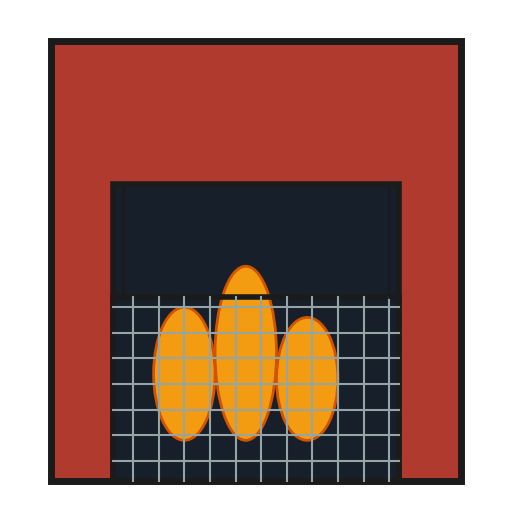 Pare-feu de cheminée
5
5
A fire screen that sticks, drops or smokes the room
A fire screen that sticks, drops or smokes the room
Fire screen troubleshooting.
Flow
Loading...
6
6
History and honest limits
History and honest limits
**James C. Matthews** of Canton, Texas, filed US 244,397 on 10 May 1881; it is dated 19 July 1881.
**Honest limits.** The patent gives no weights or sizes. Masses, rise height and opening sizes in the notebook are examples, and the Atwood model leaves out friction in the grooves and pulleys.
Matériaux
3- 1 pièceEspace réservé
- 3 mEspace réservé
- 2 kgEspace réservé
Outils requis
5- Espace réservé
- Espace réservé
- Espace réservé
- 1 vendor sell this, none ship to you yetEspace réservé
- Espace réservé
Blueprints liés
Ces blueprints partagent des connaissances — techniques, matériaux ou principes


CC0 Domaine public
Ce blueprint est publié sous CC0. Vous êtes libre de copier, modifier, distribuer et utiliser ce travail pour tout usage, sans demander la permission.
Soutenez le Maker en achetant des produits via son Blueprint où il perçoit une Commission Maker définie par les Vendeurs, ou créez une nouvelle itération de ce Blueprint et incluez-le comme connexion dans votre propre Blueprint pour partager les revenus.