ART
BEAUTÉ ET BIEN-ÊTRE
ARTISANAT
CULTURE ET HISTOIRE
DIVERTISSEMENT
ENVIRONNEMENT
NOURRITURE ET BOISSONS
INGÉNIERIE INVERSE
SCIENCES
SPORTS
TECHNOLOGIE
TECHNOLOGIE PORTABLE
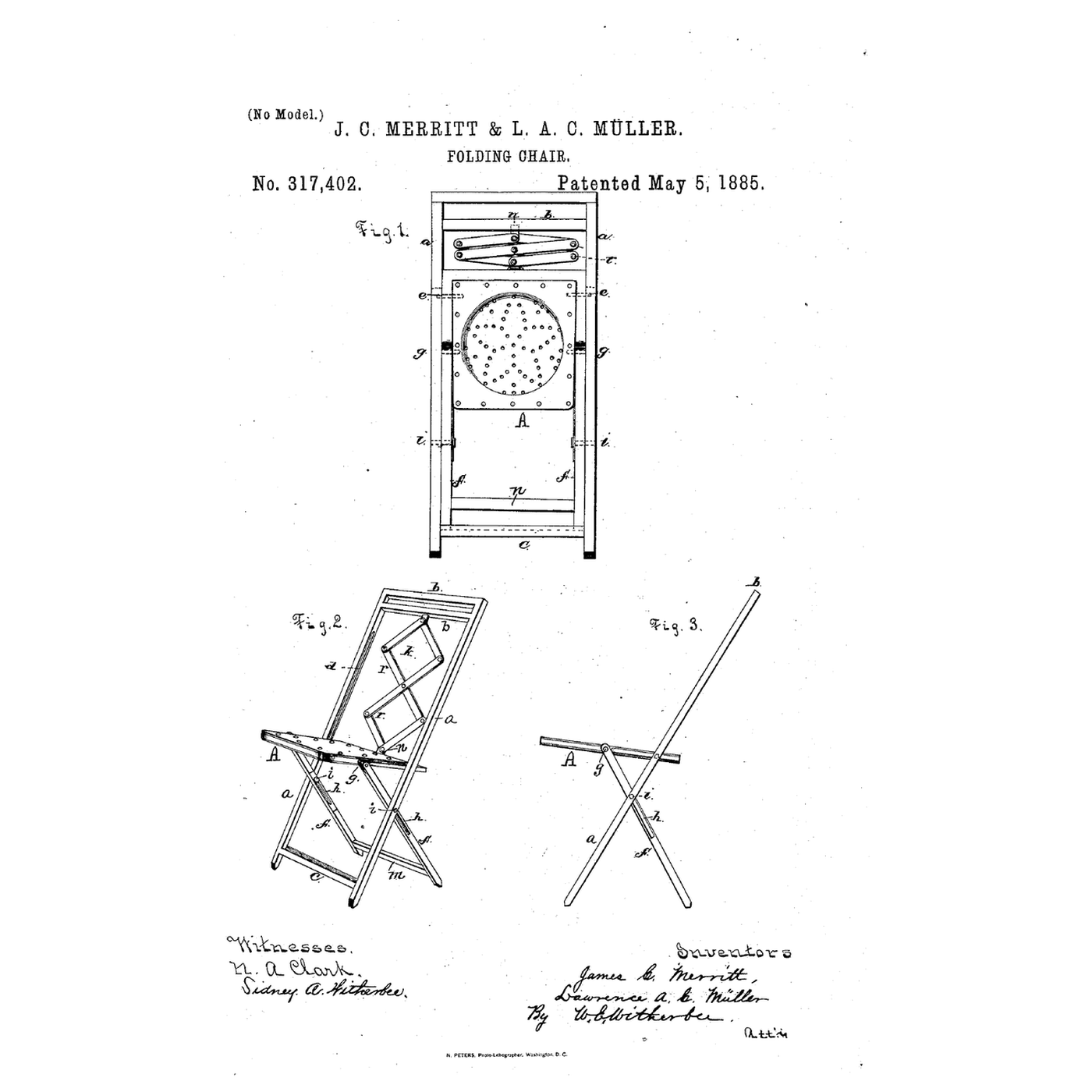


The Folding Chair: Pins in Slots Until It Is Only a Frame
A chair that folds must be rigid when open and small when shut. Crossed legs pinned together fold like scissors, but most folding chairs still end up as thick as their seat and legs together.
James C. Merritt and Lawrence A. C. Müller of Highland Falls, New York (Müller assignor to Joseph Denton), received US 317,402, dated 5 May 1885 (filed 3 December 1883), for a chair that "may be folded up perfectly flat and with the seat and back legs entirely within the main frame". Pins on the seat slide up slots in the front legs, pins on the front legs slide in slots in the back legs, and "in packing there is no waste space between the chairs, as, being flat, one lies directly on the one beneath."
This rung works out stacking and tipping, then builds a one-fifth scale model that folds flat.
Intermédiaire
About 4 hours
Consignes
1
1
Stacking and tipping
Stacking and tipping
Chargement du notebook Jupyter…
2
2
Parts that turn on a pin
Parts that turn on a pin
Every joint in the chair is a pin, fixed or sliding. The embedded blueprint forges the hinge that opens every door.
3
3
Read US 317,402
Read US 317,402
"The chair is composed of a main frame, which constitutes the front legs and back frame of the chair, of a seat, and back legs, which cross the front legs, and these parts are so connected with each other that the chair may be folded up perfectly flat and with the seat and back legs entirely within the main frame, and may be opened either way and used whichever way it may be opened."
"As all of the pieces used to compose the seat and legs are straight pieces, when the chair is folded it is perfectly flat, and is of no greater thickness than that of the material used". "The front legs are formed on their inner sides with slots or grooves d d, at the bottom of which rest pins e e, secured to the seat. When the chair is being folded, the pins e e slide upward in the slots d d".
The patent adds a back "composed of strips r r, pivoted together to form what is termed a 'lazy-tongs'", and a groove in the bottom cross-piece into which "the beveled ends of the back legs are lowered after being folded within the main frame, preventing the legs from being turned and thus locking the chair."
4
4
Lazy-tongs: a linkage that folds itself
Lazy-tongs: a linkage that folds itself
The chair's extra back is a lazy-tongs, the same crossed-bar linkage as a pantograph. The embedded blueprint builds one.
5
5
Build a one-fifth scale model
Build a one-fifth scale model
Draw the chair full size first, in side view: a main frame of two front legs joined by top and bottom cross-pieces; a seat between the front legs; two back legs pivoted at the front edge of the seat, crossing the front legs. Mark where each pin sits open and where it must slide to when folded. Scale it to one fifth.
Cut the parts from thin pine strips. Cut the slots in the front legs (for the seat pins) and in the back legs (for the front-leg pins) with a drill and coping saw; short lengths of dowel are the pins. Glue only the fixed joints.
Fold it. If it will not lie flat, a slot is too short: lengthen it until the back legs clear the bottom cross-piece, as the patent says. Measure its folded thickness against a board's. Open it and press on the seat: the pins should sit at the slot ends.
Matériaux pour cette étape :
 Planche de pin1 pièce
 Goujons de bois dur1 pièce
 Colle à bois1 pièce
Outils nécessaires :
 Scie à chantourner
 Perceuse sans fil
 Jeu de forets
 Assortiment de papier abrasif
 Règle
Règle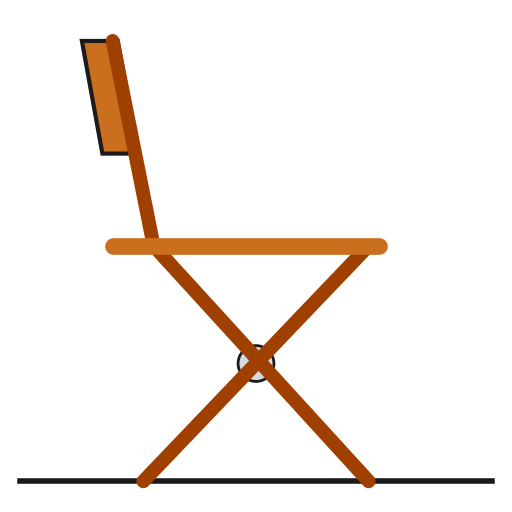 Chaise pliante
6
6
A folding chair that sticks or wobbles
A folding chair that sticks or wobbles
Folding chair troubleshooting.
Flow
Loading...
7
7
History and honest limits
History and honest limits
**James C. Merritt** and **Lawrence A. C. Müller** of Highland Falls, New York, filed US 317,402 on 3 December 1883; it is dated 5 May 1885. Müller assigned his share to Joseph Denton. The patent calls it a "reversible folding chair": it opens either way.
**Honest limits.** The patent gives no dimensions. The board thickness, heights and spreads in the notebook are examples; take the model's sizes from your own full-size drawing.
Matériaux
3- 1 pièceEspace réservé
- 1 pièceEspace réservé
- 1 pièceEspace réservé
Outils requis
6- Espace réservé
- 1 vendor sell this, none ship to you yetEspace réservé
- Espace réservé
- Espace réservé
- Espace réservé
- Espace réservé
Blueprints liés
Ces blueprints partagent des connaissances — techniques, matériaux ou principes


CC0 Domaine public
Ce blueprint est publié sous CC0. Vous êtes libre de copier, modifier, distribuer et utiliser ce travail pour tout usage, sans demander la permission.
Soutenez le Maker en achetant des produits via son Blueprint où il perçoit une Commission Maker définie par les Vendeurs, ou créez une nouvelle itération de ce Blueprint et incluez-le comme connexion dans votre propre Blueprint pour partager les revenus.