ART
BEAUTÉ ET BIEN-ÊTRE
ARTISANAT
CULTURE ET HISTOIRE
DIVERTISSEMENT
ENVIRONNEMENT
NOURRITURE ET BOISSONS
INGÉNIERIE INVERSE
SCIENCES
SPORTS
TECHNOLOGIE
TECHNOLOGIE PORTABLE



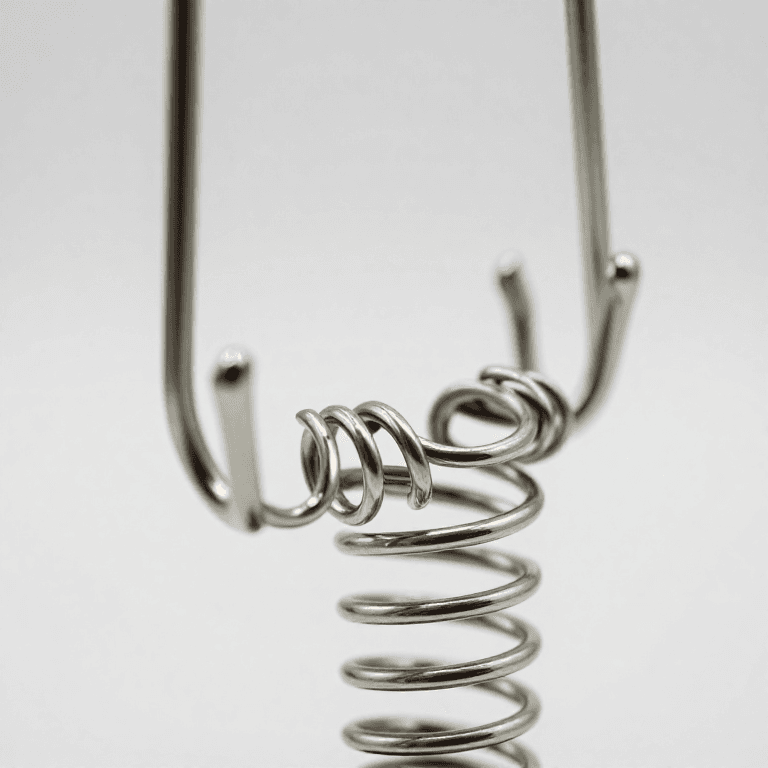
The Helical Spring Toy: A Spring Too Soft to Hurry
A helical spring that walks down stairs by itself, flowing its turns from one end to the other, looks like magic. It is careful proportion: flat wire, turns that just touch without pressing on each other, and a stiffness so low for its weight that every motion is slow enough to see.
Richard T. James of Upper Darby, Pennsylvania, assignor to James Industries, filed US 2,415,012, *Toy and Process of Use*, on 21 August 1946; it was granted 28 January 1947. The patent sets out the proportions: a flat cross-section about four times as wide as it is thick, a coil diameter about thirty times that width, no compression between turns at rest, and a natural frequency between 10 and 100 cycles a minute.
This rung works out why that combination walks, and measures a spring toy's stiffness and waves.
Débutant
About 2 hours
Consignes
1
1
Natural frequency and slow waves
Natural frequency and slow waves
Chargement du notebook Jupyter…
2
2
Stiffness first
Stiffness first
The toy's whole behaviour follows from its stiffness. The embedded blueprint measures a spring's stiffness by Hooke's law.
3
3
Measure it and make it walk
Measure it and make it walk
Weigh the spring. Hang it from one end and measure how far it stretches under its own weight, then add a 50 g mass and measure again: the extra stretch gives its stiffness. Bounce it gently and time twenty oscillations: compare with the notebook's formula.
Stretch it along a smooth floor with a partner holding the far end, flick one end sideways and time the pulse across; stretch it further and time again.
Finally, set it on the top step of a flight of stairs with even treads, pull the top turns over to the next step, and let go. Try steps of different heights: too low and it stalls, too high and it tumbles.
Matériaux pour cette étape :
 Ressort Slinky (métal)1 pièce
Outils nécessaires :
 Balance de cuisine numérique
 Mètre ruban
 Chronomètre
 Poids
Poids4
4
A spring toy that will not walk
A spring toy that will not walk
Why a spring toy stalls on the stairs.
Flow
Loading...
5
5
History and honest limits
History and honest limits
**Richard T. James**, a naval engineer, filed **US 2,415,012** on 21 August 1946, assigned to James Industries of Philadelphia; it was granted 28 January 1947. The toy was sold as the Slinky.
**Honest limits.** The oscillation and wave formulas treat the spring as uniform and ignore the turns' contact at rest; the real toy's collapsed turns make its behaviour richer than the model. The mass in the notebook is illustrative — weigh yours.
Matériaux
1- Ressort Slinky (métal)10 % de commission1 pièceEspace réservé
Outils requis
4- Espace réservé
- 1 vendor sell this, none ship to you yetEspace réservé
- Espace réservé
- Espace réservé
Blueprints liés
Ces blueprints partagent des connaissances — techniques, matériaux ou principes


CC0 Domaine public
Ce blueprint est publié sous CC0. Vous êtes libre de copier, modifier, distribuer et utiliser ce travail pour tout usage, sans demander la permission.
Soutenez le Maker en achetant des produits via son Blueprint où il perçoit une Commission Maker définie par les Vendeurs, ou créez une nouvelle itération de ce Blueprint et incluez-le comme connexion dans votre propre Blueprint pour partager les revenus.