ART
BEAUTÉ ET BIEN-ÊTRE
ARTISANAT
CULTURE ET HISTOIRE
DIVERTISSEMENT
ENVIRONNEMENT
NOURRITURE ET BOISSONS
INGÉNIERIE INVERSE
SCIENCES
SPORTS
TECHNOLOGIE
TECHNOLOGIE PORTABLE
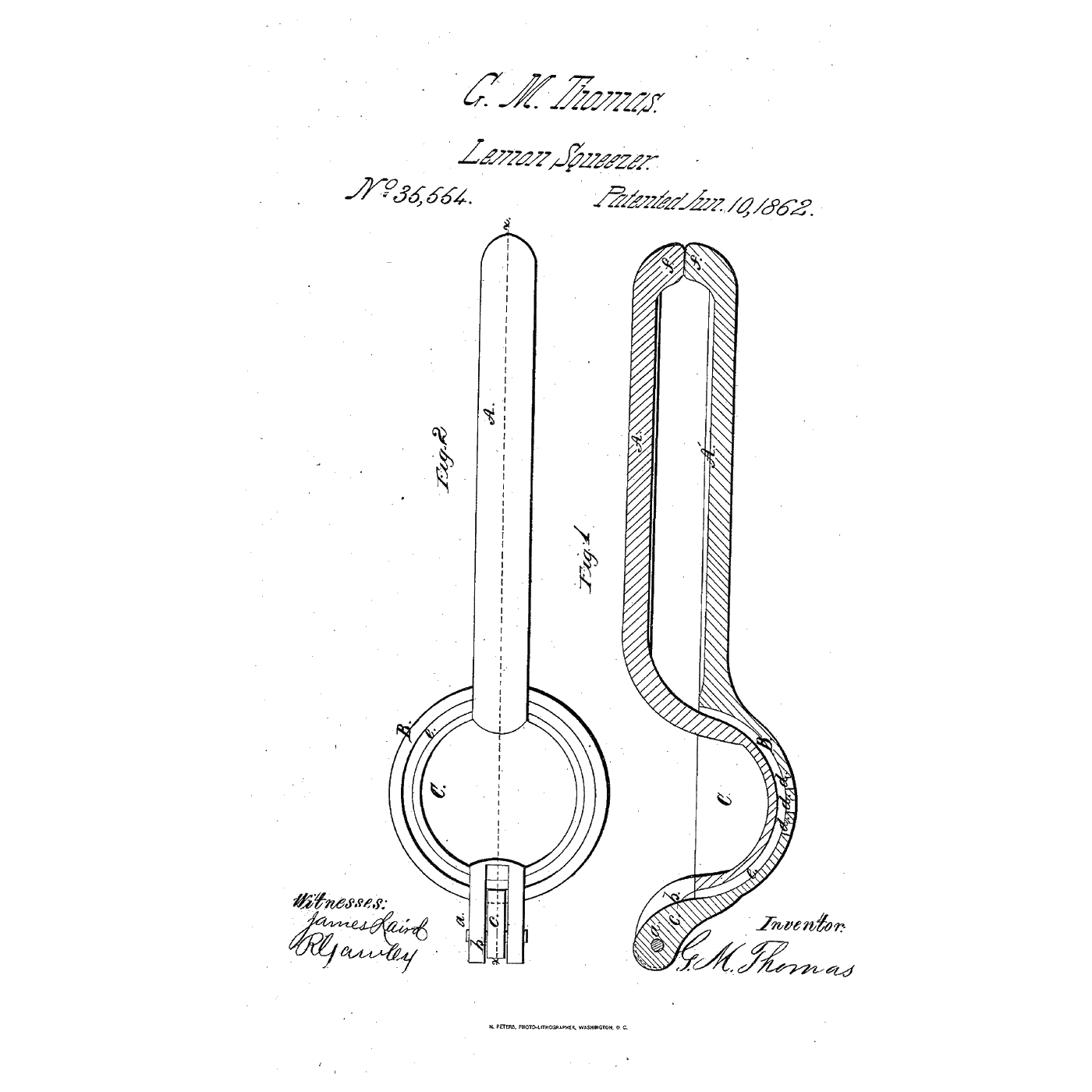


The Hinged-Bowl Lemon Squeezer: Two Cast Handles, One Bowl Inside the Other
The wooden lemon squeezers of the day soon soaked up stale juice and smelled of it.
George M. Thomas of New York received US 35,554, dated 10 June 1862, for "constructing the squeezer of cast metal and of such form or in such a manner that a very durable, economical, and light implement for the purpose is obtained, and one that may be manipulated or operated with greater facility than the ordinary kinds in general use." Two handles are pinned together at their front ends; the lower carries a perforated bowl, the upper a smaller half-sphere that fits inside it with a space between; the half lemon is put in the lower bowl and the handles are pressed together. The lower bowl hangs below its handle, so the squeezer can rest on a glass.
This rung works out the force of the handles, with a work check, then makes the squeezer from flat bar, a tin cup and a hardwood dome and squeezes lemons with it.
Intermédiaire
About 4 hours
Consignes
1
1
Force at the bowls
Force at the bowls
Chargement du notebook Jupyter…
2
2
A squeezer before it
A squeezer before it
The embedded blueprint presses the lemon on a cone under a lever-driven cap. Thomas puts the bowl and its half-sphere on the two handles themselves.
3
3
Read US 35,554
Read US 35,554
"The lower handle, A′, is provided with a bowl, B, of semispherical form, and perforated at its bottom, as shown at d in Fig. 1. The inner surface of the bowl B is enameled, or should be, in order to prevent oxidation. The bowl B and handle A′ are cast in one piece, and the bowl projects below the handle, the latter being on a level or in the same plane with the upper edge of the former."
"The lemon is squeezed by being divided, as usual, and one-half at a time placed in the bowl B, and forcing the bowl C down upon it by pressing the handles A A′ together."
4
4
Make the squeezer and press lemons
Make the squeezer and press lemons
**Handles.** Cut two 25 cm lengths of 20 × 5 mm mild steel flat bar. Drill both 1 cm from one end for an M6 pivot bolt, and bend the other ends slightly apart as the stops f.
**Lower bowl.** Cut the bottom 3 cm off a clean tin can about 7 cm across, punch holes in its base with a nail, and rivet its rim to the lower handle 5 cm behind the pivot so it hangs below.
**Upper dome.** Rasp a hardwood block into a half-sphere that fits inside the cup with about 5 mm to spare, and screw it to the upper handle opposite the cup.
**Test.** Bolt the handles together. Halve a lemon, put one half cut side down in the cup over a glass, and press the handles together, reading your squeeze with the spring scale hooked on the handles' ends. Weigh the juice, and compare with a half squeezed by hand.
Matériaux pour cette étape :
 Plat en acier doux0.5 mètre
 Boîte de conserve1 pièce
 Bloc de bois dur1 pièce
 Vis à bois2 pièces
 Rivets aveugles4 pièces
 Assortiment de boulons à tête hexagonale1 pièce
 Écrou hexagonal1 pièce
 Citron2 pièces
Outils nécessaires :
 Scie à métaux
 Perceuse sans fil
 Jeu de forets
 Limes (lime à main)
 Étau d'établi
 Cisaille à tôle
 Clous
Clous Marteau
 Kit de riveteuse
 Râpe
Râpe Jeu de tournevis
 Clé à molette
 Couteau de cuisine
 Balance de cuisine numérique
 Dynamomètre (peson à ressort)
 Verre à boire
 Gants de travail en cuir
5
5
A squeezer that sprays, slips or leaves juice
A squeezer that sprays, slips or leaves juice
Hinged-bowl lemon squeezer troubleshooting.
Flow
Loading...
6
6
History and honest limits
History and honest limits
**George M. Thomas** of New York, New York, received US 35,554, dated 10 June 1862. His handles A A′ were joined by a fulcrum pin a through a slot b in the upper handle, the bowl C was cast with the upper handle and smaller than B to leave a space e, and the handles' ends were curved at f as stops. He thought cast iron, japanned, the best material, and did not claim a cast-metal squeezer as such, but one with two handles on a fulcrum pin and bowls fitting one within the other below the handles.
**Honest limits.** Flat bar, a tin cup and a hardwood dome stand in for his cast-iron handles and bowls. The notebook ignores friction; its forces and lengths are examples. Your juice weights are the result.
Matériaux
8- 0.5 mètreEspace réservé
- 1 pièceEspace réservé
- 1 pièceEspace réservé
- 2 piècesEspace réservé
- 4 piècesEspace réservé
- Espace réservé
- 1 pièceEspace réservé
- 2 piècesEspace réservé
Outils requis
17- Espace réservé
- 1 vendor sell this, none ship to you yetEspace réservé
- Espace réservé
- Espace réservé
- Espace réservé
- Espace réservé
- Espace réservé
- Espace réservé
- Espace réservé
- Espace réservé
- Espace réservé
- Espace réservé
- Espace réservé
- Espace réservé
- Espace réservé
- Espace réservé
- Espace réservé
Blueprints liés
Ces blueprints partagent des connaissances — techniques, matériaux ou principes



CC0 Domaine public
Ce blueprint est publié sous CC0. Vous êtes libre de copier, modifier, distribuer et utiliser ce travail pour tout usage, sans demander la permission.
Soutenez le Maker en achetant des produits via son Blueprint où il perçoit une Commission Maker définie par les Vendeurs, ou créez une nouvelle itération de ce Blueprint et incluez-le comme connexion dans votre propre Blueprint pour partager les revenus.