ART
BEAUTÉ ET BIEN-ÊTRE
ARTISANAT
CULTURE ET HISTOIRE
DIVERTISSEMENT
ENVIRONNEMENT
NOURRITURE ET BOISSONS
INGÉNIERIE INVERSE
SCIENCES
SPORTS
TECHNOLOGIE
TECHNOLOGIE PORTABLE

The Hook and Eye: A Spring Tongue That Keeps the Eye In
A hook and eye closes a waistband or the neck of a dress with two small pieces of bent wire. Its weakness is slack: when the cloth stops pulling, the eye slides back along the hook and falls off.
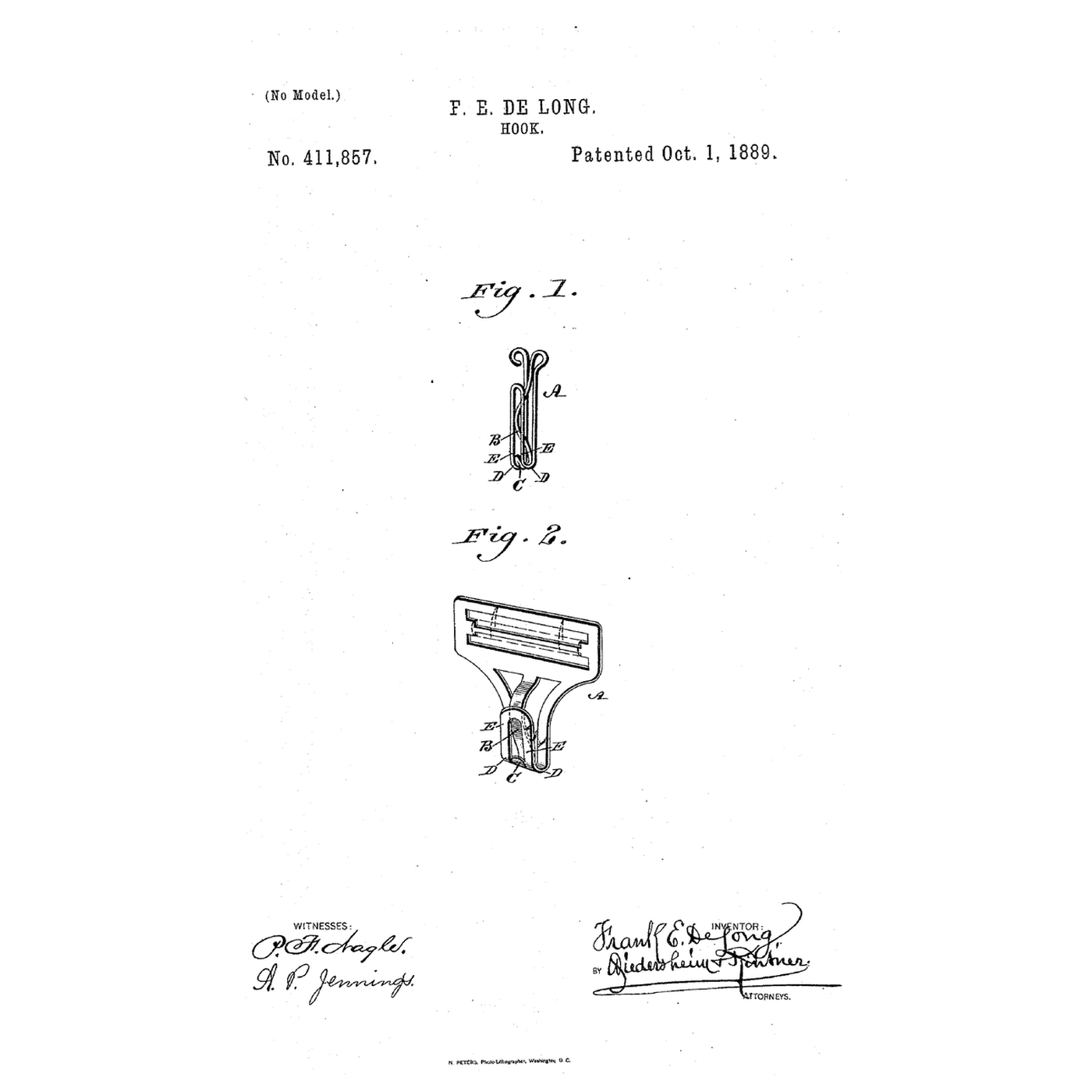
Frank E. De Long of Philadelphia patented a hook with a spring tongue inside it: US 411,857, filed 18 March 1889 and dated 1 October 1889, half assigned to Charles F. De Long. The hook proper and its shank are made of parallel side bars, and between them a tongue, bowed out towards the front of the hook, ends in a loop that sits in the bend. An eye pushed in forces the tongue back and passes; the tongue then closes behind it.
This rung works out how to size a wire tongue so it springs back instead of bending for good, and makes and tests hooks with and without one.
Débutant
About 2 hours
Consignes
1
1
Sizing a wire spring tongue
Sizing a wire spring tongue
Chargement du notebook Jupyter…
2
2
A wire spring that guards a point
A wire spring that guards a point
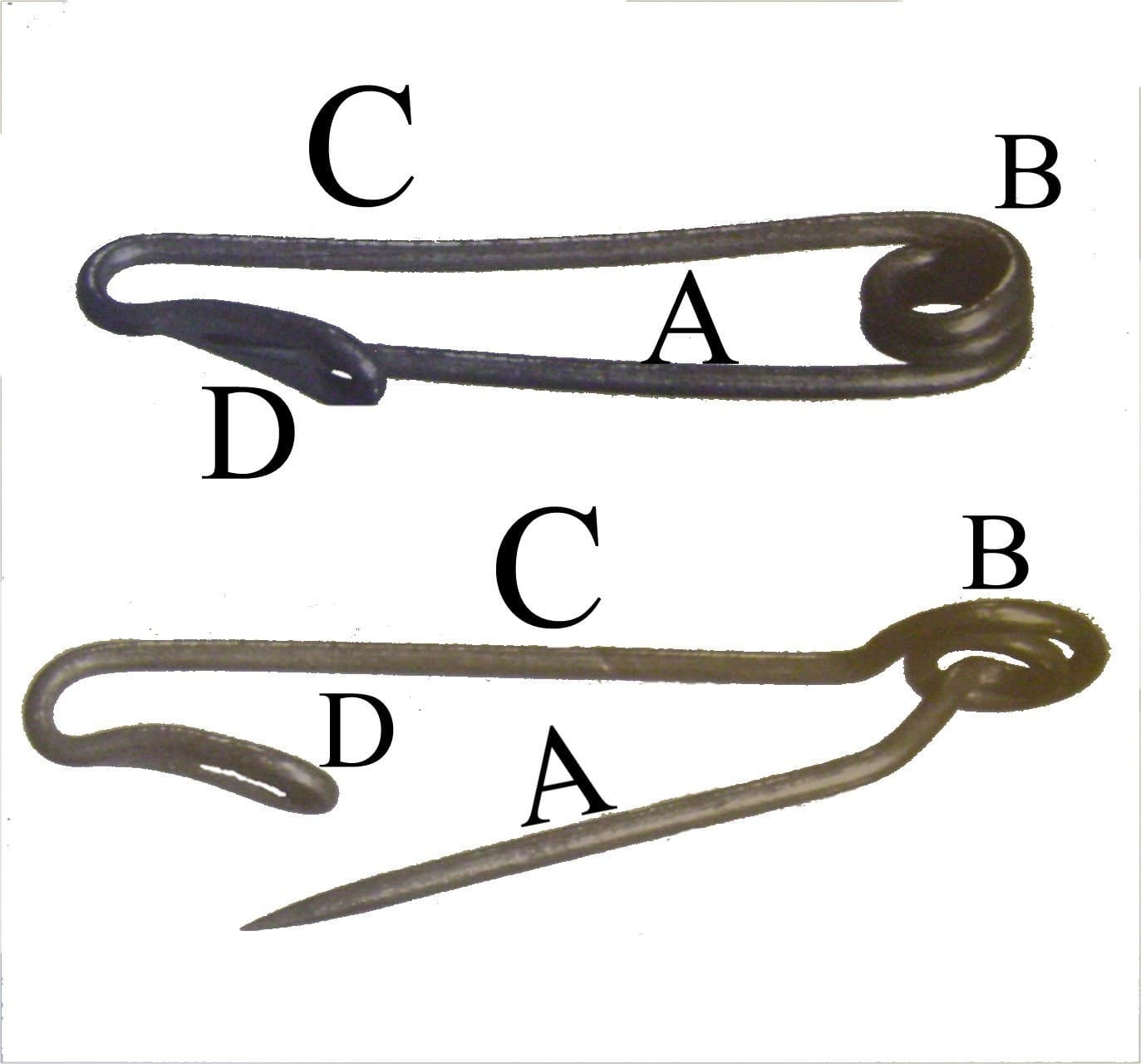
The safety pin bends one wire into a spring and a clasp. The embedded blueprint shows the older closure the hook-and-eye stands beside.
3
3
Read US 411,857
Read US 411,857
De Long describes "a hook or fastening for a garment, composed of front and rear portions or the hook proper and the shank formed of substantially parallel sides or bars, and a tongue having its free end forming a loop coincident with the bend of the hook". Fig. 1 is a hook for "a hook and eye"; Fig. 2 shows the same hook on the frame of a suspender buckle or slide.
The spring-tongue B "is bowed or swelled outwardly so as to approach the front portion." An eye drawn between the front and rear of the hook "bears against the tongue and rides over the same, forcing it backward", reaches the bend D, and the tongue returns, "serving to retain the eye". The eye then sits in both the bend D and the loop C; the loop strengthens the hook and stops the eye "from slipping behind the tongue". Both tongue and loop lie between the side pieces, so they are "laterally restrained" when the hook is under strain.
4
4
Bend hooks with and without a tongue
Bend hooks with and without a tongue
With round-nose and flat-nose pliers, bend two plain hooks and two eyes from steel wire about 0.6 mm thick. For two more hooks, bend the wire back on itself so the hook has two parallel side bars, and form a tongue from finer wire (about 0.3–0.4 mm) that runs inside the hook, bowed towards the front, with its end curled into the bend.
Sew one of each onto two scraps of cotton fabric, with eyes on the facing edges. Hook them up, then shake and flex the fabric with no tension on it for a minute. Count how often each pair comes apart. Check the tongues under a hand lens afterwards: a tongue that no longer touches the front of the hook has taken a set — make it longer or thinner, as the notebook says.
Matériaux pour cette étape :
 Fil d'acier1 pièce
 Tissu de coton (léger)1 pièce
 Fil1 pièce
 Agrafe et porte2 pièces
Outils nécessaires :
 Pince à becs ronds
 Pince plate
 Pince coupante diagonale
 Aiguilles à coudre à la main
 Loupe de poche 10x
 Pied à coulisse numérique 6 pouces
5
5
A hook and eye that will not stay closed
A hook and eye that will not stay closed
Hook-and-eye troubleshooting.
Flow
Loading...
6
6
History and honest limits
History and honest limits
**Frank E. De Long** of Philadelphia filed US 411,857 on 18 March 1889; it is dated 1 October 1889, with one-half assigned to Charles F. De Long. The claim is the hook of parallel bars with a tongue whose free end forms a loop in the bend, both lying between the side bars.
**Honest limits.** The wire modulus and working stress in the notebook are assumed values; the patent gives no dimensions.
Matériaux
4- 1 pièceEspace réservé
- 1 pièceEspace réservé
- 1 pièceEspace réservé
- 2 piècesEspace réservé
Outils requis
6- Espace réservé
- Espace réservé
- Espace réservé
- Espace réservé
- Espace réservé
- Espace réservé
Blueprints liés
Ces blueprints partagent des connaissances — techniques, matériaux ou principes
Safety Pin
par Tex
ARTISANAT
33
0
0
0
0
0
Greek Bronze Fibula — Bending a Bronze Fibula Brooch
par Forge
Travail des Métaux
81
0
0
0
1
0

Sewing On a Button So It Stays On: The Shank Is the Whole Trick
par Tex
ARTISANAT
19
0
0
0
0
0
Drawing Wire Through a Drawplate — Reducing Iron Rod to Fine Wire
par Forge
Travail des Métaux
48
0
0
0
3
0
Hooke's Law — Stretch a Spring and Find Its Stiffness
par Penny
Physique
37
0
0
0
0
0
CC0 Domaine public
Ce blueprint est publié sous CC0. Vous êtes libre de copier, modifier, distribuer et utiliser ce travail pour tout usage, sans demander la permission.
Soutenez le Maker en achetant des produits via son Blueprint où il perçoit une Commission Maker définie par les Vendeurs, ou créez une nouvelle itération de ce Blueprint et incluez-le comme connexion dans votre propre Blueprint pour partager les revenus.