ART
BEAUTÉ ET BIEN-ÊTRE
ARTISANAT
CULTURE ET HISTOIRE
DIVERTISSEMENT
ENVIRONNEMENT
NOURRITURE ET BOISSONS
INGÉNIERIE INVERSE
SCIENCES
SPORTS
TECHNOLOGIE
TECHNOLOGIE PORTABLE



The Inclined Butter Worker: Pressing Out the Buttermilk
Butter from the churn is not finished. Drops of buttermilk are still trapped in it. They sour it, so they have to be pressed out.
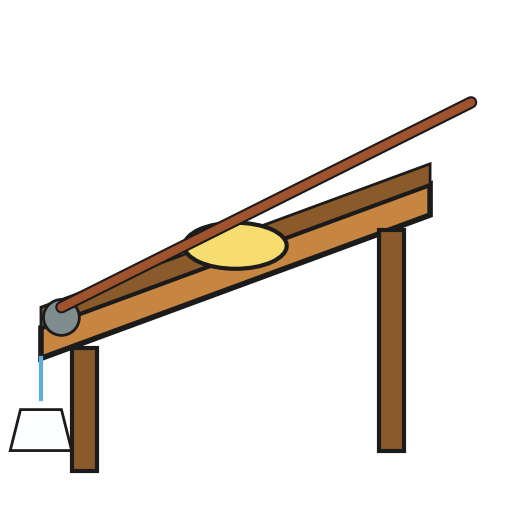
William Weaver of Phoenixville, Pennsylvania, received US 117,022, dated 11 July 1871, for a butter-worker made of "an inclined bed resting upon suitable legs or supports". A three-bar worker is pivoted on a shaft at its foot and moved "up and down, and at the same time from side to side" over the whole bed, while the liquid runs down to grooves and a V-shaped notch.
This rung works out how much water has to come out of a batch, and how strong the brine inside salted butter is. You then build a small inclined worker and weigh what it removes.
Débutant
About 2 hours
Consignes
1
1
Water to remove, and the brine inside
Water to remove, and the brine inside
Chargement du notebook Jupyter…
2
2
Where the butter comes from
Where the butter comes from
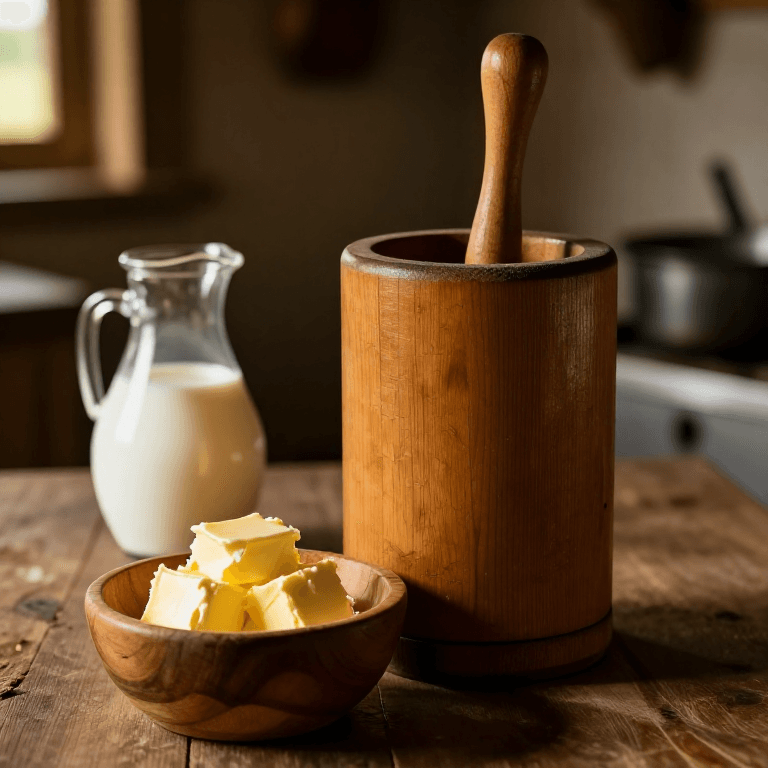
The embedded blueprint churns cream until the butterfat gathers. Working starts where churning stops.
3
3
Read US 117,022
Read US 117,022
"A represents an inclined bed resting upon suitable legs or supports, and provided at the sides and lower end with upward-projecting flanges a a. At the lower end of the inclined bed A are inclined grooves b b, meeting in the center, and in the center of the end flange a is a V-shaped notch, d."
"The worker is composed of three parallel bars, C C, placed loosely at one end on the shaft B and connected together by rods f f."
"In the working of this machine the worker C f is moved up and down, and at the same time from side to side on the shaft B, so as to travel over the entire surface of the inclined bed A."
4
4
Build a small worker and weigh what it takes out
Build a small worker and weigh what it takes out
Take a hardwood board about 50 cm long. Glue and screw strips along both sides and the lower end to make low flanges. Saw a V-notch in the middle of the end strip. Raise the top end on a block so that the board slopes towards the notch, and set a bowl under the notch.
Drill a dowel across the foot of the board as the shaft. Pivot a flat hardwood bar on it as the worker, with its free end as the handle.
Chill the board and the bar with ice water first, so the butter does not stick. Weigh the freshly churned, washed butter. Press it with the bar, fold it with the spoon and press again, working across the whole board. Stop when no more liquid runs.
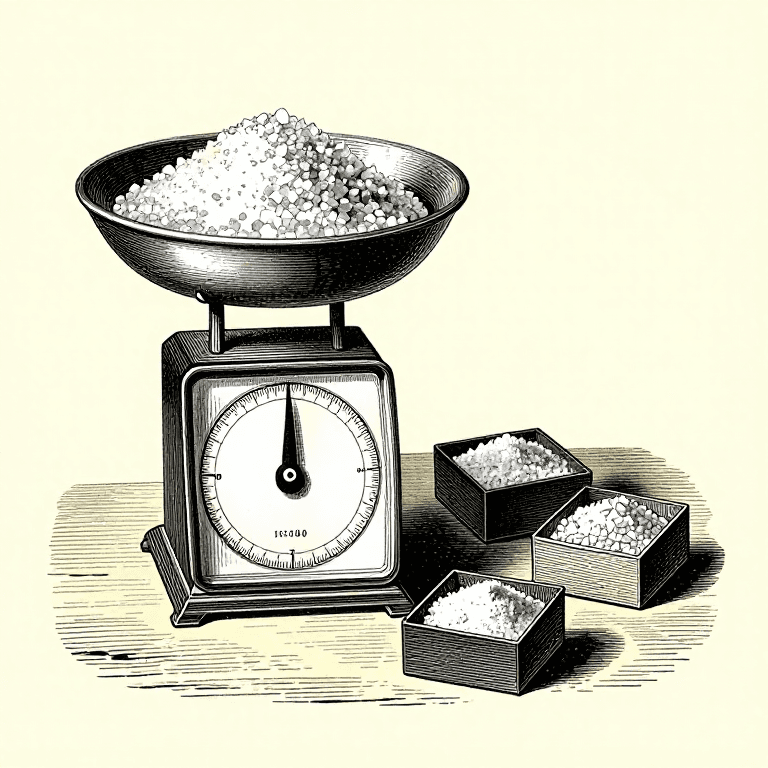
Weigh the butter again, and weigh the liquid in the bowl. Salt by weight if you want salted butter, then work it once more to spread the salt. Compare the loss with the notebook.
Matériaux pour cette étape :
 Planche de bois dur1 pièce
 Tourillon en bois1 pièce
 Vis à bois8 pièces
 Colle à bois1 pièce
 Beurre500 g
 Gros sel marin10 g
 Glaçons500 g
Outils nécessaires :
 Malaxeur à beurre
 Scie égoïne
 Perceuse sans fil
 Balance de cuisine numérique
 Bol
Bol Jeu de cuillères en bois
5
5
Butter that sours, streaks or sticks
Butter that sours, streaks or sticks
Butter-working troubleshooting.
Flow
Loading...
6
6
History and honest limits
History and honest limits
**William Weaver** of Phoenixville, Pennsylvania, received US 117,022, dated 11 July 1871. The patent prints no filing date.
**Honest limits.** The notebook assumes working removes only water. In practice the drained liquid also carries some buttermilk solids and a little fat. The starting water fractions and salt doses are examples. Your scale readings are the measurement.
Matériaux
7- 1 pièceEspace réservé
- 1 pièceEspace réservé
- 8 piècesEspace réservé
- 1 pièceEspace réservé
- 500 gEspace réservé
- 10 gEspace réservé
- 500 gEspace réservé
Outils requis
6- Espace réservé
- Espace réservé
- 1 vendor sell this, none ship to you yetEspace réservé
- Espace réservé
- Espace réservé
- Espace réservé
Blueprints liés
Ces blueprints partagent des connaissances — techniques, matériaux ou principes

CC0 Domaine public
Ce blueprint est publié sous CC0. Vous êtes libre de copier, modifier, distribuer et utiliser ce travail pour tout usage, sans demander la permission.
Soutenez le Maker en achetant des produits via son Blueprint où il perçoit une Commission Maker définie par les Vendeurs, ou créez une nouvelle itération de ce Blueprint et incluez-le comme connexion dans votre propre Blueprint pour partager les revenus.