ART
BEAUTÉ ET BIEN-ÊTRE
ARTISANAT
CULTURE ET HISTOIRE
DIVERTISSEMENT
ENVIRONNEMENT
NOURRITURE ET BOISSONS
INGÉNIERIE INVERSE
SCIENCES
SPORTS
TECHNOLOGIE
TECHNOLOGIE PORTABLE


The Reversible Crochet Hook Holder: Collet Jaws Grip the Hook Either Way Round
A fine steel hook is hard to hold, and its point catches when carried.
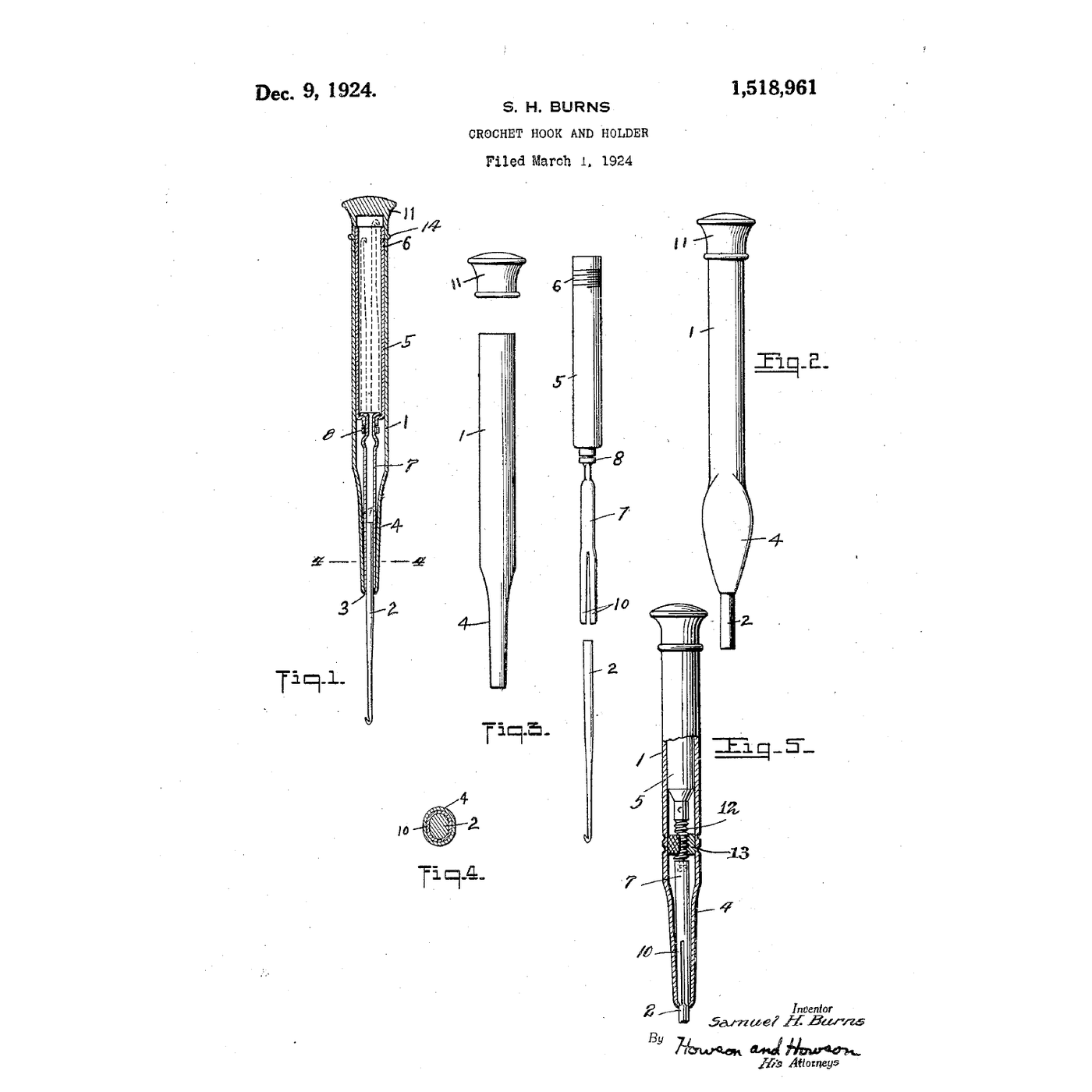
Samuel H. Burns of Brooklyn, New York, received US 1,518,961, patented 9 December 1924, for a crochet hook and holder "in which the needle can be reversed and left with the point inside the holder for protection when not in use": split jaws on a small tube are drawn into the handle's flattened, tapered end by a threaded inner shell and grip the hook's non-round shank; the hollow inner shell stores hooks of other sizes.
This rung works out how hard a taper squeezes the jaws, then builds a collet holder from brass, aluminium and an M4 screw and measures the pull it holds.
Avancé
About 4 hours
Consignes
1
1
Grip from the taper
Grip from the taper
Chargement du notebook Jupyter…
2
2
A hook protected in its handle before it
A hook protected in its handle before it
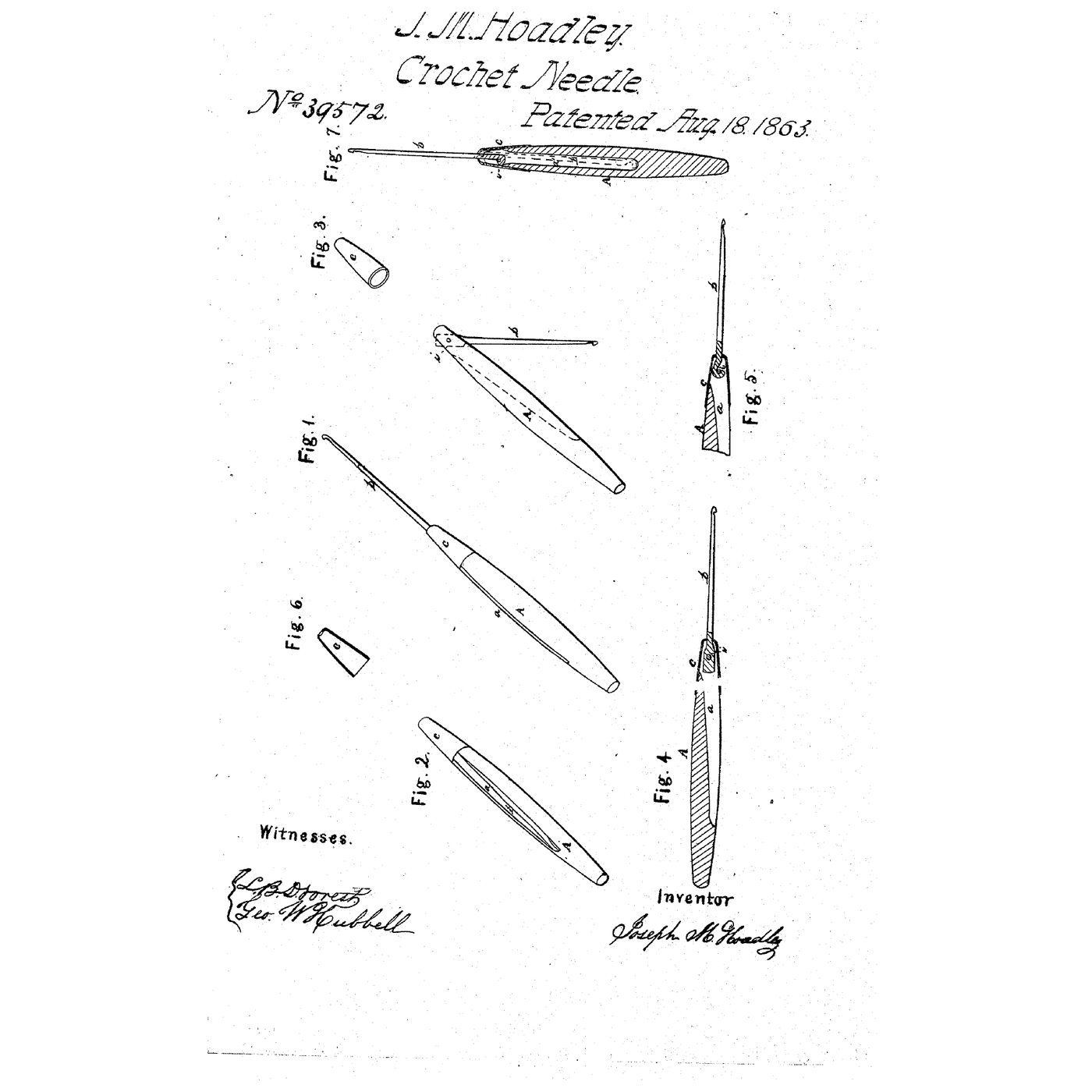
The embedded blueprint folds the hook into its handle. Burns takes the hook out, turns it round and clamps it point-in.
3
3
Read US 1,518,961
Read US 1,518,961
"The shank of the hook is then introduced into opening 3 of the tapered end and the jaws 10 until the desired length of the shank is left outside the holder when the inner shell 5 can be screwed into the outer shell and the clamping jaws 10 forced into the opening 3 of the tapered end thus gripping the shank of the hook."
"By making the inner shell 5 hollow, and of the proper length, I can use it as a reservoir for an assortment of needles for various sizes and kinds of crochet work."
4
4
Make the nose
Make the nose
Cut 30 mm of 12 mm aluminium rod. Drill 3.5 mm through on the axis, then 8.5 mm from the back 18 mm deep. Finish the bottom of the bore with the 8.5 mm bit's point, then file the front 15 mm to a flattened taper.
Matériaux pour cette étape :
 Tige d'aluminium1 pièce
Outils nécessaires :
 Scie à métaux
 Étau d'établi
 Perceuse sans fil
 Jeu de forets
 Limes (lime à main)
 Pied à coulisse numérique 6 pouces
 Lunettes de sécurité transparentes
5
5
Make the jaws
Make the jaws
Cut 30 mm of 8 mm brass rod. Drill 3.3 mm through on the axis and tap the back 10 mm M4. File the front to a cone matching the bore's bottom, and saw two cuts across it 12 mm deep, making four jaws.
Matériaux pour cette étape :
 Barre de laiton1 pièce
Outils nécessaires :
Scie à métauxÉtau d'établiPerceuse sans filJeu de forets Jeu de tarauds et filières
 Jeu de limes aiguilles
6
6
Assemble the handle
Assemble the handle
Epoxy the nose into one end of 120 mm of 1/2" brass tube. Epoxy an M4 nut in a 20 mm hardwood plug, centred, and set it 50 mm behind the nose. Screw 90 mm of M4 threaded rod through the nut into the jaws.
Matériaux pour cette étape :
 Tube en laiton de 1/2 pouce de diamètre extérieur1 pièce
 Époxy à deux composants1 pièce
 Écrou hexagonal1 pièce
 Goujons de bois dur1 pièce
 Tige filetée1 pièce
Outils nécessaires :
Scie à métauxPerceuse sans filJeu de forets7
7
Clamp a hook both ways
Clamp a hook both ways
Choose a hook from the set with a shank under 3.3 mm and file two flats on it. Push it through the nose into the jaws and turn the rod's back end to draw the jaws in until it grips. Then reverse it, point inside, and clamp it again.
Matériaux pour cette étape :
 Jeu de crochets1 pièce
Outils nécessaires :
Jeu de limes aiguilles8
8
Measure the grip
Measure the grip
Tie yarn to the hook's throat and pull along it with the force meter until it slips. Repeat at finger-tight and at firm; then twist the hook by hand and see if it turns.
Matériaux pour cette étape :
 Fil1 pièce
Outils nécessaires :
 Dynamomètre (peson à ressort)
9
9
A holder that slips, binds or will not open
A holder that slips, binds or will not open
Reversible crochet hook holder troubleshooting.
Flow
Loading...
10
10
History and honest limits
History and honest limits
**Samuel H. Burns** of Brooklyn, New York, filed US 1,518,961 on 1 March 1924, a continuation in part of his application of 5 June 1922; it was patented 9 December 1924. The flattened tapered end gives the thumb and forefinger a grip, and with a non-round shank the hook cannot turn in it. His small tube turns freely on the inner shell, so the jaws are drawn in without revolving; a cap on the inner shell turns it.
**Honest limits.** Our jaws turn with the screw, where his did not, and a threaded rod replaces his threaded inner shell. The drill point leaves a steep 118° cone, which grips less than a shallow taper would. Sizes are ours. Your pull forces are the result.
Matériaux
9- 1 pièceEspace réservé
- 1 pièceEspace réservé
- Espace réservé
- 1 pièceEspace réservé
- 1 pièceEspace réservé
- 1 pièceEspace réservé
- 1 pièceEspace réservé
- 1 pièceEspace réservé
- 1 pièceEspace réservé
Outils requis
10- Espace réservé
- Espace réservé
- 1 vendor sell this, none ship to you yetEspace réservé
- Espace réservé
- Espace réservé
- Espace réservé
- Espace réservé
- Espace réservé
- Espace réservé
- Espace réservé
Blueprints liés
Ces blueprints partagent des connaissances — techniques, matériaux ou principes


CC0 Domaine public
Ce blueprint est publié sous CC0. Vous êtes libre de copier, modifier, distribuer et utiliser ce travail pour tout usage, sans demander la permission.
Soutenez le Maker en achetant des produits via son Blueprint où il perçoit une Commission Maker définie par les Vendeurs, ou créez une nouvelle itération de ce Blueprint et incluez-le comme connexion dans votre propre Blueprint pour partager les revenus.