ART
BEAUTÉ ET BIEN-ÊTRE
ARTISANAT
CULTURE ET HISTOIRE
DIVERTISSEMENT
ENVIRONNEMENT
NOURRITURE ET BOISSONS
INGÉNIERIE INVERSE
SCIENCES
SPORTS
TECHNOLOGIE
TECHNOLOGIE PORTABLE
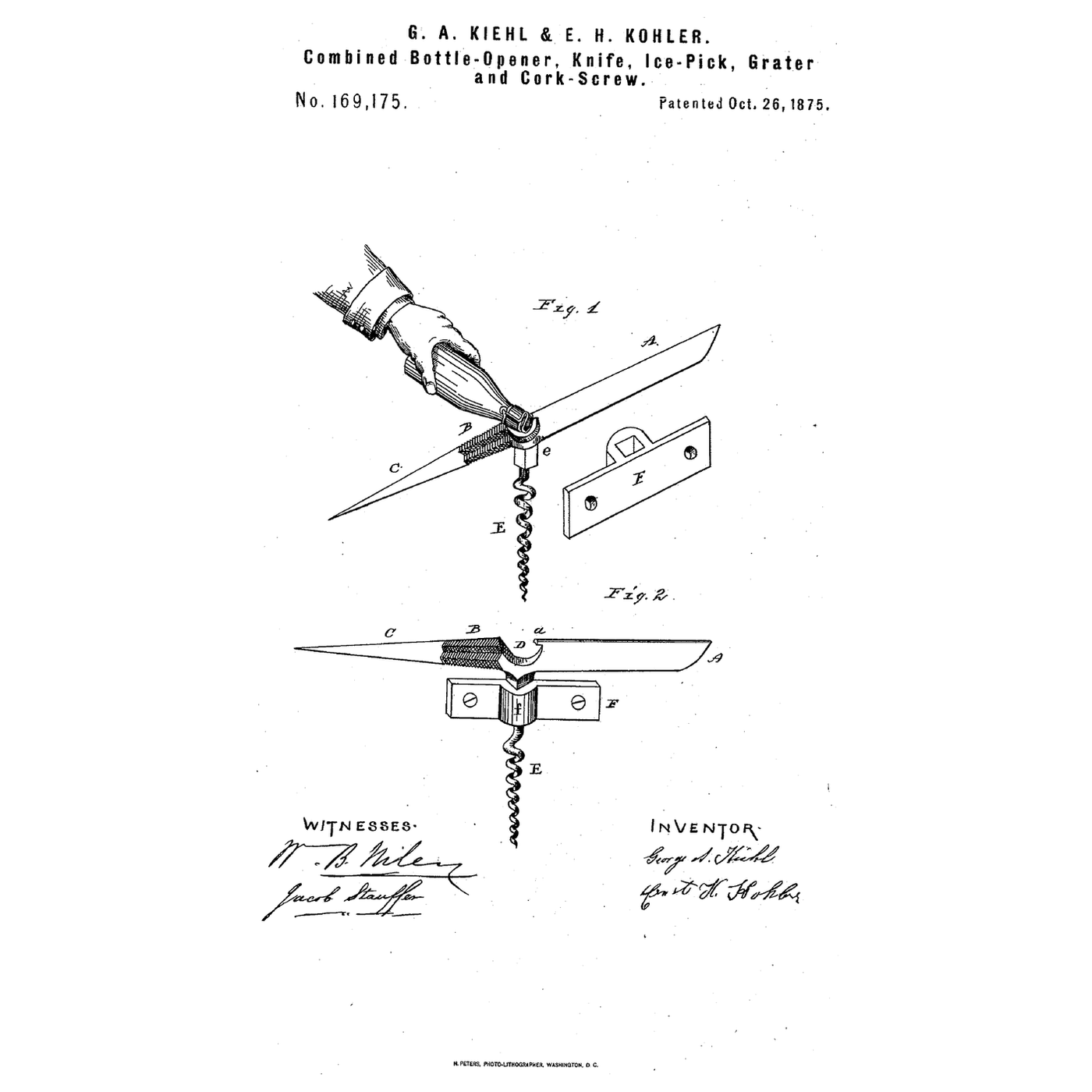


The Socket-Bracket Bar Tool: Bottle Opener, Knife, Ice Pick, Grater and Corkscrew in One
A bottling works fastened its corks with stout hinged wires, and a saloon keeper needed a way to release them, a knife for lemons, an ice pick, a nutmeg grater and a corkscrew, all within reach behind the counter.
George A. Kiehl and Ernst H. Kohler of Lancaster, Pennsylvania, received US 169,175, dated 26 October 1875, for a T-shaped tool meant "for removing the stout hinged wires for holding the corks in bottles containing soda and mineral waters, sarsaparilla, or the like, used in nearly all bottling establishments; at the same time to combine with it a knife for cutting lemons, an ice-pick, a nutmeg-grater, and a cork-screw, all in one implement". A projection on the heel of the knife catches the wire's fold, the bottle's mouth rests in the dished centre, and the bottle is turned as a lever; the corkscrew below stands in a bracket fixed to the counter.
This rung works out the force the bottle puts on the wire, with a work check, then makes the tool from flat bar with a bracket for the counter, and opens a wire-fastened bottle with it.
Avancé
About 5 hours
Consignes
1
1
The bottle as the lever
The bottle as the lever
Chargement du notebook Jupyter…
2
2
A counter opener before it
A counter opener before it
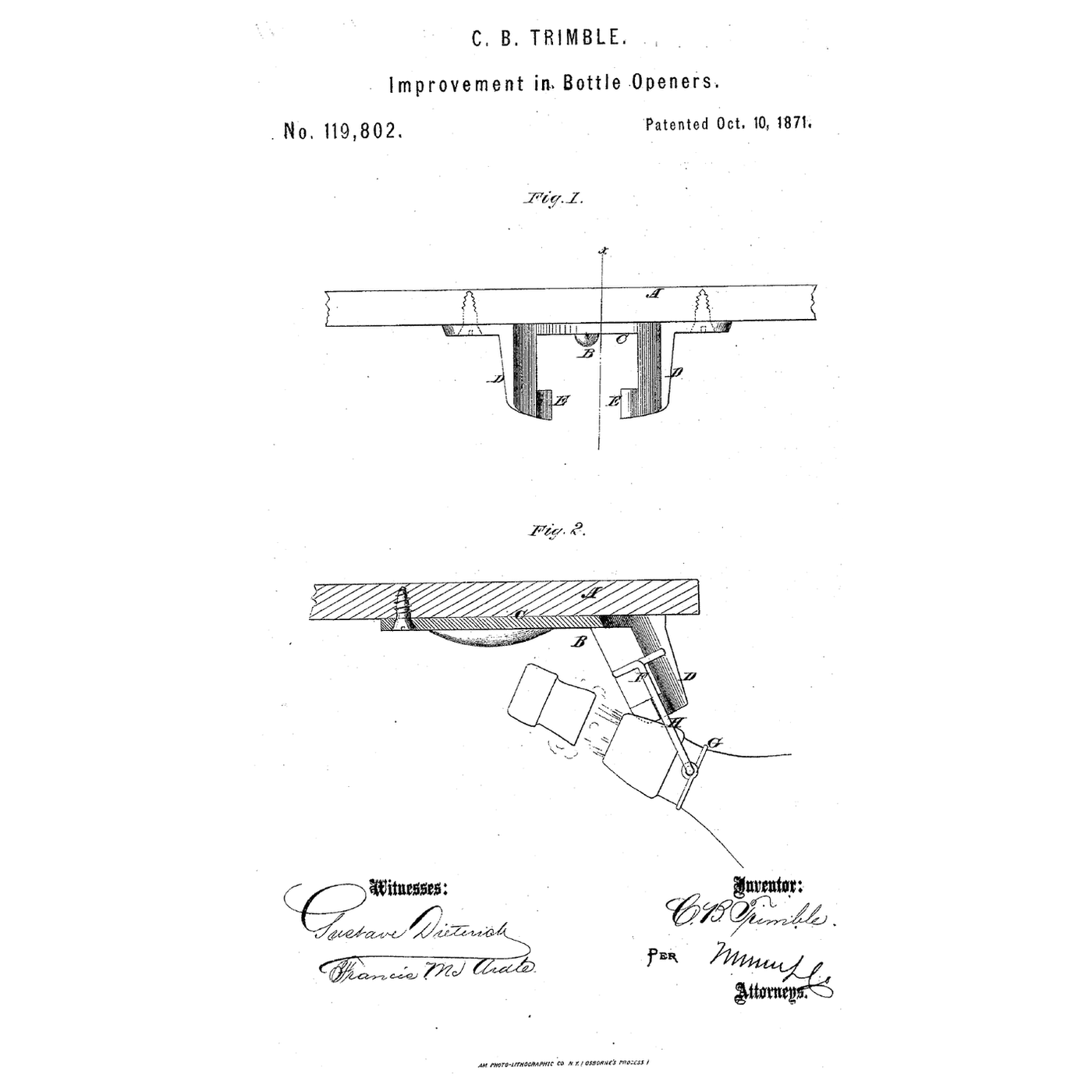
The embedded blueprint fixes a stirrup under the counter to push a wire yoke off. Kiehl and Kohler's tool stands in a bracket on the counter too, and adds a knife, an ice pick, a grater and a corkscrew.
3
3
Read US 169,175
Read US 169,175
"Most bottling establishments now employ the patent hinged wires for holding the cork firmly in place. This wire bail is bent into U form, so as to be swung up on the cork and forced over or partially into it, so as to require considerable force to release the cork by hand that it may be expelled by the carbonic gas confined with the liquid in the bottle."
"The operation consists in introducing the projection a on the heel of the knife A into the upper wire fold. The bottle itself forms the lever by which the stiff wire is pressed down from the cork; hence the dished or concave central part D is to receive the head or mouth of the bottle, with the cork and its appliances."
4
4
Make the tool and open a wire-fastened bottle
Make the tool and open a wire-fastened bottle
**Bar.** Cut 30 cm of 25 × 5 mm mild steel flat bar. Mark its middle. Heat the middle with the torch and hammer it over a hole in a hardwood block into a shallow dish that the bottle's mouth and cork sit in. At the dish's edge on the knife side, file a short hooked projection that will enter the fold of the bottle's wire.
**Knife.** On one arm, file a bevel along one edge and finish it on the sharpening stone for cutting lemons.
**Ice pick and grater.** File the other arm to a point. Near its root, cut rows of small raised teeth with the cold chisel, like a rasp, for grating nutmeg.
**Corkscrew and bracket.** Wind 2 mm spring steel wire into an open helix round a 6 mm rod and file its end to a point. Drill the dish's centre, pass the straight tail up through it and bend it flat over the dish, and epoxy a nut filed square round the shank below as the collar. Cut a square socket in a hardwood block that the collar fits; screw the block to the counter's edge so the tool stands in it without turning.
**Wire-fastened bottle.** Pour chilled soda water into a clean beer bottle, press a tapered cork in, twist a wire ring round the neck and bend a U-shaped bail from galvanised wire, hinged on the ring, that swings up over the cork.
**Test.** Wearing safety glasses, rest the mouth in the dish with the projection in the bail's fold and turn the bottle: the wire comes down off the cork. Cut a lemon, grate a nutmeg and chip some ice with the other parts.
Matériaux pour cette étape :
 Plat en acier doux0.3 mètre
 Bloc de bois dur2 pièces
 Vis à bois2 pièces
 Écrou hexagonal1 pièce
 Bouteilles de bière ambrées1 pièce
 Eau gazeuse (bouteille scellée)1 pièce
 Bouchons de liège1 pièce
 Fil d'acier galvanisé0.5 mètre
 Citron1 pièce
 Noix de muscade entière1 pièce
 Glaçons1 pièce
 Fil d'acier à ressort0.3 mètre
 Époxy à deux composants1 pièce
Outils nécessaires :
 Scie à métaux
 Chalumeau à propane
 Enclume
 Marteau
 Étau d'établi
 Limes (lime à main)
 Pierre à aiguiser
 Burin à froid
 Perceuse sans fil
 Jeu de forets
 Pince à becs ronds
 Pince plate
 Pince coupante
 Jeu de tournevis
 Gants de travail en cuir
 Lunettes de sécurité transparentes
5
5
A bar tool that slips, will not lift the wire or turns in its bracket
A bar tool that slips, will not lift the wire or turns in its bracket
Socket-bracket bar tool troubleshooting.
Flow
Loading...
6
6
History and honest limits
History and honest limits
**George A. Kiehl and Ernst H. Kohler** of Lancaster, Pennsylvania, filed US 169,175 on 25 August 1875; it is dated 26 October 1875. The tool was of steel or case-hardened malleable iron, the ice pick C was roughened at B like a rasp for grating nutmegs, and the corkscrew E had a square collar e so it would not turn in the socket bracket F. Their claim is the T-shaped implement with its concave centre, projection, knife, ice pick, grater and collared corkscrew.
**Honest limits.** Filed mild steel stands in for his steel or case-hardened iron, so the knife dulls quickly, and a hand-wired beer bottle of re-corked soda water stands in for a factory-wired bottle. The notebook ignores friction; its forces and lengths are examples. Your opening is the result.
Matériaux
13- 0.3 mètreEspace réservé
- 2 piècesEspace réservé
- 2 piècesEspace réservé
- 1 pièceEspace réservé
- 1 pièceEspace réservé
- Espace réservé
- 1 pièceEspace réservé
- 0.5 mètreEspace réservé
- 1 pièceEspace réservé
- 1 pièceEspace réservé
- 1 pièceEspace réservé
- 0.3 mètreEspace réservé
- 1 pièceEspace réservé
Outils requis
16- Espace réservé
- Espace réservé
- Espace réservé
- Espace réservé
- Espace réservé
- Espace réservé
- Espace réservé
- Espace réservé
- 1 vendor sell this, none ship to you yetEspace réservé
- Espace réservé
- Espace réservé
- Espace réservé
- Espace réservé
- Espace réservé
- Espace réservé
- Espace réservé
Blueprints liés
Ces blueprints partagent des connaissances — techniques, matériaux ou principes
The Counter-Stirrup Bottle Opener: Press the Bottle Up and the Yoke Comes Off
par YourGrandma
Travail des Métaux
13
0
0
0
0
0
The Ice Pick: A Chisel, a Point and a Sliding Weighted Handle
par Forge
Outils de Métallurgie
12
0
0
0
0
0
The Button Corkscrew: A Helix That Grips and a Disc That Stops It
par YourGrandma
NOURRITURE ET BOISSONS
15
0
0
0
0
0
The Law of the Lever — Archimedes' Balance of Weight and Distance
par Martin
Physique
60
0
0
0
1
0
CC0 Domaine public
Ce blueprint est publié sous CC0. Vous êtes libre de copier, modifier, distribuer et utiliser ce travail pour tout usage, sans demander la permission.
Soutenez le Maker en achetant des produits via son Blueprint où il perçoit une Commission Maker définie par les Vendeurs, ou créez une nouvelle itération de ce Blueprint et incluez-le comme connexion dans votre propre Blueprint pour partager les revenus.