ART
BEAUTÉ ET BIEN-ÊTRE
ARTISANAT
CULTURE ET HISTOIRE
DIVERTISSEMENT
ENVIRONNEMENT
NOURRITURE ET BOISSONS
INGÉNIERIE INVERSE
SCIENCES
SPORTS
TECHNOLOGIE
TECHNOLOGIE PORTABLE
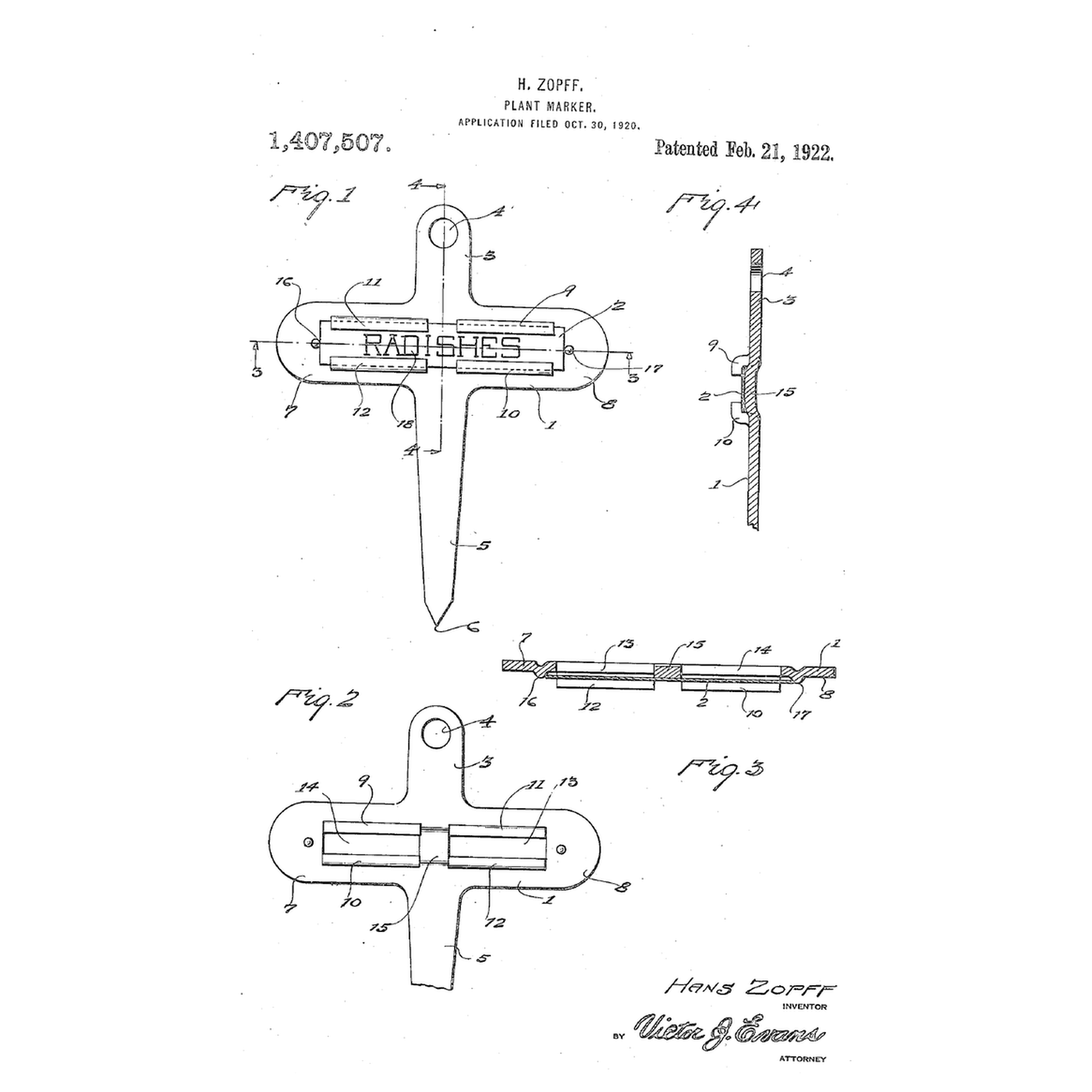


The Stamped Cross Plant Marker: One Pressed Body and a Spring Name Plate
A plant marker with a frame, a cover and a key has parts to lose and costs more to make.
Hans Zopff of Monroe, Michigan, received US 1,407,507, patented 21 February 1922, for a marker "constructed of a minimum number of parts" and "preferably stamped from sheet metal": a cross-shaped body with a perforated head, a tapered pointed stake and two arms whose struck-out guides hold a sprung name plate, pressed tight by a rib and stopped by bosses.
This rung works out how hard the rib presses the plate, then cuts the body from aluminium sheet and measures the pull needed to slide the plate out, with and without the rib.
Intermédiaire
About 3 hours
Consignes
1
1
Rib pressure on the plate
Rib pressure on the plate
Chargement du notebook Jupyter…
2
2
A sprung sheet-metal marker before it
A sprung sheet-metal marker before it
The embedded blueprint holds a card with a spring strip in a riveted frame. Zopff stamps the holder into the body itself and makes the name plate the spring.
3
3
Read US 1,407,507
Read US 1,407,507
"The carrying body 1 is cast in one piece, or preferably stamped from sheet metal substantially in cross shape, providing a head 3 which is perforated at 4 to permit the marker to be attached by means of a wire, string, or the like, to tag nursery trees or the like if it is so desired."
"The bracing rib 15 is slightly struck forwardly, as clearly shown in Figs. 3 and 4 of the drawing, for forcing the name plate 2 firm against the guides 9, 10, 11 and 12 to prevent accidental movement of the name plate relative to the carrying body."
4
4
Cut the cross
Cut the cross
Mark a cross on 1 mm aluminium sheet: a stake 30 mm wide and 200 mm long tapering to a point, arms 140 × 40 mm across its top, and a 30 mm head above. Cut it with tin snips and file every edge smooth.
Matériaux pour cette étape :
 Tôle d'aluminium1 pièce
Outils nécessaires :
 Cisaille à tôle
 Limes (lime à main)
 Règle
Règle Marqueur permanent
 Gants de travail en cuir
5
5
Drill the head
Drill the head
Centre-punch the head and drill a 6 mm hole for a tie wire.
Outils nécessaires :
 Pointeau
 Marteau
 Perceuse sans fil
 Jeu de forets
 Lunettes de sécurité transparentes
6
6
Strike out the guides
Strike out the guides
Mark a 25 mm band across the arms. On each arm chop two pairs of parallel slits 4 mm apart and 40 mm long with the cold chisel on the vice's anvil, one pair centred on the band's top edge and one on its bottom edge. Push each strip between its slits 1 mm forward from the back: four bridges.
Outils nécessaires :
 Burin à froidMarteau
 Étau d'établiRègleMarqueur permanentLunettes de sécurité transparentes
7
7
Raise the rib and bosses
Raise the rib and bosses
Open the vice jaws 8 mm and lay the body face down across them. Set a drill bit's shank on the band's centre and tap it in about 2 mm: the rib. From the back, centre-punch a dimple 52 mm each side of the centre: the bosses.
Outils nécessaires :
Étau d'établiJeu de foretsPointeauMarteau8
8
Stamp and fit the plate
Stamp and fit the plate
Cut a plate 25 × 100 mm from aluminium sheet, file its corners and drill a 3 mm hole 4 mm from one end. Stamp the plant's name on it. Bow it slightly and slide it under the bridges until it springs in between the bosses.
Matériaux pour cette étape :
Tôle d'aluminium1 pièceOutils nécessaires :
Cisaille à tôleLimes (lime à main)Perceuse sans filJeu de forets Kit de poinçons à frapper le métal (bijouterie)Marteau
9
9
Measure the plate's grip
Measure the plate's grip
Hook the force meter through the plate's hole and pull along the arms until it slides out; note the force. Repeat three times, then tap the rib flat and repeat.
Outils nécessaires :
 Dynamomètre (peson à ressort)
10
10
A plate that rattles, jams or slides out
A plate that rattles, jams or slides out
Stamped cross marker troubleshooting.
Flow
Loading...
11
11
History and honest limits
History and honest limits
**Hans Zopff**, a citizen of Germany residing at Monroe, Michigan, filed US 1,407,507 on 30 October 1920; it was patented 21 February 1922. He preferred a name plate of resilient or spring sheet metal, with its indicia printed on or cut out, and wrote that an all-metal marker may be "Parkerized" or chemically treated to render it rust proof, so it can be used a number of seasons. It comprises two pieces: the body and the name plate.
**Honest limits.** He gives no sizes; ours are examples, and slits and pliers stand in for a stamping die. Aluminium needs no rust-proofing; a steel body would. The notebook treats the plate as a simple beam, and an aluminium plate presses less than his spring metal. Your pull forces are the result.
Matériaux
1- 1 pièceEspace réservé
Outils requis
14- Espace réservé
- Espace réservé
- Espace réservé
- Espace réservé
- Espace réservé
- Espace réservé
- Espace réservé
- 1 vendor sell this, none ship to you yetEspace réservé
- Espace réservé
- Espace réservé
- Espace réservé
- Espace réservé
- Espace réservé
- Espace réservé
Blueprints liés
Ces blueprints partagent des connaissances — techniques, matériaux ou principes



CC0 Domaine public
Ce blueprint est publié sous CC0. Vous êtes libre de copier, modifier, distribuer et utiliser ce travail pour tout usage, sans demander la permission.
Soutenez le Maker en achetant des produits via son Blueprint où il perçoit une Commission Maker définie par les Vendeurs, ou créez une nouvelle itération de ce Blueprint et incluez-le comme connexion dans votre propre Blueprint pour partager les revenus.