ART
BEAUTÉ ET BIEN-ÊTRE
ARTISANAT
CULTURE ET HISTOIRE
DIVERTISSEMENT
ENVIRONNEMENT
NOURRITURE ET BOISSONS
INGÉNIERIE INVERSE
SCIENCES
SPORTS
TECHNOLOGIE
TECHNOLOGIE PORTABLE
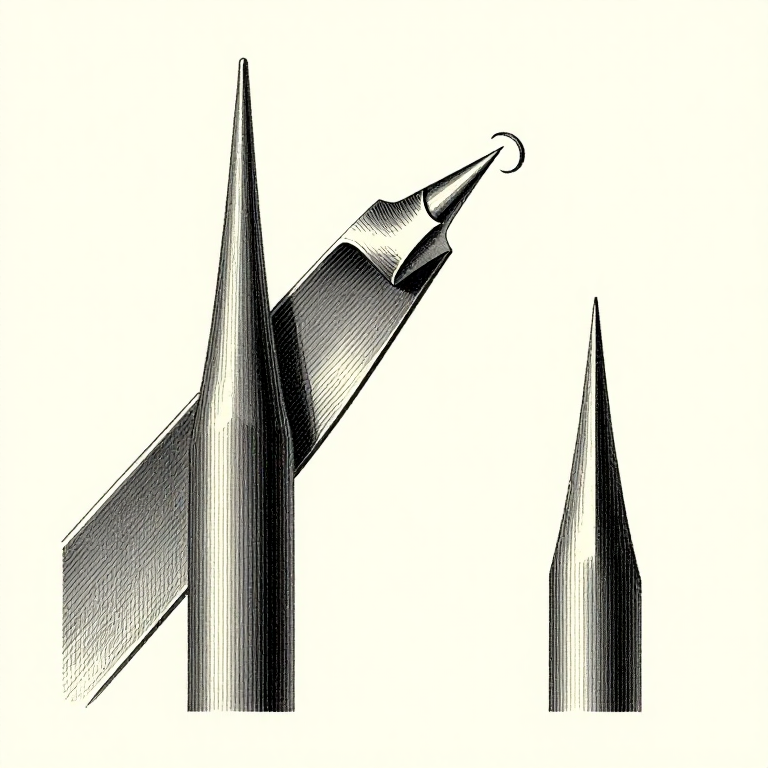


The Wire Edge: The Only Proof You Have Reached the Apex
The hardest question in sharpening is knowing when to stop. Grind too little and the two surfaces have not met yet; the edge is still rounded and no amount of polishing will fix it. Grind too long and you are wasting steel and time.
There is an unambiguous answer, and it is physical rather than visual: a WIRE EDGE — a thin ribbon of metal pushed over to the far side, running the whole length of the edge. It can only form once the bevel has reached the very apex, because there is nothing left to support the metal there.
So the rule is simple: raise a wire edge along the whole edge, then remove it. Everything before that is preparation, and everything after it is polish.
Intermédiaire
2 hours
Consignes
1
1
Feel for it with a thumb, moving off the edge
Feel for it with a thumb, moving off the edge
Draw a thumb gently ACROSS the flat side, away from the edge — never along it. A wire edge catches as a faint roughness or a tiny lip you can feel but often cannot see.
Always move off the edge, never along it. A sharpened edge will open a thumb without any pressure at all, and drawing along it is exactly how that happens. This is the one genuinely sharp-object habit in the whole batch.
Check along the WHOLE length. A wire edge over two thirds of the blade means the other third has not reached the apex yet and is still blunt, which is why a freshly sharpened tool sometimes cuts beautifully at one corner and not at the other.
Outils nécessaires :
 Jeu de ciseaux à bois - à biseau
 Loupe de bijoutier
2
2
Raise it on purpose, then keep going until it runs the full length
Raise it on purpose, then keep going until it runs the full length
Work the bevel on the coarse stone until you can feel the wire along the entire edge, corner to corner. Do not move to a finer grit before then.
This is the discipline the whole process rests on. Moving up a grit early means the finer stone spends its time polishing a rounded edge, which is slow, satisfying and completely useless. Most disappointing sharpening is this mistake.
If one region refuses to raise a wire, that region is not being touched. Colour it with marker and look at where the stone actually lands — usually the blade is being held at a slightly different angle at that corner, or the stone is dished.
Outils nécessaires :
 Pierre à aiguiser
 Marqueur permanentJeu de ciseaux à bois - à biseau
3
3
Remove it, do not tear it off
Remove it, do not tear it off
Take a few light strokes on the flat back, then a few more on the bevel, alternating and getting lighter, until the wire is gone. Finish on the strop.
Do not pull the wire off with your fingers or drag it through wood. It is attached to the apex, and tearing it away takes part of the edge with it, leaving a ragged line that looks sharp and fails in the first minute of work. That is why a tool can be 'sharp' on the bench and blunt after two cuts.
Each pass should be lighter than the last. The wire gets thinner, flips to the other side, gets thinner again, and eventually falls away on its own as the two polished surfaces finally meet.
Outils nécessaires :
Pierre à aiguiser Cuir à rasoirJeu de ciseaux à bois - à biseau
 Pâte à polir
4
4
Three tests, in increasing order of honesty
Three tests, in increasing order of honesty
First the light test: edge-up under a lamp, no bright line anywhere along it. That rules out obvious bluntness in two seconds.
Then paper: a sharp edge slices clean through a hanging sheet without tearing or snagging. Then end grain — pare a thin curl across the end of a softwood offcut. End grain is the real test because the fibres are unsupported, and only a genuine apex severs them instead of crushing them.
A blade that passes paper and fails end grain has a wire edge still attached, or one corner that never came to the apex. That is a useful diagnosis rather than a disappointment, and it tells you exactly which step to return to.
Matériaux pour cette étape :
 Planche de résineux sec1 pièce
Outils nécessaires :
Jeu de ciseaux à bois - à biseauLoupe de bijoutierMatériaux
1- 1 pièceEspace réservé
Outils requis
6- Espace réservé
- Espace réservé
- Espace réservé
- Espace réservé
- Espace réservé
- Espace réservé
Blueprints liés
Ces blueprints partagent des connaissances — techniques, matériaux ou principes
CC0 Domaine public
Ce blueprint est publié sous CC0. Vous êtes libre de copier, modifier, distribuer et utiliser ce travail pour tout usage, sans demander la permission.
Soutenez le Maker en achetant des produits via son Blueprint où il perçoit une Commission Maker définie par les Vendeurs, ou créez une nouvelle itération de ce Blueprint et incluez-le comme connexion dans votre propre Blueprint pour partager les revenus.