Collaboration
ART
BEAUTÉ ET BIEN-ÊTRE
ARTISANAT
CULTURE ET HISTOIRE
DIVERTISSEMENT
ENVIRONNEMENT
NOURRITURE ET BOISSONS
INGÉNIERIE INVERSE
SCIENCES
SPORTS
TECHNOLOGIE
TECHNOLOGIE PORTABLE
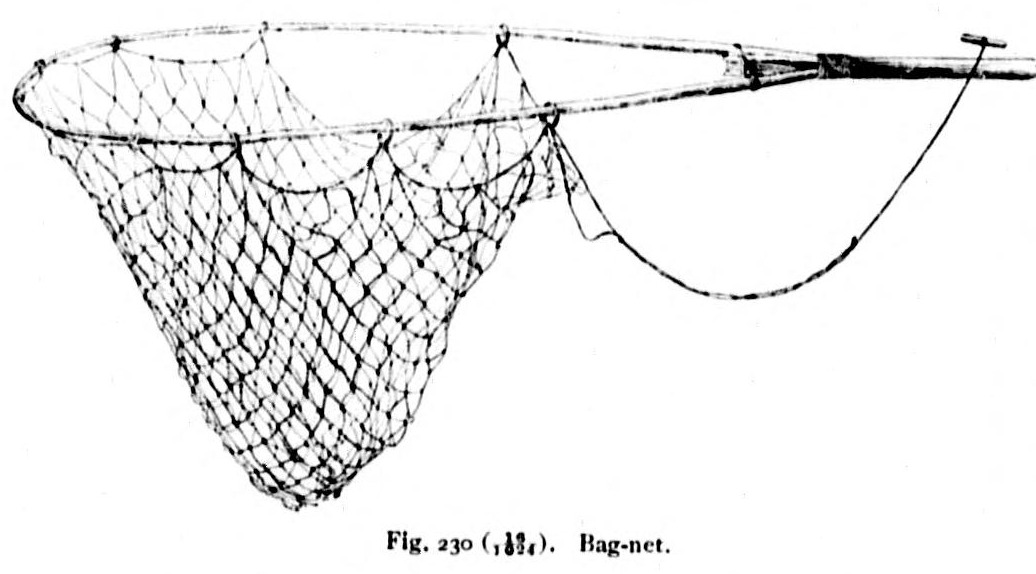


Thompson (Nlaka'pamux) Salmon Bag-Net: Dogbane Twine Netted on a Gauge, Hung from Horn Rings on a Hoop that Closes with the Catch (Teit, 1900)
The Thompson (Nlaka'pamux) salmon dip-net James Teit recorded on the rivers of British Columbia: a bag of thigh-spun dogbane twine with even, double-knotted meshes, its mouth as wide as a man's outstretched arms, hung from small horn rings slid round a fir or cedar hoop on a long handle; let go of the purse string and the fish's weight pulls the rings together and traps it.
Intermédiaire
Several days
Consignes
1
1
Read Teit
Read Teit
"He lets go the piece of stick, when the weight of the fish causes the horn rings to come together, and thus close the mouth of the net."
2
2
Make the twine
Make the twine
Clean dogbane bark fibre over a board edge and roll it on the thigh into two-stranded twine (see the tule-mat blueprint). A net takes a great deal.
Matériaux pour cette étape :
 Fibre d'écorce d'apocyn1 pièce
Outils nécessaires :
 Couteau
3
3
Net the bag
Net the bag
Net a deep bag in large meshes, tying each with a double knot over a wooden netting stick so every mesh is the same size (ours: a netting needle to carry the twine, meshes about 8 cm). Make the mouth about as wide round as a man's arms held out in a circle with the middle fingers touching.
Matériaux pour cette étape :
Fibre d'écorce d'apocyn1 pièceOutils nécessaires :
 Baguette calibreuse de maille
 Navette ou aiguille à filet en bois
4
4
Hoop and handle
Hoop and handle
Bend a hoop of fir or cedar and fix it to a long straight handle of the same wood.
Matériaux pour cette étape :
 Perches de bois vert1 pièce
 Brin d'osier1 pièce
Outils nécessaires :
 HacheCouteau
5
5
Rings and purse string
Rings and purse string
Make small horn rings (ours: antler slices bored through), slip them onto the hoop and tie the bag's mouth to them. Tie a string to the bag with a small stick at its end as a handle (ours: run it through the rings so pulling holds the mouth open).
Matériaux pour cette étape :
 Rondelles de bois de cerf1 pièceFibre d'écorce d'apocyn1 pièce
 Goujon en bois1 pièce
Outils nécessaires :
 Alêne en osCouteau
6
6
Fish it
Fish it
From a platform built out from the bank where fish hug the shore, dip the net and let it drift down with the current, holding the stick. When you feel a fish, let go: the rings slide together and close the mouth. Draw it ashore, pull the stick to open the bag and tip the fish out. For small fish the meshes were tied straight to the hoop instead.
Outils nécessaires :
Perches de bois vert7
7
Troubleshooting
Troubleshooting
Bag-net troubleshooting.
Flow
Loading...
8
8
History and honest limits
History and honest limits
From James Teit, *The Thompson Indians of British Columbia*, **Memoirs of the American Museum of Natural History, Jesup North Pacific Expedition** vol. I part IV (1900), pp. 190-191, 249-250 and Figs. 134, 230 (checked on the archive.org scan cihm_16242; p. 249 from the text layer). Caught fish were kept in a ring of boulders on the bank. Mesh size, ring size and number, handle length and how the string is rigged are ours.
Matériaux
5- 1 pièceEspace réservé
- 1 pièceEspace réservé
- 1 pièceEspace réservé
- 1 pièceEspace réservé
- 1 pièceEspace réservé
Ce plan fabrique
Blueprints liés
Ces blueprints partagent des connaissances — techniques, matériaux ou principes

CC0 Domaine public
Ce blueprint est publié sous CC0. Vous êtes libre de copier, modifier, distribuer et utiliser ce travail pour tout usage, sans demander la permission.
Soutenez le Maker en achetant des produits via son Blueprint où il perçoit une Commission Maker définie par les Vendeurs, ou créez une nouvelle itération de ce Blueprint et incluez-le comme connexion dans votre propre Blueprint pour partager les revenus.