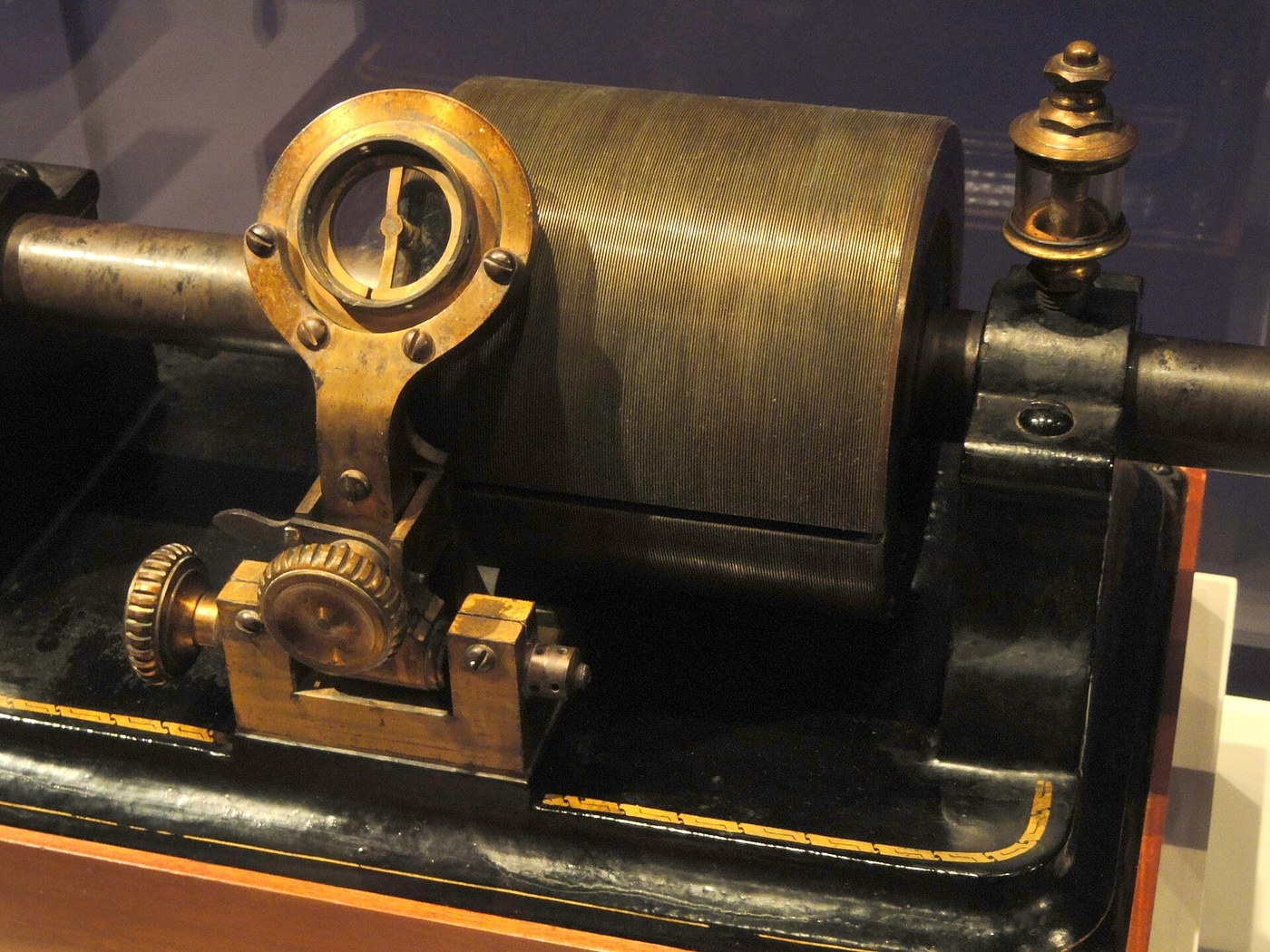


Tinfoil Phonograph
Until 1877, sound was the one thing that could not be kept. Writing preserved words, photography preserved light, but a voice existed only while it was being made. Then Edison wrapped a sheet of tin foil around a grooved brass cylinder, shouted at a diaphragm with a needle on the back of it, cranked the handle — and the machine spoke back.
The mechanism is almost insultingly simple. A diaphragm vibrates, a stylus dents soft foil to a depth that follows the sound, and running the dents back under a stylus makes a second diaphragm repeat the motion. There is no electricity, no amplifier and no electronics of any kind. The energy in your voice is the only thing driving it.
This blueprint builds the 1877 machine as a hand-cranked working model. It records badly and wears out fast — exactly as the original did.
Consignes
Deburr every cut edge as you go
Deburr every cut edge as you go
Brass sheet and turned stock leave edges that will cut you and tear the foil. File and deburr each part before assembly.
Outils nécessaires :
 Limes (lime à main)
Turn or source a brass cylinder about 100 mm long
Turn or source a brass cylinder about 100 mm long
Use a solid brass billet or heavy tube around 90-110 mm long and 50-100 mm in diameter, running true. Any wobble in the cylinder becomes a wow in the recording.
Matériaux pour cette étape :
 Barreau de laiton 360, diamètre 50 mm x 150 mm1 pièce
Cut a helical groove around the cylinder
Cut a helical groove around the cylinder
Cut a shallow spiral groove, about 0.5 mm wide and 0.4 mm deep, at the same pitch as the lead screw you will use — Edison's machine used 10 threads per inch, roughly 2.5 mm. The groove gives the foil somewhere to be pushed into.
Mount the cylinder on a threaded shaft of matching pitch
Mount the cylinder on a threaded shaft of matching pitch
Fix the cylinder to a threaded rod running in two nutted bearings, so that one turn of the crank advances the cylinder axially by exactly one groove pitch. Pitch of the shaft must equal pitch of the groove — this is what keeps the stylus tracking.
Matériaux pour cette étape :
 Tige filetée1 pièce
Fit a crank handle and a heavy flywheel
Fit a crank handle and a heavy flywheel
Add a crank at one end and as much rotating mass as you can. Speed variation by hand is the single biggest quality problem, and a flywheel is the only thing that fixes it.
Build the mouthpiece and diaphragm
Build the mouthpiece and diaphragm
Make a short funnel ending in a circular opening about 40 mm across, and clamp a thin diaphragm over it. Mica is the traditional material; thin aluminium or a taut sheet of drum plastic works. The diaphragm must be tight and free to vibrate at its centre.
Matériaux pour cette étape :
 Feuille de mica1 feuille
Fix a blunt stylus to the centre of the diaphragm
Fix a blunt stylus to the centre of the diaphragm
Cement a short steel needle, tip rounded rather than sharp, to the middle of the diaphragm so it points radially at the cylinder. Blunt is deliberate — the stylus must emboss the foil, not cut it.
Matériaux pour cette étape :
 Aiguille en métal1 pièce
Mount the diaphragm assembly on an adjustable carriage
Mount the diaphragm assembly on an adjustable carriage
Support it so you can advance or retract the stylus by a fraction of a millimetre against the cylinder, and lock it. You will spend most of your setup time on this adjustment.
Cut a sheet of foil to wrap the cylinder
Cut a sheet of foil to wrap the cylinder
Cut heavy-duty aluminium kitchen foil to the cylinder circumference plus 15 mm, and slightly shorter than the grooved length. Genuine tin foil is softer and records better, but aluminium is far easier to obtain and works.
Matériaux pour cette étape :
 Papier aluminium1 rouleau
Wrap the foil smooth and clamp the seam
Wrap the foil smooth and clamp the seam
Lay it on without a single crease and clamp the overlap in the cylinder's slot or under a bar. Every wrinkle becomes a loud click on playback, once per revolution.
Set the stylus to just touch the foil
Set the stylus to just touch the foil
Advance the stylus until it barely dimples the foil with the crank turning. Too light records nothing; too heavy tears through and ruins the sheet.
Crank steadily and speak loudly into the mouthpiece
Crank steadily and speak loudly into the mouthpiece
Turn at a constant speed — around one revolution per second — and speak close and loud. Your voice is the only power source; there is nothing amplifying it.
Return the carriage to the start and back off the stylus slightly
Return the carriage to the start and back off the stylus slightly
Wind back to the beginning of the groove and reduce the stylus pressure a little for playback. Reproducing needs the stylus to follow the dents, not deepen them.
Crank again at the same speed and listen
Crank again at the same speed and listen
Put your ear to the mouthpiece. Expect something faint, distorted and unmistakably your own voice. Match the playback speed to the recording speed or the pitch will be wrong.
Accept that the recording is nearly disposable
Accept that the recording is nearly disposable
Each replay flattens the dents further; a foil survives only a handful of plays. Once removed from the cylinder it can never be re-registered accurately enough to play again. Record something new rather than trying to save it.
History & Context — the first machine that gave sound back
History & Context — the first machine that gave sound back
What was genuinely new in 1877. Recording sound was not new: Édouard-Léon Scott de Martinville's phonautograph had been tracing waveforms onto soot-blackened paper since 1857. But it was a scientific instrument for looking at sound, with no way to play anything back — some of those traces were only turned into audio in 2008, using computers. Edison's contribution was reproduction: a single mechanism that could both indent the trace and be driven by it. His patent issued in February 1878, and the first words he recorded were reportedly a verse of “Mary had a little lamb”.
An honest note on priority. The French poet and inventor Charles Cros deposited a sealed description of a sound-reproducing machine, the “paléophone”, with the Académie des Sciences in April 1877 — months before Edison had a working device. Cros never built it. Both facts are true and both are usually reported alone: Edison built the first working phonograph, and he was not the first to write down how one might work.
Why the foil version died so quickly. Tin foil is soft enough to take an impression from a voice, which is the whole reason it works — and far too soft to survive being read repeatedly by a needle. A recording lasted a few plays. It could not be removed and refitted, could not be copied, and could not be sold. Edison himself set the machine aside for a decade. The commercial recording industry only began when Bell and Tainter's graphophone work in the 1880s replaced foil with wax, which is hard enough to be played hundreds of times and can be shaved and re-recorded. Edison's own improved wax phonograph followed in 1888.
The physics worth noticing. This is vertical-cut, or hill-and-dale, recording: the depth of the indentation encodes the waveform. Later disc records used lateral cut, where the groove wanders side to side instead. Both store the same information; the choice affects how the stylus tracks and how much the record wears. And the entire chain here is acoustic — no transducer, no gain stage anywhere. That is why you have to shout, and why the playback is barely a whisper.
Matériaux
6- Espace réservé
- 1 pièceEspace réservé
- 1 feuilleEspace réservé
- 1 pièceEspace réservé
- 1 rouleauEspace réservé
- Espace réservé
Outils requis
1- Espace réservé
CC0 Domaine public
Ce blueprint est publié sous CC0. Vous êtes libre de copier, modifier, distribuer et utiliser ce travail pour tout usage, sans demander la permission.
Soutenez le Maker en achetant des produits via son Blueprint où il perçoit une Commission Maker définie par les Vendeurs, ou créez une nouvelle itération de ce Blueprint et incluez-le comme connexion dans votre propre Blueprint pour partager les revenus.