
Typewriter
Fifty-odd typebars all swing toward the same point on the platen. That is the whole problem: every letter has to strike the identical spot, so if two bars are in the air at once they collide and jam in a tangle you have to pull apart by hand.
The Sholes, Glidden and Soule machine solved the mechanics and left the jamming to the keyboard layout. The arrangement we call QWERTY separates the letter pairs that occur most often in English, so consecutive strikes come from opposite sides of the basket and the bars have time to fall clear.
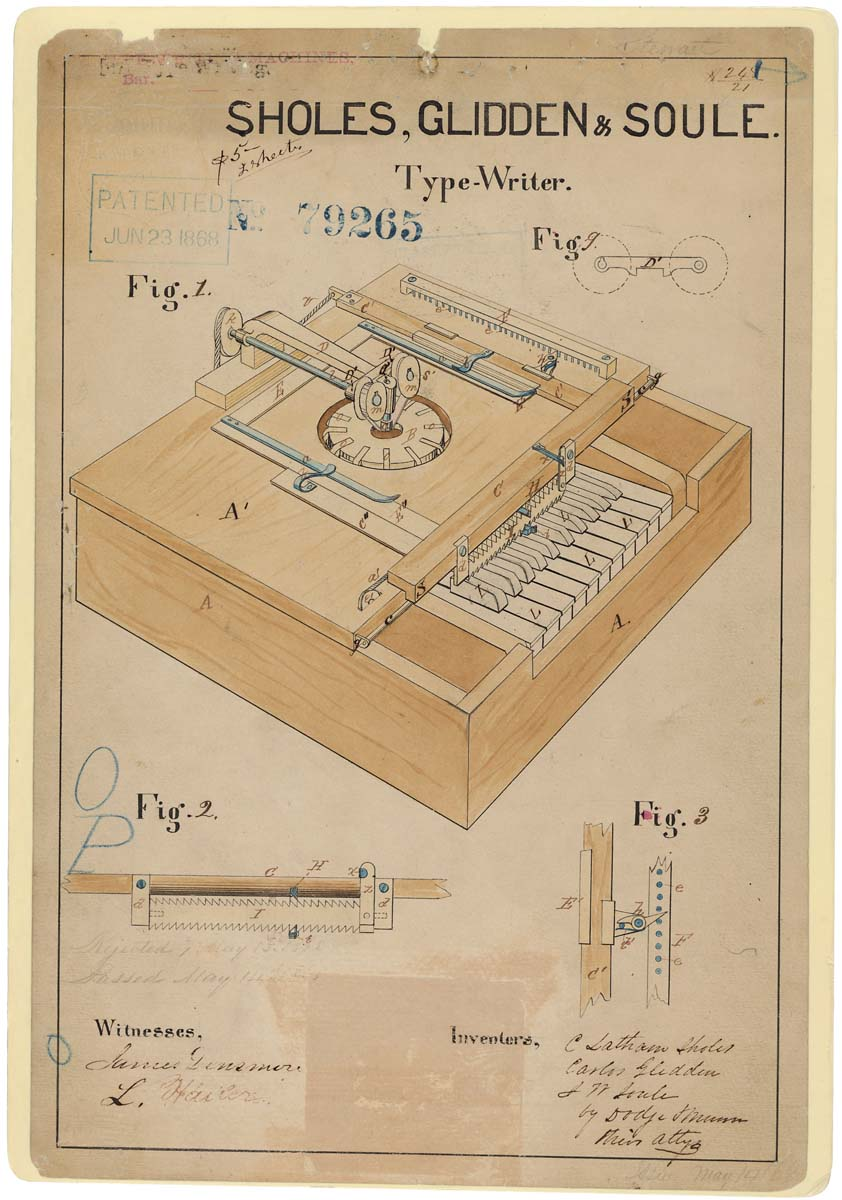
US Patent 79,265, "Improvement in Type-Writing Machines", granted 23 June 1868 to three inventors — Christopher Latham Sholes, Carlos Glidden and Samuel W. Soule, all of Milwaukee. The keyboard you are reading this on is a mechanical workaround for a machine none of us has ever used.
Consignes
Read US 79,265 and note all three inventors
Read US 79,265 and note all three inventors
The patent names Sholes, Glidden AND Soule. It is usually called the Sholes and Glidden machine after the later commercial model — the patent itself has three names on it.
Understand the single-point constraint
Understand the single-point constraint
Every typebar must strike the SAME point, because that is where the paper is presented. All the difficulty follows from this one requirement.
Build a two-bar rig before building fifty
Build a two-bar rig before building fifty
Make two pivoting arms aimed at one point. Strike them in quick succession and watch them tangle. You have just reproduced the jam, and everything else is a response to it.
Matériaux pour cette étape :
 Rond en acier doux1 pièce
Cut a segment to carry the typebar pivots
Cut a segment to carry the typebar pivots
Make a curved plate — the segment — with a slot per bar, arranged so all the arcs converge. Spacing here fixes everything downstream.
Matériaux pour cette étape :
 Tôle d'acier doux1 feuille
Outils nécessaires :
 Lime à métaux
Make the typebars identical in length and mass
Make the typebars identical in length and mass
Every bar must swing and return at the same rate. A heavy bar lingers in the strike zone and is the one that jams against its neighbour.
Outils nécessaires :
 Règle
RègleSolder or braze a type slug to each bar
Solder or braze a type slug to each bar
Fix a raised, mirror-image letter at the tip. Mirrored, because it prints by direct contact — the same convention as movable type.
Fit a return spring to every bar
Fit a return spring to every bar
Each bar must fall back the instant the key is released. Sluggish return is the direct cause of jamming, so tune these before blaming the layout.
Matériaux pour cette étape :
 Jeu de ressorts de compression1 pièce
Link keys to bars with levers, not direct pushes
Link keys to bars with levers, not direct pushes
Run a linkage from each key to its bar. The leverage ratio decides how hard the machine is to type on and how hard it strikes the paper — the same trade-off.
Mount a cylindrical platen that can rotate and travel
Mount a cylindrical platen that can rotate and travel
The paper wraps a roller which advances one line at a time and moves sideways one character per strike. The paper moves; the bars do not.
Matériaux pour cette étape :
 Tourillons en bois dur 1/4"1 pièce
Add an escapement to step the carriage
Add an escapement to step the carriage
Fit a toothed rack and a pawl that releases exactly one tooth per strike. This is a clock escapement doing letter spacing — borrowed wholesale from horology.
Ink through a ribbon between slug and paper
Ink through a ribbon between slug and paper
Run an inked ribbon across the strike point. The slug never touches ink directly, so it stays clean and the letter stays sharp.
Matériaux pour cette étape :
 Encre à écrire20 ml
Lay out the keys alphabetically and type a paragraph
Lay out the keys alphabetically and type a paragraph
Try an A-B-C layout first. Common pairs like TH, ER and ST sit adjacent and jam constantly — this is the experiment that produced QWERTY.
Re-map the keys to separate frequent pairs
Re-map the keys to separate frequent pairs
Move the letters of common digraphs to opposite sides of the basket and retype the same paragraph. Count the jams before and after — that number is the whole justification for QWERTY.
Check alignment by typing a full line of one letter
Check alignment by typing a full line of one letter
Type twenty M's in a row. They should sit on one baseline at even spacing; drift reveals escapement or platen faults immediately.
Compendium — a layout designed for a machine nobody uses
Compendium — a layout designed for a machine nobody uses
The patent. US 79,265, "Improvement in Type-Writing Machines", granted 23 June 1868 to C. Latham Sholes, Carlos Glidden and Samuel W. Soule of Milwaukee, Wisconsin. Sholes was a newspaper editor and printer. The machine went through many revisions before Remington began manufacturing it in 1873 as the Sholes and Glidden Type-Writer — Soule's name drops out of the popular account, though it is on the patent.
Why the jam is unavoidable. All typebars must converge on a single printing point, so the strike zone is shared. Bar A must have cleared the zone before bar B arrives, and at typing speed the interval is a fraction of a second. Return spring strength, bar mass and pivot friction all set the clearing time, but no amount of tuning removes the collision risk for two bars that start adjacent and swing along nearly the same arc.
QWERTY is a mechanical solution, and the usual story about it is too simple. The layout evolved through the 1870s in consultation with users, including telegraph operators, and it does separate many frequent English digraphs across the basket. The popular claim that it was designed "to slow typists down" is wrong — the goal was to avoid jams so typists could go FASTER without stopping to untangle bars. It is equally wrong to present it as an optimum: TH and ER are notoriously still awkward, and the layout is a compromise reached commercially, not a computed solution. Dvorak's 1936 alternative is measurably better on paper and has never displaced it, which makes QWERTY a standard example of technological lock-in.
What the machine borrowed and what it changed. The escapement stepping the carriage one character at a time is lifted from clockmaking. The mirrored raised slug is movable type reduced to one letter on a lever. What was genuinely new was the combination — a keyboard that selects a character mechanically, at speed, with the paper doing the moving. The social consequence was larger than the mechanical one: typing became one of the first office occupations widely open to women, and the machines were marketed accordingly. The last thing this patent still touches is the arrangement of the keys under your fingers, preserved for a jam that stopped being possible decades ago.
Matériaux
5- 1 pièceEspace réservé
- 1 feuilleEspace réservé
- Espace réservé
- 1 pièceEspace réservé
- 20 mlEspace réservé
Blueprints liés
Ces blueprints partagent des connaissances — techniques, matériaux ou principes


CC0 Domaine public
Ce blueprint est publié sous CC0. Vous êtes libre de copier, modifier, distribuer et utiliser ce travail pour tout usage, sans demander la permission.
Soutenez le Maker en achetant des produits via son Blueprint où il perçoit une Commission Maker définie par les Vendeurs, ou créez une nouvelle itération de ce Blueprint et incluez-le comme connexion dans votre propre Blueprint pour partager les revenus.