
Understanding Aluminum Extraction from Bauxite — The Metal More Precious Than Gold
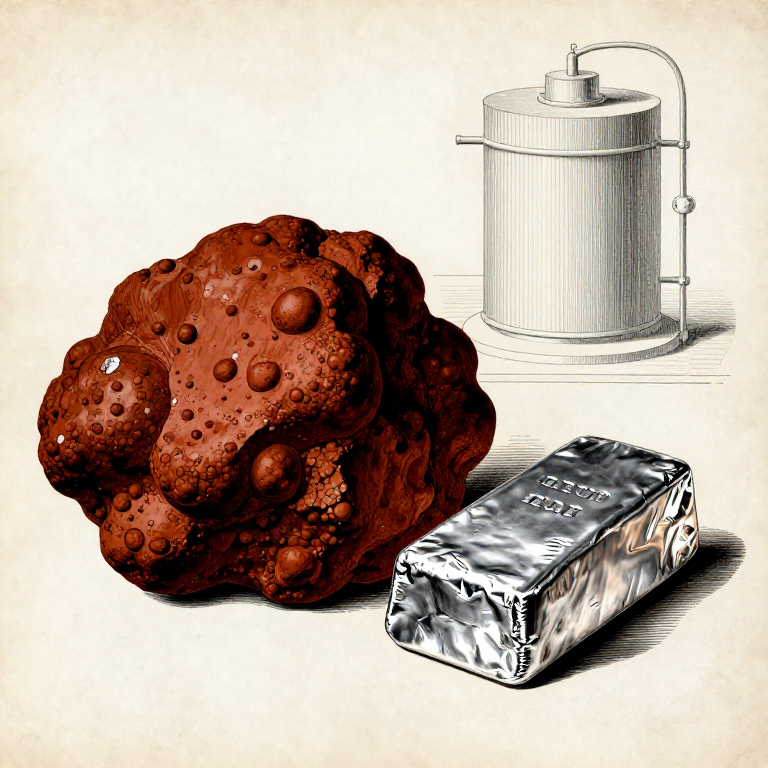
Aluminum (Al, element 13) is the most abundant metal in the Earth's crust at 8.1% by mass — more common than iron. Yet it was one of the last metals to be isolated, and for decades after its discovery it was more expensive than gold. Napoleon III reportedly reserved his aluminum dinner plates for his most honored guests, while lesser guests ate from gold.
The reason for this paradox is the same as titanium's: aluminum oxide (Al₂O₃, corundum) is extraordinarily stable. Carbon cannot reduce it at any achievable temperature. Hans Christian Ørsted first produced impure aluminum in 1825 by reacting aluminum chloride with potassium amalgam. Friedrich Wöhler improved the method in 1827 using pure potassium. Henri Sainte-Claire Deville developed a sodium-reduction process in 1854 that made small-scale production possible, but aluminum remained a precious metal at $1,200 per kilogram (more than silver).
The breakthrough came in 1886 when Charles Martin Hall (USA) and Paul Héroult (France) independently and simultaneously discovered that aluminum oxide dissolves in molten cryolite (Na₃AlF₆) and can be electrolyzed at approximately 960 °C to produce liquid aluminum metal. The Hall-Héroult process slashed the price of aluminum from $12/kg to $0.60/kg within a decade and remains the sole commercial production method today.
NOTE: Like titanium, aluminum cannot be extracted by traditional smelting. This blueprint is primarily educational — it explains the chemistry, demonstrates why carbon reduction fails, describes the Hall-Héroult process, and includes a small-scale electrolysis demonstration using aluminum compounds.
Contenu dangereux
Ce blueprint contient des procédures dangereuses. Connectez-vous et activez le contenu dangereux dans les paramètres de votre compte pour voir les instructions étape par étape.
CC0 Domaine public
Ce blueprint est publié sous CC0. Vous êtes libre de copier, modifier, distribuer et utiliser ce travail pour tout usage, sans demander la permission.
Soutenez le Maker en achetant des produits via son Blueprint où il perçoit une Commission Maker définie par les Vendeurs, ou créez une nouvelle itération de ce Blueprint et incluez-le comme connexion dans votre propre Blueprint pour partager les revenus.