
Understanding Vanadium from Vanadinite — The Rainbow-Blooded Metal Named for a Goddess
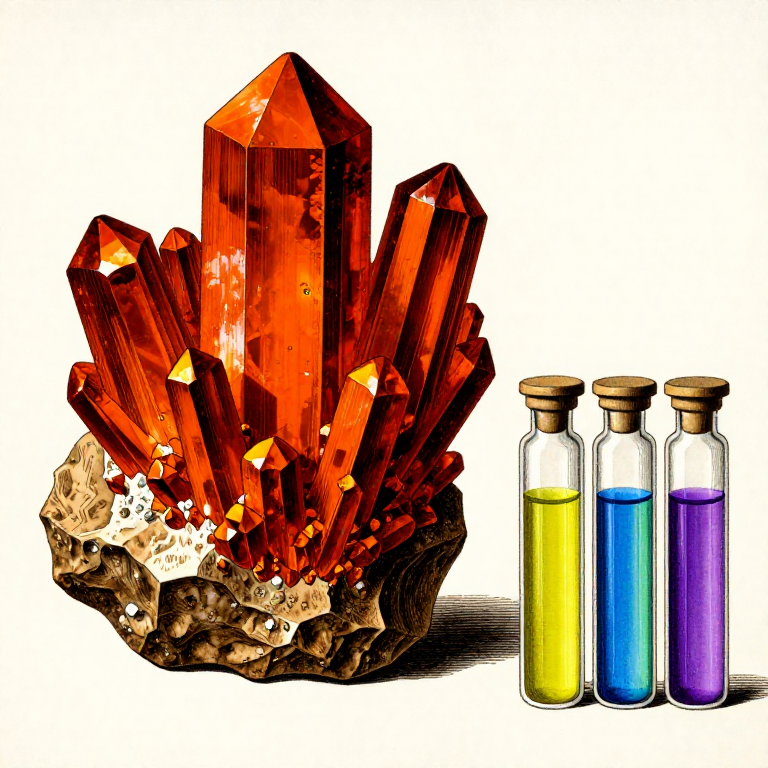
Vanadium (V, element 23) is named after Vanadís, a byname of the Norse goddess Freyja — an unusually poetic origin for a chemical element. The name was chosen by Swedish chemist Nils Gabriel Sefström, who rediscovered the element in 1831, because vanadium compounds display an extraordinary range of vivid colors: yellow (V₂O₅), blue (VO²⁺), green (V³⁺), and violet (V²⁺). This chromatic wealth was deemed worthy of the goddess of beauty and fertility.
Vanadium was actually first discovered by Andrés Manuel del Río in Mexico City in 1801, who found it in a lead ore (vanadinite, Pb₅(VO₄)₃Cl) from Zimapán. He initially named it 'erythronium' (from Greek for 'red') but retracted his claim after a French chemist incorrectly told him it was just chromium. Sefström's independent rediscovery 30 years later confirmed del Río's original finding — one of the saddest priority disputes in chemistry.
Vanadinite (Pb₅(VO₄)₃Cl) is a lead vanadate chloride containing approximately 10.8% vanadium and 73.2% lead. It is one of the most strikingly beautiful minerals — brilliant orange, red, or yellow hexagonal crystals that are prized by mineral collectors. Vanadium is primarily produced from magnetite ores that contain vanadium as a minor component, not from vanadinite.
HAZARD: Vanadium pentoxide (V₂O₅) dust is toxic — it irritates the respiratory tract and causes bronchitis, pneumonia, and pulmonary edema with significant exposure. Vanadinite is a LEAD mineral — all lead compounds are toxic. Handle vanadinite with gloves and wash hands afterward. Do not grind or crush vanadinite without respiratory protection.
Contenu dangereux
Ce blueprint contient des procédures dangereuses. Connectez-vous et activez le contenu dangereux dans les paramètres de votre compte pour voir les instructions étape par étape.
CC0 Domaine public
Ce blueprint est publié sous CC0. Vous êtes libre de copier, modifier, distribuer et utiliser ce travail pour tout usage, sans demander la permission.
Soutenez le Maker en achetant des produits via son Blueprint où il perçoit une Commission Maker définie par les Vendeurs, ou créez une nouvelle itération de ce Blueprint et incluez-le comme connexion dans votre propre Blueprint pour partager les revenus.