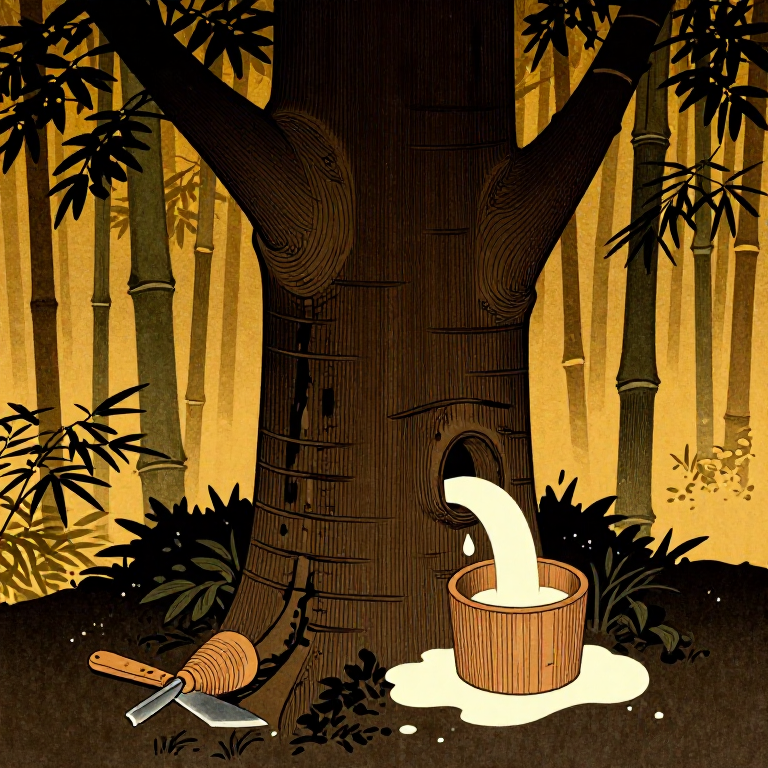


Lacquer Tapping — Traditional Technique for Harvesting Natural Lacquer from Toxicodendron vernicifluum
An explanation of the lacquer harvesting technique that forms the foundation of Japanese traditional craftsmanship. "Lacquer tapping" (漆掻き), the process of extracting lacquer sap from Toxicodendron vernicifluum, is a technology with over 9,000 years of history. This covers the entire process from the harvesting season (June through October), the method of cutting horizontal grooves, collection of lacquer sap, filtration, and grading. Only approximately 200ml of this precious natural resin can be obtained from a single tree per season. Since urushiol contained in lacquer sap causes contact dermatitis, protective measures are essential.
Consignes
Understanding the Lacquer Tree (Urushi no Ki)
Understanding the Lacquer Tree (Urushi no Ki)
Selecting Suitable Lacquer Trees
Selecting Suitable Lacquer Trees
Outils nécessaires :
 Measuring Tape 3m
 Marking Chalk
Safety Precautions for Lacquer Tapping
Safety Precautions for Lacquer Tapping
Matériaux pour cette étape :
 Long-Sleeve Cotton Work Shirt1 pièce
 Long Cotton Work Pants1 pièce
 Nitrile Rubber Gloves4 pièces
 Adhesive Sealing Tape1 rouleau
 Safety Goggles1 pièce
 Cotton Face Towel2 pièces
Preparing Lacquer Tapping Tools
Preparing Lacquer Tapping Tools
Matériaux pour cette étape :
 Rapeseed Oil200 milliliter
 Cotton Cleaning Cloth3 pièces
Outils nécessaires :
 Bark Stripping Plane (Kawahagi Kanna)
 Lacquer Scraping Plane (Kaki Kanna)
 Bamboo Scraping Spatula (Hera)
 Wooden Lacquer Collection Cup (Urushi Oke)
 Whetstone 1000 Grit
Understanding the Tapping Season and Schedule
Understanding the Tapping Season and Schedule
Shaving the Outer Bark (Medate)
Shaving the Outer Bark (Medate)
Outils nécessaires :
Bark Stripping Plane (Kawahagi Kanna) Small Hand Brush
Cutting Horizontal Grooves (Urushi-kaki)
Cutting Horizontal Grooves (Urushi-kaki)
Outils nécessaires :
Lacquer Scraping Plane (Kaki Kanna)Collecting the Seeped Lacquer Sap
Collecting the Seeped Lacquer Sap
Outils nécessaires :
Bamboo Scraping Spatula (Hera)Wooden Lacquer Collection Cup (Urushi Oke)Transferring and Storing Collected Sap
Transferring and Storing Collected Sap
Matériaux pour cette étape :
 Polyethylene Airtight Storage Container 500ml2 pièces
 Record Notebook1 pièce
Outils nécessaires :
Bamboo Scraping Spatula (Hera)Filtering the Raw Lacquer (Urushi-koshi)
Filtering the Raw Lacquer (Urushi-koshi)
Matériaux pour cette étape :
 Yoshino Filtering Paper (Thick Grade)10 feuilles
 Yoshino Filtering Paper (Fine Grade)10 feuilles
Outils nécessaires :
 Filtering Board (Koshidai)
 Nitrile Rubber GlovesPolyethylene Airtight Storage Container 500ml
Stirring to Homogenize (Nayashi)
Stirring to Homogenize (Nayashi)
Outils nécessaires :
 Shallow Wooden Lacquer Bowl (Urushi Bachi)
 Wooden Mixing Spatula
 Hygrometer
 Room Thermometer
Determining the Lacquer Grade
Determining the Lacquer Grade
Matériaux pour cette étape :
 Glass Test Plate5 pièces
Outils nécessaires :
 Lacquer Curing Box (Urushi Buro)HygrometerRoom Thermometer
 Lacquer Grading Reference Chart
Tool Maintenance and Storage
Tool Maintenance and Storage
Matériaux pour cette étape :
Rapeseed Oil100 milliliterCotton Cleaning Cloth3 piècesOutils nécessaires :
Whetstone 1000 GritMatériaux
15- Espace réservé
- 1 pièceEspace réservé
- 4 piècesEspace réservé
- 1 rouleauEspace réservé
- 1 pièceEspace réservé
- 2 piècesEspace réservé
- 300 milliliterEspace réservé
- 3 piècesEspace réservé
- Espace réservé
- 1 pièceEspace réservé
- 10 feuillesEspace réservé
- 10 feuillesEspace réservé
- 5 piècesEspace réservé
- 4 piècesEspace réservé
- 1 pièceEspace réservé
Outils requis
18- Espace réservé
- Espace réservé
- Espace réservé
- Espace réservé
- Espace réservé
- Espace réservé
- Espace réservé
- Espace réservé
- Espace réservé
- Espace réservé
- Espace réservé
- Espace réservé
- Espace réservé
- Espace réservé
- Espace réservé
- Espace réservé
- Espace réservé
- Espace réservé
CC0 Domaine public
Ce blueprint est publié sous CC0. Vous êtes libre de copier, modifier, distribuer et utiliser ce travail pour tout usage, sans demander la permission.
Soutenez le Maker en achetant des produits via son Blueprint où il perçoit une Commission Maker définie par les Vendeurs, ou créez une nouvelle itération de ce Blueprint et incluez-le comme connexion dans votre propre Blueprint pour partager les revenus.