Collaboration
ART
BEAUTÉ ET BIEN-ÊTRE
ARTISANAT
CULTURE ET HISTOIRE
DIVERTISSEMENT
ENVIRONNEMENT
NOURRITURE ET BOISSONS
INGÉNIERIE INVERSE
SCIENCES
SPORTS
TECHNOLOGIE
TECHNOLOGIE PORTABLE
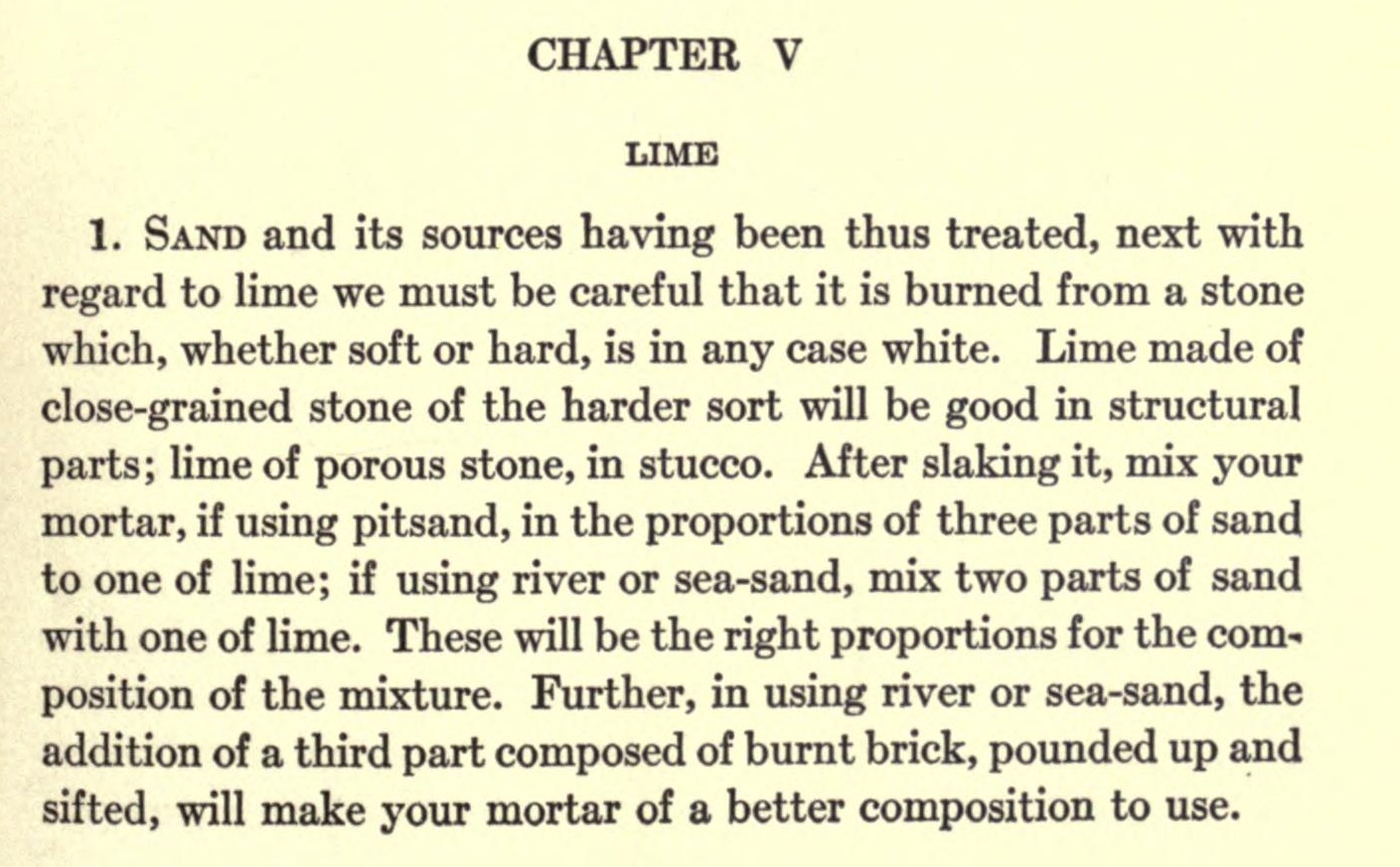


Roman Lime Mortar: Three of Pitsand or Two of River Sand to One of Slaked Lime, with Pounded Brick (Vitruvius)
Building mortar as Vitruvius gives it in Book II: test the sand by feel and on a white cloth, then mix slaked lime with three parts of fresh pitsand, or with two parts of river or sea sand plus pounded, sifted burnt brick. The sand you have sets the proportion.
Débutant
An hour per batch, after the lime is slaked
Consignes
1
1
His proportions
His proportions
Chargement du notebook Jupyter…
2
2
Read Vitruvius
Read Vitruvius
"After slaking it, mix your mortar, if using pitsand, in the proportions of three parts of sand to one of lime."
3
3
Test the sand
Test the sand
Good pitsand (black, gray, red or 'carbuncular') crackles when rubbed in the hand. Throw some on a white cloth and shake it out: if the cloth is not soiled, the sand is clean enough. Use pitsand fresh from the pit; left lying in sun and frost it turns earthy and will not bind.
Matériaux pour cette étape :
 Sable1 pièce
Outils nécessaires :
 Tissu de coton
 Pelle
4
4
Or sift river or sea sand
Or sift river or sea sand
With no sandpit, sift sand from a river bed, gravel or the beach. It dries slowly, will not carry vaults, and sea sand gives a salty bloom under stucco.
Matériaux pour cette étape :
Sable1 pièceOutils nécessaires :
 CriblePelle
5
5
Pound the brick
Pound the brick
For river or sea sand, pound burnt brick and sift it.
Matériaux pour cette étape :
 Brique1 pièce
Outils nécessaires :
 Mortier et pilonCrible
6
6
Mix
Mix
Use slaked lime from white stone (hard, close-grained stone for walls). Measure with one vessel: 3 sand to 1 lime for pitsand; 2 sand to 1 lime for river or sea sand, adding "a third part" of the brick (ours: one measure). Hoe it together dry, then with water to a stiff, workable paste (water ours).
Matériaux pour cette étape :
 Chaux éteinte1 pièceSable1 pièceBrique1 pièce
 Eau1 pièce
Outils nécessaires :
 Auge à mortier
 Houe
 Seau
7
7
Troubleshooting
Troubleshooting
Mortar troubleshooting.
Flow
Loading...
8
8
History and honest limits
History and honest limits
From Vitruvius, **The Ten Books on Architecture**, Book II chs. IV-V, tr. M. H. Morgan (1914), pp. 44-46 (checked on the archive.org scan vitruviustenbook00vitruoft). He adds that limestone loses about a third of its weight in the kiln. He gives parts, not a vessel, and no water: the measuring, the water and our reading of the brick 'third part' as one measure are ours.
Matériaux
4- 3 piècesEspace réservé
- 1 pièceEspace réservé
- 1 pièceEspace réservé
- 1 pièceEspace réservé
Ce plan fabrique
Blueprints liés
Ces blueprints partagent des connaissances — techniques, matériaux ou principes

CC0 Domaine public
Ce blueprint est publié sous CC0. Vous êtes libre de copier, modifier, distribuer et utiliser ce travail pour tout usage, sans demander la permission.
Soutenez le Maker en achetant des produits via son Blueprint où il perçoit une Commission Maker définie par les Vendeurs, ou créez une nouvelle itération de ce Blueprint et incluez-le comme connexion dans votre propre Blueprint pour partager les revenus.