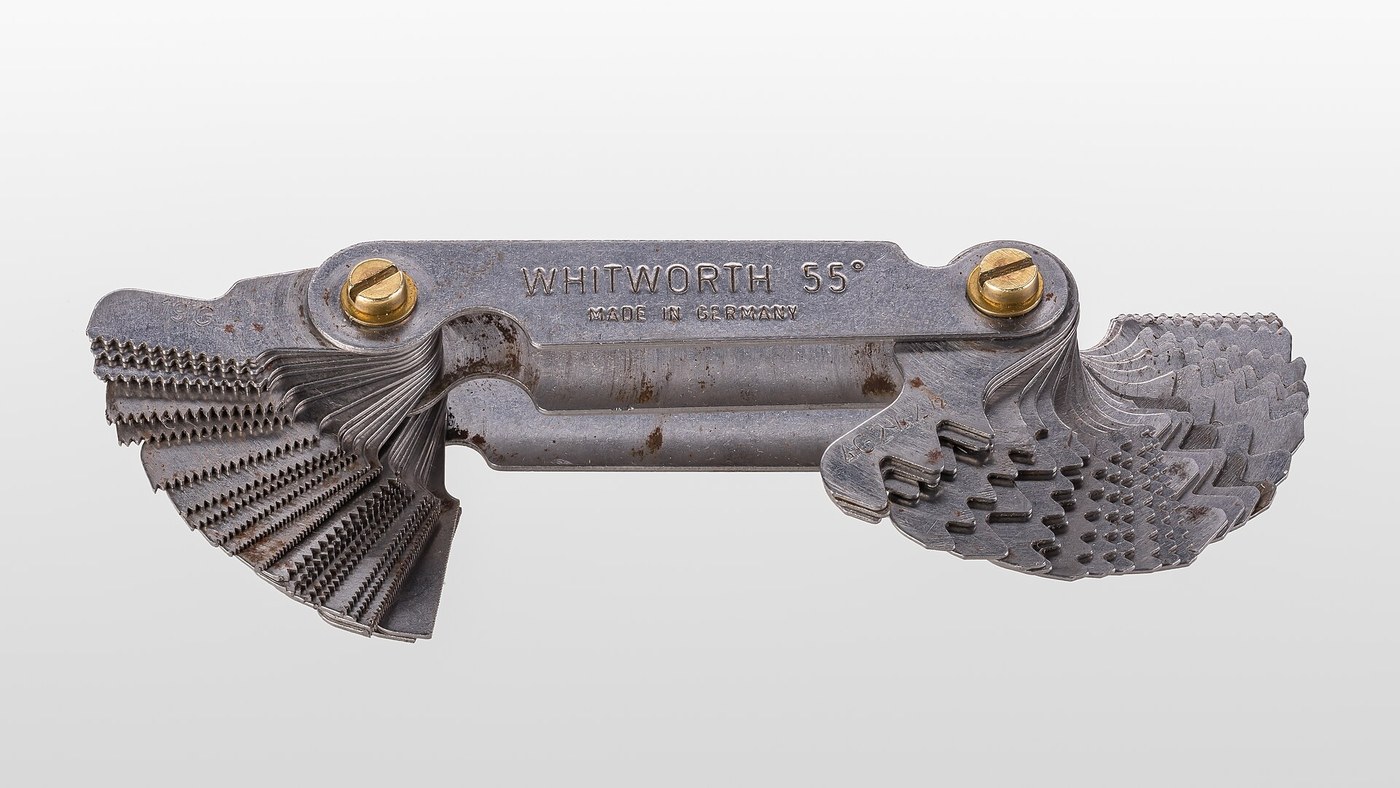


Whitworth Screw Thread
Consignes
Experience the problem
Experience the problem
Gather mismatched fasteners and try to interchange them.
- Collect bolts and nuts of similar diameter from different sources — metric, imperial, coarse, fine.
- Try each nut on each bolt.
- Note which pairs start and then jam.
Matériaux pour cette étape :
 Règle1 pièce
Measure the three things that define a thread
Measure the three things that define a thread
A thread is not one dimension but several, and all must match.
- Major diameter — across the crests.
- Pitch — crest to crest, or threads per inch.
- Flank angle — the included angle of the V.
Matériaux pour cette étape :
 Rapporteur1 pièce
 Digital Multimeter - Basic1 pièce
Make a pitch gauge and identify unknowns
Make a pitch gauge and identify unknowns
Build the tool that makes threads identifiable rather than guessed at.
- Cut a card or thin metal blade with teeth at a known pitch.
- Make several blades at different pitches and label them.
- Offer each to an unknown thread until one seats with no gaps.
Matériaux pour cette étape :
 Feuillard d'acier à ressort1 strip
Understand why the crests are rounded
Understand why the crests are rounded
Whitworth's rounded crest and root is a deliberate strength decision.
- Sketch a sharp V thread and mark the root.
- Sketch a rounded root beside it.
- Note where the cross-section is thinnest in each.
History and context
History and context
Joseph Whitworth (1803-1887) trained under Henry Maudslay, the man whose screw-cutting lathe made precise threads possible in the first place. In 1841 he presented a paper proposing a uniform system, based on averaging the practice he found by collecting screws from workshops across the country. The Whitworth thread was adopted by the railways, then generally, and became effectively the British national standard — arguably the first national engineering standard of any kind.
He did not patent it, and that is why it worked. A standard that must be licensed is not a standard. Whitworth's business was selling the precision machine tools and gauges that let others WORK to the standard, which is a considerably better position than owning the thread itself.
Whitworth's other contribution was measurement. He built a measuring machine capable of detecting a millionth of an inch and popularised the use of gauges and surface plates made flat by the three-plate method, where three surfaces are lapped against each other in rotation until all three are flat — a technique that produces a true plane from nothing but the requirement that it be self-consistent.
Standards fragmented anyway. America developed the Sellers thread with a 60-degree angle and flat crests, Whitworth stayed British, and the metric ISO thread eventually won globally. Britain's changeover was slow and painful — British motorcycles and machine tools continued to need Whitworth spanners for decades, and restorers still buy them today. Getting to one standard is harder than getting to a good one.
Matériaux
4- 1 pièceEspace réservé
- 1 pièceEspace réservé
- Digital Multimeter - Basic10 % de commission1 pièce€12.37
- 1 stripEspace réservé
Blueprints liés
Ces blueprints partagent des connaissances — techniques, matériaux ou principes
CC0 Domaine public
Ce blueprint est publié sous CC0. Vous êtes libre de copier, modifier, distribuer et utiliser ce travail pour tout usage, sans demander la permission.
Soutenez le Maker en achetant des produits via son Blueprint où il perçoit une Commission Maker définie par les Vendeurs, ou créez une nouvelle itération de ce Blueprint et incluez-le comme connexion dans votre propre Blueprint pour partager les revenus.