ART
BEAUTÉ ET BIEN-ÊTRE
ARTISANAT
CULTURE ET HISTOIRE
DIVERTISSEMENT
ENVIRONNEMENT
NOURRITURE ET BOISSONS
INGÉNIERIE INVERSE
SCIENCES
SPORTS
TECHNOLOGIE
TECHNOLOGIE PORTABLE


Yoshino Tissue: Kozo Paper So Thin Fifty Sheets Weigh 35 Grams (Nibu, after Rein 1889)
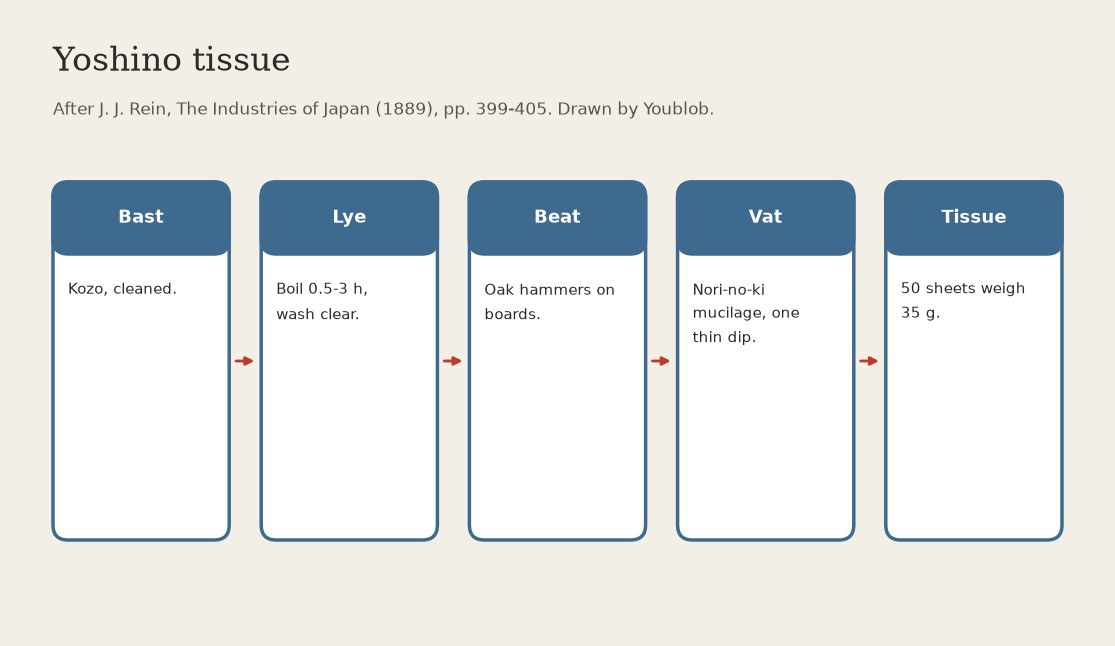
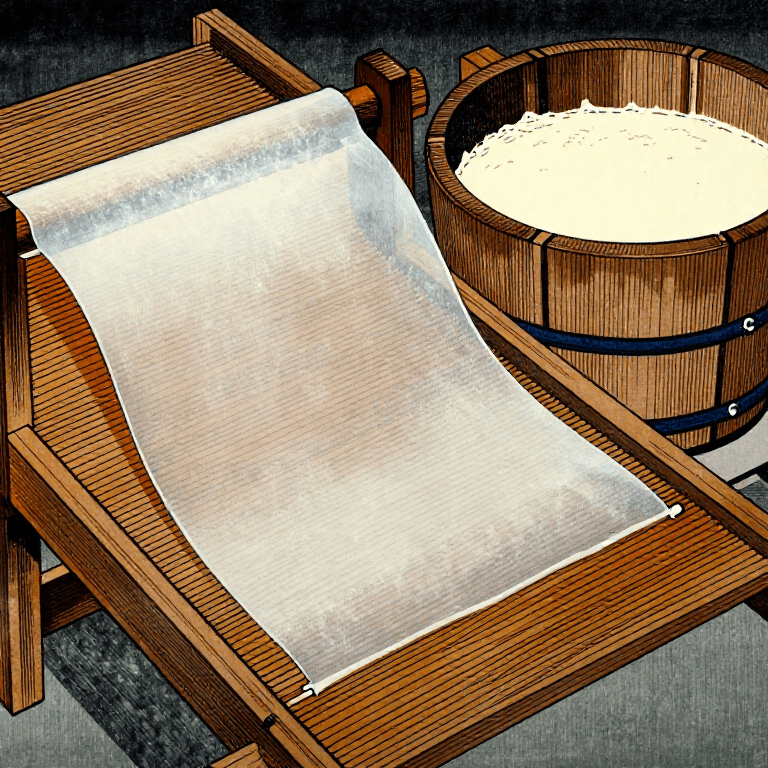
Yoshino-gami from Nibu in Yamato was the finest tissue of Japan: so thin that fifty sheets weigh 35 g, yet so strong that lacquer makers wrung thick lacquer through two or three layers and used them again. Light, tough tissue like this is what covers model wings.
Result: kozo tissue, sheets 48 x 25.5 cm, 50 sheets 35 g (about 5.7 g per square metre).
Source: J. J. Rein, The Industries of Japan (1889), pp. 399-405. Not given: amounts per vat, lye strength, beating time. Picture drawn by Youblob.
Avancé
3 days
Consignes
1
1
Clean the bast
Clean the bast
Take kozo bast freed of the dark outer skin and green parts, and cut out knot-holes and faulty spots.
Matériaux pour cette étape :
 Écorce de kozo1 as required
2
2
Boil in ash lye
Boil in ash lye
Boil the bast in an iron kettle with lye made from ashes, half an hour to three hours, until it is soft and crushes between the fingers.
Outils nécessaires :
 Lessive de cendres de bois
 Bouilloire en fonte
3
3
Wash clear
Wash clear
Wash the soft bast in a tub of fresh water, changing it four or five times until the water stays clear.
Matériaux pour cette étape :
 Eau1 as required
Outils nécessaires :
 Baquet en bois
4
4
Beat to pulp
Beat to pulp
Lay the wet bast on a thick hardwood board and beat it with oak hammers of 1 to 2 lb, stirring and mixing in water often, until it is an even fibrous pulp. If the fibres are not yet apart, boil it again in plain water.
Outils nécessaires :
 Planche de bois plate
 Maillet en boisBouilloire en fonte
5
5
Charge the vat
Charge the vat
Put the pulp in the vat with water. Press out Nori-no-ki (Hydrangea paniculata) bark in water and add the slippery mucilage; it keeps the fibres floating apart. Ours: press the bark out in a linen bag.
Matériaux pour cette étape :
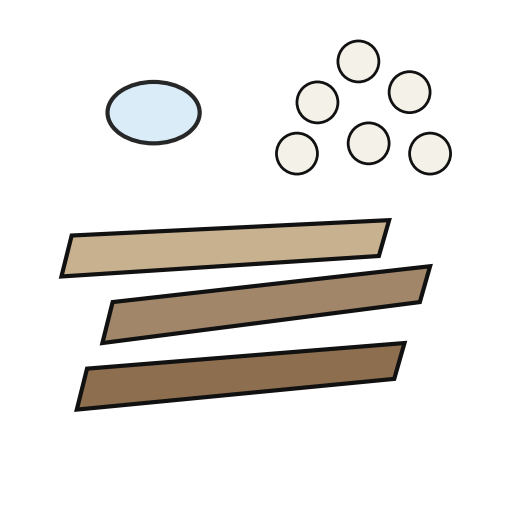 Écorce de nori-no-ki (Hydrangea paniculata)1 as requiredEau1 as required
Outils nécessaires :
 Cuve
 Sac en lin
6
6
Scoop one thin layer
Scoop one thin layer
Dip a mould of fine bamboo sticks bound with silk thread and let the stuff flow toward you, so the fibres lie parallel. Fill it once only: a second, crossed filling makes a thicker paper.
Outils nécessaires :
 SugetaCuve
7
7
Pile and dry on boards
Pile and dry on boards
Pile the wet sheets on a mat with bamboo splints between them. When dry enough, brush each onto a smooth board and stand it slantwise in the sun; the dry sheet comes off by itself.
Outils nécessaires :
 Natte de bambou
 Large brossePlanche de bois plate
8
8
Check the tissue
Check the tissue
Sheets 48 x 25.5 cm; fifty of them should weigh about 35 g. The tissue is yellowish, silky and strong enough to be wrung without tearing.
Matériaux
3- 1 as requiredEspace réservé
- 2 as requiredEspace réservé
- 1 as requiredEspace réservé
Outils requis
10- Espace réservé
- Espace réservé
- Espace réservé
- Espace réservé
- Espace réservé
- Espace réservé
- Espace réservé
- Espace réservé
- Espace réservé
- Espace réservé
Ce plan fabrique
Blueprints liés
Ces blueprints partagent des connaissances — techniques, matériaux ou principes

CC0 Domaine public
Ce blueprint est publié sous CC0. Vous êtes libre de copier, modifier, distribuer et utiliser ce travail pour tout usage, sans demander la permission.
Soutenez le Maker en achetant des produits via son Blueprint où il perçoit une Commission Maker définie par les Vendeurs, ou créez une nouvelle itération de ce Blueprint et incluez-le comme connexion dans votre propre Blueprint pour partager les revenus.