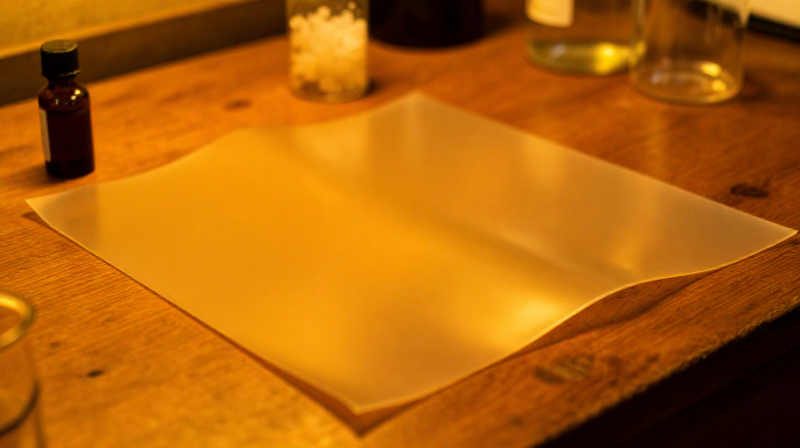


Making Celluloid — The First Synthetic Plastic That Changed Everything
Celluloid (cellulose nitrate plasticised with camphor) was the first commercially successful synthetic plastic — and the material that launched the age of plastics, photography, and cinema. In 1869, John Wesley Hyatt in Newark, New Jersey, was searching for a substitute for ivory billiard balls (an elephant was killed for every three balls). He discovered that nitrocellulose, when mixed with camphor under heat and pressure, produced a mouldable, translucent material that could be shaped, carved, and polished like ivory or tortoiseshell.
The chemistry is elegant: camphor (C₁₀H₁₆O), a waxy terpene from the camphor laurel tree, acts as a plasticiser — its small molecules slip between the rigid nitrocellulose chains, pushing them apart and allowing them to slide past each other when heated. The result is a thermoplastic: rigid at room temperature but softened by gentle heat into a mouldable mass. This was the first time humanity had created a material that did not exist in nature — a turning point in the relationship between civilisation and materials.
Celluloid made possible photographic film (Kodak, 1889), motion picture film (the Lumière brothers, 1895), shirt collars, combs, spectacle frames, piano keys, and toys. It was eventually displaced by cellulose acetate (safety film) and Bakelite because of its dangerous flammability — celluloid is essentially solid guncotton with camphor, and it burns violently.
SAFETY WARNING: Celluloid is HIGHLY FLAMMABLE — it ignites easily and burns with intense heat. The nitrocellulose component is the same explosive material as guncotton. Work away from open flames. The solvent (ethanol or acetone) used in preparation is also flammable. Adequate ventilation is essential.
相关蓝图
这些蓝图共享知识——技术、材料或原理
CC0 公共领域
此蓝图以 CC0 协议发布。你可以自由复制、修改、分发和使用此作品,无需征得许可。
通过购买蓝图中的产品支持创客,他们将获得 创客佣金 (由供应商设定),或创建此蓝图的新版本并将其作为连接包含在你自己的蓝图中以分享收入。