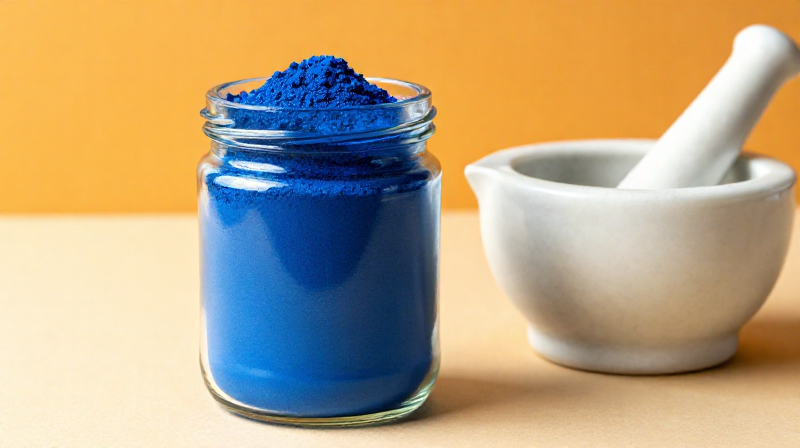


Making Phthalocyanine Blue — The Copper Complex That Became the World's Most Used Blue Pigment
Phthalocyanine Blue (Pigment Blue 15, CI 74160) is the single most important blue pigment developed in the 20th century. Discovered accidentally in 1928 at Scottish Dyes Ltd when a batch of phthalimide reacted with iron from a cracked enamel reactor lining, copper phthalocyanine was subsequently characterised by R.P. Linstead at Imperial College London and commercialised by ICI in 1935 as 'Monastral Blue'.
The molecule is a flat, sixteen-membered macrocyclic ring surrounding a central copper atom — structurally related to the porphyrins that colour blood (haemoglobin) and chlorophyll. This large, stable, planar structure absorbs orange-red light intensely, producing a vivid, strong blue with tinting power that dwarfs all earlier blue pigments. A single gram of phthalo blue can tint ten times more paint than an equivalent mass of ultramarine.
The laboratory synthesis involves heating phthalic anhydride (or phthalonitrile) with urea and a copper salt in a high-boiling solvent with a catalytic amount of ammonium molybdate. The reaction proceeds at 180–200 °C as the phthalic units cyclise around the copper ion, building the macrocyclic ring four units at a time.
Phthalo Blue has near-perfect lightfastness, extraordinary chemical resistance (surviving boiling in concentrated sulfuric acid), and complete insolubility in all common solvents. It is used in automotive paints, printing inks, plastics, artists' paints, and industrial coatings worldwide.
SAFETY WARNING: The synthesis involves heating to 200 °C in a high-boiling solvent. Urea decomposes to release ammonia. Use a fume hood or work outdoors. Phthalic anhydride is an irritant and sensitiser — avoid inhaling dust.
相关蓝图
这些蓝图共享知识——技术、材料或原理
CC0 公共领域
此蓝图以 CC0 协议发布。你可以自由复制、修改、分发和使用此作品,无需征得许可。
通过购买蓝图中的产品支持创客,他们将获得 创客佣金 (由供应商设定),或创建此蓝图的新版本并将其作为连接包含在你自己的蓝图中以分享收入。