
艺术
美容与健康
工艺
文化与历史
娱乐
环境
食品与饮料
绿色未来
逆向工程
科学
体育
技术
可穿戴设备
Salt-Curing Meat for Preservation — Dry Salting Without Refrigeration
TheChef

创建者

TheChef

26. 五月 2026DK
15
0
0
0
0

Salt-Curing Meat for Preservation — Dry Salting Without Refrigeration

Salt preserves meat by drawing out water through osmosis and creating an environment too hostile for bacteria. This single technique — packing meat in dry salt — kept armies fed on campaign, provisioned ships for months-long voyages, and allowed landlocked communities to eat fish caught hundreds of kilometres away. Salt curing predates smoking and is simpler: no fire, no special structure, just salt and time.

The process works because bacteria need moisture to grow. When salt is packed against meat, it draws water out of both the meat and any bacteria on the surface. The resulting brine further inhibits bacterial growth. After several days in salt, the meat loses enough moisture to remain stable at room temperature for weeks or months.

Salt curing was so fundamental to food security that salt itself became one of the most traded commodities in human history — the word salary comes from the Latin salarium, related to salt. Control of salt deposits was a strategic advantage equivalent to controlling water or iron ore.

初学者
30 minutes preparation + 5-14 days curing

说明

1

Select and prepare the meat

Choose fresh, lean cuts — fat goes rancid even when salted, so trim visible fat. Pork belly, beef brisket, fish fillets, and venison all cure well. Cut the meat into pieces no more than 5-8 cm thick — salt penetrates slowly, and thick pieces rot in the centre before the salt reaches them. The meat must be fresh and cold — do not cure meat that has been sitting at warm temperatures.

此步骤所需材料:

Coarse Sea SaltCoarse Sea Salt2 公斤
2

Apply the salt

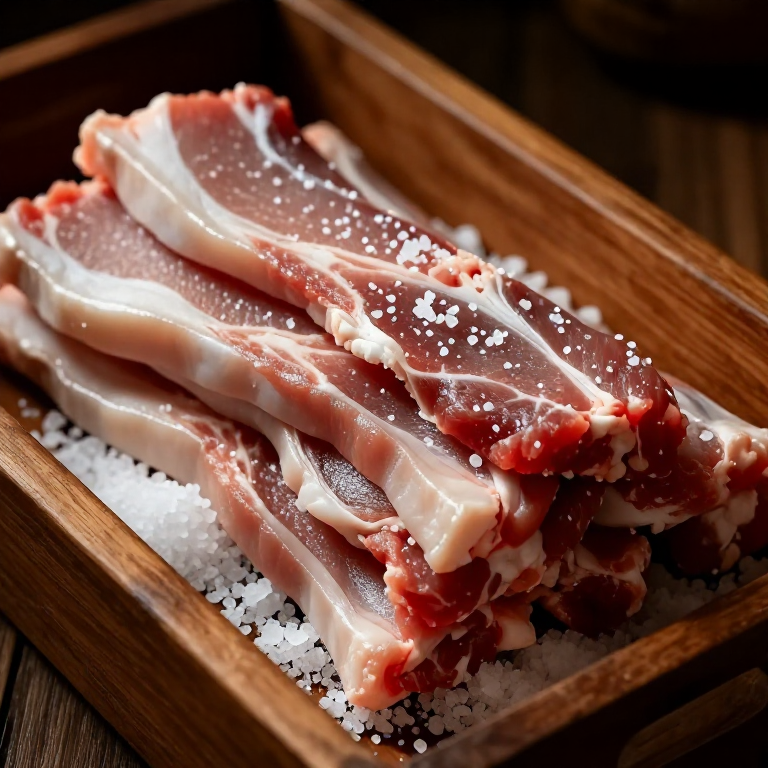
Rub coarse salt vigorously into all surfaces of the meat, pressing it into every crevice and fold. Use about 30-40% of the meat's weight in salt — for 1 kg of meat, use 300-400 g of salt. This sounds excessive, but the goal is complete coverage. The salt draws moisture out of the meat by osmosis; within hours, a pool of brine forms. Coarse salt works better than fine salt because it dissolves slowly, maintaining a sustained osmotic pull.
3

Pack in a curing vessel

Layer the salted meat in a clean wooden trough, stone crock, or clay vessel. Place a layer of salt on the bottom, then a layer of meat, then more salt, building up until all pieces are buried in salt. Every surface of every piece must be in contact with salt — any exposed meat becomes a site for spoilage. Cover the vessel with a wooden lid or clean cloth.
4

Weight the meat and drain

Place a heavy stone or wooden board on top of the meat to press it down. The weight compresses the layers and helps the salt penetrate evenly. Within 24 hours, a significant amount of brine collects at the bottom of the vessel. Tilt the vessel to drain this brine off daily — the meat cures faster in dry salt than submerged in brine. Repack and add fresh salt to replace what dissolved.
5

Cure for the required time

Small thin pieces (fish fillets, sliced meat) cure in 3-5 days. Thick cuts (pork belly, brisket) need 7-14 days. The meat is ready when it feels firm throughout — press the centre with a finger; if it yields softly, the salt has not fully penetrated. In cool weather (below 10 °C), curing is slower but safer. In warm weather, cure in the coolest available location and check daily for off-smells.
6

Rinse and dry

Remove the meat from the salt and brush off the excess. Rinse briefly in clean water to remove surface salt — do not soak, or you will draw salt back out. Hang the cured meat in a cool, dry, well-ventilated place to form a pellicle — a dry, slightly tacky surface layer that protects against insects and further moisture loss. Properly dry-cured meat stored in a cool, dry place keeps for months.

材料

1

已连接蓝图材料

CC0 公共领域

此蓝图以 CC0 协议发布。你可以自由复制、修改、分发和使用此作品,无需征得许可。

通过购买蓝图中的产品支持创客,他们将获得 创客佣金 (由供应商设定),或创建此蓝图的新版本并将其作为连接包含在你自己的蓝图中以分享收入。

讨论

(0)

登录 加入讨论

加载评论中...