SENI
KECANTIKAN & KESEHATAN
KERAJINAN
BUDAYA & SEJARAH
HIBURAN
LINGKUNGAN
MAKANAN & MINUMAN
REKAYASA BALIK
ILMU PENGETAHUAN
OLAHRAGA
TEKNOLOGI
PERANGKAT PAKAI
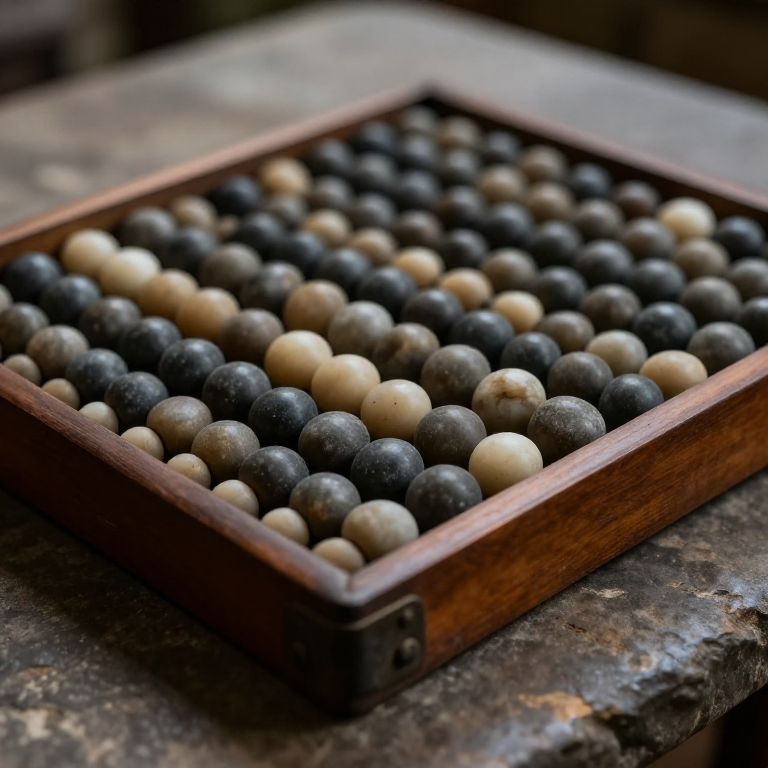


Sieve of Eratosthenes — Hunt Prime Numbers on a Grid
A hands-on maths project for the classroom: make a hundred-square, then cross out the multiples of each number with counters until only the prime numbers are left. A Python cell checks the 25 primes you find, and a compendium explains why primes are the building blocks of every number.
Pemula
30 minutes
Instruksi
1
1
What is a prime?
What is a prime?
A prime number can only be split into equal groups as one big group or as single ones -- 5, 7 and 11 are primes. Every other number can be built by multiplying smaller ones. Around 240 BC Eratosthenes found a simple way to sift the primes out, and you will do it by hand.
2
2
Make a hundred-square
Make a hundred-square
On a sheet of card rule a 10 by 10 grid and write the numbers 1 to 100 in it, ten to a row. This is your sieve.
Material untuk langkah ini:
 Paket Kertas Karton Aneka Warna1 buah
Alat yang dibutuhkan:
 Set Pensil Grafit
 Penggaris
3
3
Cross out the multiples
Cross out the multiples
Cross off 1 (not prime). Circle 2, then place a counter on -- or cross out -- every other multiple of 2: 4, 6, 8, and so on. Move to the next uncrossed number, 3, circle it, and cross out every third number. Do the same for 5 and 7. Once you pass 10 you can stop. Every number still uncrossed is prime -- count them: there should be 25.
Material untuk langkah ini:
 Manik kaca1 buah
4
4
Check the primes you found
Check the primes you found
Memuat notebook Jupyter…
Alat yang dibutuhkan:
 Komputer Desktop
5
5
Compendium: the atoms of arithmetic
Compendium: the atoms of arithmetic
What your grid shows. (1) Every whole number above 1 is either prime or breaks down into primes in exactly one way -- the Fundamental Theorem of Arithmetic -- so primes are the 'atoms' that build all the other numbers. (2) You only had to cross out multiples up to the square root of 100 (that is, 10), because any larger composite already got crossed by a smaller factor -- a neat shortcut worth thinking about. (3) Primes get rarer as numbers grow, but never run out (Euclid proved there are infinitely many). (4) The hunt for large primes and the difficulty of un-multiplying big numbers is exactly what keeps online banking and messaging secure today.
Bahan
3- Placeholder
- 1 buahPlaceholder
- 1 lembarPlaceholder
Alat yang Diperlukan
3- Placeholder
- Placeholder
- Placeholder
Blueprint terkait
Blueprint ini berbagi pengetahuan — teknik, bahan, atau prinsip



CC0 Domain Publik
Cetak biru ini dirilis di bawah CC0. Anda bebas untuk menyalin, memodifikasi, mendistribusikan, dan menggunakan karya ini untuk tujuan apa pun, termasuk komersial, tanpa meminta izin.
Dukung Maker dengan membeli produk melalui Cetak Biru mereka di mana mereka mendapatkan Komisi Pembuat yang ditetapkan oleh Penjual, atau buat iterasi baru dari Cetak Biru ini dan masukkan sebagai koneksi di milik Anda sendiri.