SENI
KECANTIKAN & KESEHATAN
KERAJINAN
BUDAYA & SEJARAH
HIBURAN
LINGKUNGAN
MAKANAN & MINUMAN
REKAYASA BALIK
ILMU PENGETAHUAN
OLAHRAGA
TEKNOLOGI
PERANGKAT PAKAI
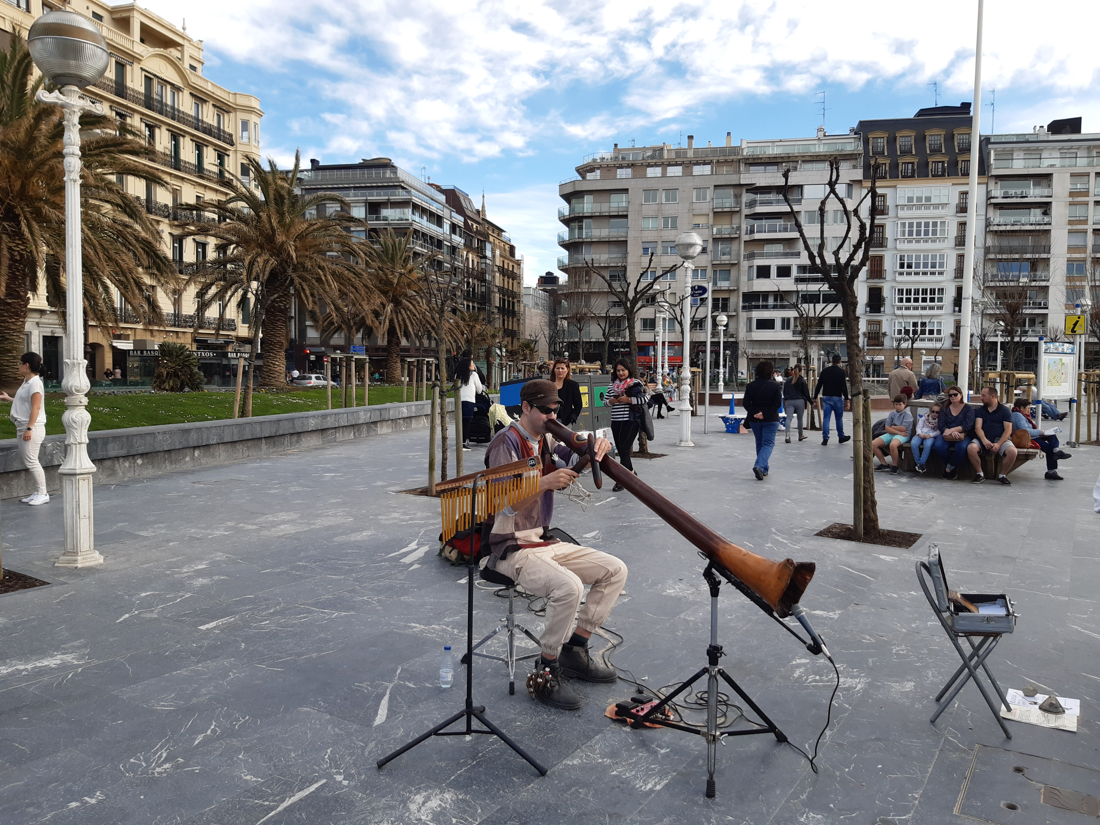
Iñaki LL (Wikimedia Commons) · CC BY-SA 4.0


Making a Didgeridoo — Australia's Lip-Buzzed Drone Pipe
Make a didgeridoo: a long hollow tube you drone through by buzzing your lips, shaping the sound with your voice and mouth and keeping it going forever with circular breathing. Clear the bore, form a beeswax mouthpiece, and learn the drone and the breath. A serious maker build in the lip-reed aerophone — one of the world's oldest wind instruments, from Aboriginal Australia.
Menengah
A few hours to build, plenty of practice to play
Instruksi
1
1
A drone you buzz with your lips
A drone you buzz with your lips
The didgeridoo is a long hollow tube with no holes and no keys. You press your lips to one end and BUZZ them, and the tube drones one deep note. All the music comes from shaping that drone with your voice, mouth and breath.
2
2
Find a long hollow tube
Find a long hollow tube
Traditionally a eucalyptus branch hollowed out by termites; to build one, take a long straight tube (large bamboo or agave stalk) about as long as your arm-and-a-half. A LONGER tube drones LOWER.
Material untuk langkah ini:
 Bambu1 buah
Alat yang dibutuhkan:
 Penusuk (Uncek)
3
3
Clear the bore
Clear the bore
Push out every node and clean the inside so air runs straight through end to end. A rough, slightly irregular bore actually helps the didgeridoo's rich buzzy overtones — it does not need to be smooth like a flute.
4
4
Form the beeswax mouthpiece
Form the beeswax mouthpiece
Warm beeswax soft and press a ring of it around the blowing end to build a smooth mouthpiece sized to your lips. A comfortable seal lets your lips buzz freely — this is the 'reed' of the instrument.
Material untuk langkah ini:
 Pelet Lilin Lebah1 buah
5
5
Buzz the drone
Buzz the drone
Rest your lips loosely on the mouthpiece — like blowing a raspberry — and blow steadily so they flap. Keep them relaxed and loose; too tight and it squeaks, just right and the whole tube booms into its deep drone.
6
6
Shape it with your voice
Shape it with your voice
Now play with your MOUTH: move your tongue, change the shape of your mouth, and hum or call into the drone. This brings out the wobbling overtones and animal calls the didgeridoo is famous for — your mouth is a filter tuning which harmonics you hear.
7
7
Learn circular breathing
Learn circular breathing
To drone without stopping: puff your cheeks full of air, and while you squeeze that cheek-air out through your lips, snatch a quick breath IN through your nose. Done smoothly the drone never breaks. It is the hardest and most magical part — practice with a straw in a glass of water first.
8
8
Compendium — the lip-reed drone and circular breathing
Compendium — the lip-reed drone and circular breathing
The didgeridoo makes its sound the same way a trumpet or a natural horn does: your buzzing LIPS are the reed. Blown loosely, your lips open and close many times a second, chopping the airflow into pulses, and the tube resonates with those pulses to sing its deep drone — this is exactly the lip-buzzing that voices the Viking Gjallarhorn and every brass instrument, which is why the didgeridoo belongs with the lip-reed aerophones, not the flutes (a flute has no reed; the didgeridoo's reed is you). Because the plain tube has no finger holes and no valves, its base note is fixed by its LENGTH — longer bores drone lower — and unlike a trumpet player, a didgeridoo player mostly stays on that one fundamental drone rather than jumping between harmonics. The artistry is all in FILTERING: your mouth, tongue and throat form a changing cavity in front of the tube, and by reshaping it you boost different overtones and add vocalisations, the very same trick as a talk-box or the human vowel — the drone is the raw sound, your vocal tract paints it. And to sustain that drone unbroken, players use circular breathing: the puffed cheeks act as a little bellows that keeps air flowing out through the lips during the split second you inhale through the nose, so the sound never stops — the same continuous-airflow principle that lets the Lao khaen and the bagpipe drone forever. Made and played by Aboriginal Australians for well over a thousand years (some say far longer), it is one of humanity's oldest wind instruments still in living use.
Alat yang Diperlukan
1- Placeholder
Blueprint terkait
Blueprint ini berbagi pengetahuan — teknik, bahan, atau prinsip
CC0 Domain Publik
Cetak biru ini dirilis di bawah CC0. Anda bebas untuk menyalin, memodifikasi, mendistribusikan, dan menggunakan karya ini untuk tujuan apa pun, termasuk komersial, tanpa meminta izin.
Dukung Maker dengan membeli produk melalui Cetak Biru mereka di mana mereka mendapatkan Komisi Pembuat yang ditetapkan oleh Penjual, atau buat iterasi baru dari Cetak Biru ini dan masukkan sebagai koneksi di milik Anda sendiri.