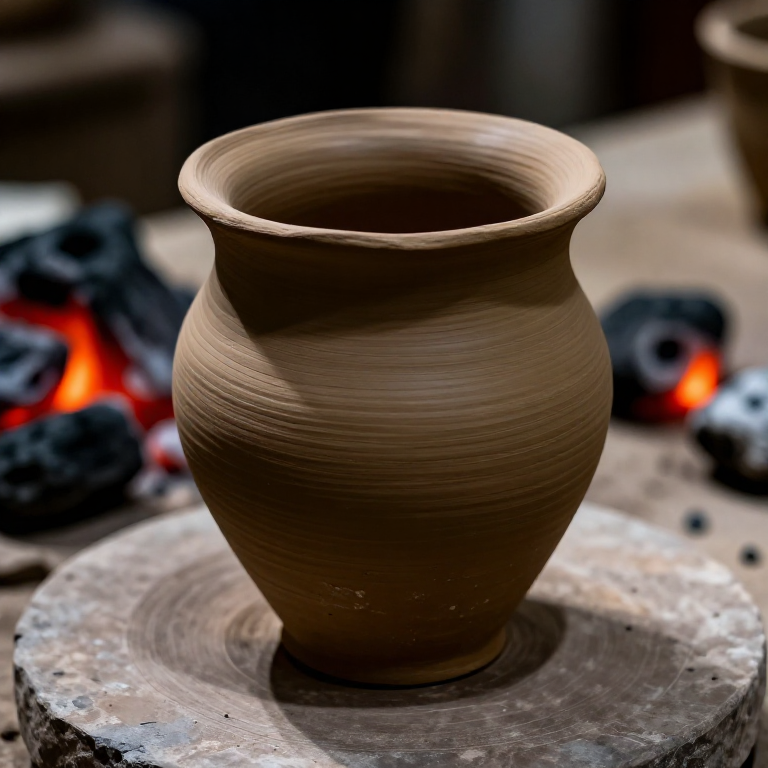


Making a Clay Crucible for Smelting — The Vessel That Holds Molten Metal
The clay crucible is the most essential tool in early metallurgy — a hand-formed vessel of refractory clay and grog that can withstand the 1,100 °C temperatures needed to melt copper and bronze. Without it, smelting is impossible.
This blueprint follows the Bronze Age method of mixing local clay with crushed pottery (grog) to create a thermal-shock-resistant vessel. The grog opens the clay body, allowing steam to escape during firing instead of shattering the crucible. The thick walls and tapered form channel heat inward while the pouring lip allows controlled transfer of molten metal into moulds.
Every bronze tool, weapon, and ornament of the ancient world began inside a vessel like this one.
Instruksi
Collect and prepare the clay
Collect and prepare the clay
Material untuk langkah ini:
 Tanah Liat Tahan Api2 kg
Crush fired pottery into grog
Crush fired pottery into grog
Material untuk langkah ini:
 Grog (pecahan gerabah bakaran yang digerus)500 g
Mix the crucible body
Mix the crucible body
Material untuk langkah ini:
 Pasir Kuarsa200 g
 Air500 ml
Alat yang dibutuhkan:
 Lempeng Batu Rata
 Batang kayu pengaduk
Wedge the clay to remove air
Wedge the clay to remove air
Form the base
Form the base
Build up the walls with coils
Build up the walls with coils
Smooth and compress the walls
Smooth and compress the walls
Alat yang dibutuhkan:
 Batu Halus
Form the pouring lip
Form the pouring lip
Thicken the base and lower walls
Thicken the base and lower walls
Dry the crucible slowly
Dry the crucible slowly
Pre-heat near a fire
Pre-heat near a fire
Fire the crucible in a kiln
Fire the crucible in a kiln
Inspect and test
Inspect and test
Bahan
5- Placeholder
- Placeholder
- 200 gPlaceholder
- 500 mlPlaceholder
- 1 buahPlaceholder
Alat yang Diperlukan
3- Placeholder
- Placeholder
- Placeholder
Bahan cetak biru terhubung
Blueprint terkait
Blueprint ini berbagi pengetahuan — teknik, bahan, atau prinsip

CC0 Domain Publik
Cetak biru ini dirilis di bawah CC0. Anda bebas untuk menyalin, memodifikasi, mendistribusikan, dan menggunakan karya ini untuk tujuan apa pun, termasuk komersial, tanpa meminta izin.
Dukung Maker dengan membeli produk melalui Cetak Biru mereka di mana mereka mendapatkan Komisi Pembuat yang ditetapkan oleh Penjual, atau buat iterasi baru dari Cetak Biru ini dan masukkan sebagai koneksi di milik Anda sendiri.