SENI
KECANTIKAN & KESEHATAN
KERAJINAN
BUDAYA & SEJARAH
HIBURAN
LINGKUNGAN
MAKANAN & MINUMAN
REKAYASA BALIK
ILMU PENGETAHUAN
OLAHRAGA
TEKNOLOGI
PERANGKAT PAKAI
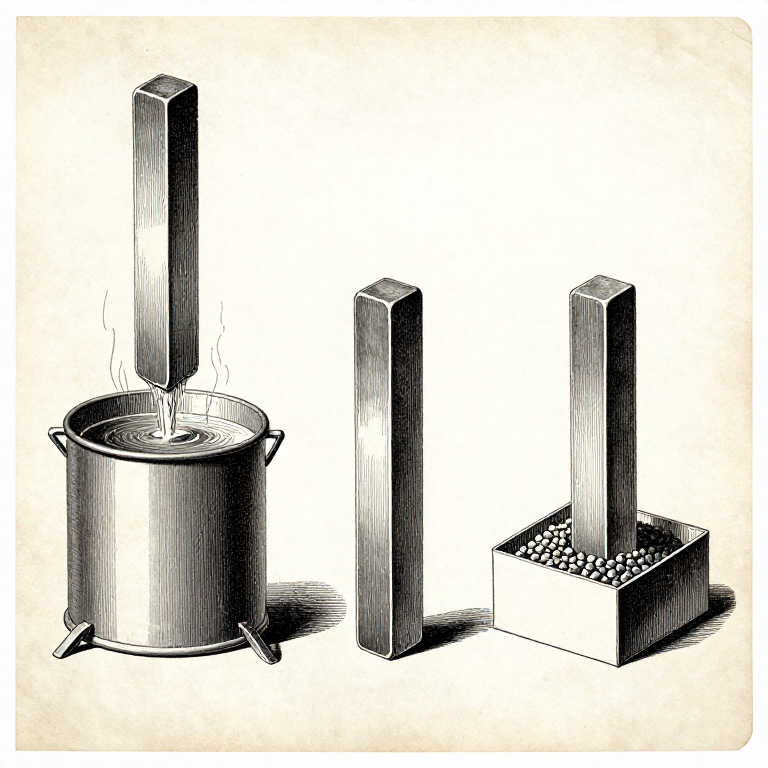

Cooling Is a Process Too: Still Air, Insulated, or Quenched
How something cools decides as much about its final state as how it was heated. The same steel, at the same temperature, becomes glass-hard, tough, or dead soft depending entirely on the rate it comes down.
There are three speeds a workshop uses deliberately. QUENCHING is as fast as possible. NORMALISING is still air. ANNEALING is as slow as you can contrive, usually by burying the work in something insulating and leaving it overnight.
Choosing one is choosing the properties of the finished piece, and doing it by accident is how a part ends up too hard to file or too soft to hold an edge.
Menengah
3 hours
Instruksi
1
1
The three rates and what each produces
The three rates and what each produces
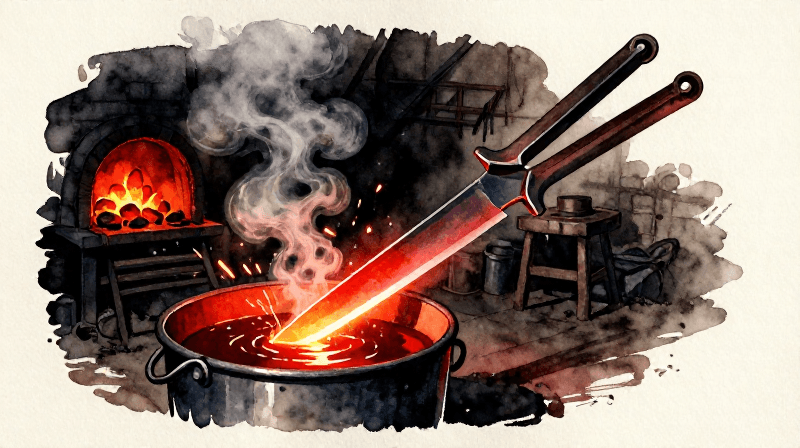
QUENCH into water, brine or oil and the steel has no time to transform gradually — it traps into a hard, brittle structure that then must be tempered. The published heat-treatment blueprint is this sequence in full.
NORMALISE by standing the work in still air and it cools at a moderate rate, giving a fine even grain and a predictable, machinable state. This is the default after forging and the reset button for a piece with a confused history.
ANNEAL by burying it in ash, vermiculite or dry lime, or by switching off the furnace and letting it cool with the work inside. That gives the softest, most workable condition — which is what you want before machining, filing or cold bending, and what the steel supplier delivers bar stock in.
Material untuk langkah ini:
 Batang baja lunak2 buah
 Air1 buah
Alat yang dibutuhkan:
 Perapian pandai besi
 Tang pandai besi
 Sarung Tangan Kulit Lengan Panjang
2
2
Thin cools faster than thick, in the same piece
Thin cools faster than thick, in the same piece
The surface-to-volume argument from the heating rung runs unchanged in reverse. A thin edge in a quench cools far faster than a thick spine a centimetre away.
That is exploited deliberately: a blade hardens at the edge and stays tougher in the spine because of this alone, and clay-coating the spine — as Japanese swordmaking does — exaggerates the effect on purpose.
It is also a hazard. Sharp changes of section cool at very different rates, so they contract at different rates, and the stress from that is what cracks a piece in the quench. A generous radius at every corner is the fix, and it is designed in rather than added later.
Material untuk langkah ini:
Batang baja lunak1 buahAir1 buahAlat yang dibutuhkan:
Tang pandai besi Lup PembesarSarung Tangan Kulit Lengan Panjang
3
3
Slow cooling for ceramics and glass, and why
Slow cooling for ceramics and glass, and why
Glass and glazed ceramics must be cooled slowly through a particular range or they crack — sometimes on the way down, sometimes days later on the shelf.
The reason is the same temperature difference across the wall that the soak rung described, acting in reverse: the outside contracts while the inside is still hot and large, and the resulting tension exceeds what a brittle material can take. Metal yields and survives; ceramic and glass do not yield, so they break.
Annealing glass means holding it at a temperature where stress can relax, then cooling slowly enough that none builds again. It is the single most common reason an otherwise good piece fails, and the failure often happens long after the kiln is cold — which makes it hard to connect to its cause.
Alat yang dibutuhkan:
 Tungku Pembakaran
 Tungku suhu tinggi
 Termokopel dengan penampil
4
4
Never guess with something hot, and never put it down carelessly
Never guess with something hot, and never put it down carelessly
Hot steel looks identical to cold steel below about 500 °C, and it stays hot enough to cause a serious burn for a long time after it stops glowing.
Adopt one habit and keep it absolutely: anything that has been in the fire is hot until you have proved otherwise. Test by bringing a hand near it rather than touching, or by touching a scrap of paper to it and seeing whether it scorches. Put hot work in one designated place, always the same place, and tell anyone else in the shop where that is.
The same applies to quench tanks — water thrown out of one by a large hot piece is scalding — and to fire itself: a banked fire looks dead and is not. None of this is a reason not to do the work; it is the small set of habits that make it ordinary rather than risky.
Material untuk langkah ini:
Air1 buahAlat yang dibutuhkan:
Sarung Tangan Kulit Lengan PanjangTang pandai besi Kacamata gelap untuk tungku
Alat yang Diperlukan
8- Placeholder
- Placeholder
- Placeholder
- Placeholder
- Placeholder
- Placeholder
- Placeholder
- Placeholder
Blueprint terkait
Blueprint ini berbagi pengetahuan — teknik, bahan, atau prinsip
Quench Hardening and Tempering a Steel Blade — Heat Treatment Fundamentals
oleh Forge
Pengerjaan Logam
72
0
0
0
4
0
The Surface Is Not the Centre: Thermal Mass and Soak Time
oleh Penny
Pengerjaan Logam
23
0
0
0
0
0
Reading Heat by Colour: The Oldest Thermometer, and Its Two Conditions
oleh Forge
Pengerjaan Logam
20
0
0
0
0
0
CC0 Domain Publik
Cetak biru ini dirilis di bawah CC0. Anda bebas untuk menyalin, memodifikasi, mendistribusikan, dan menggunakan karya ini untuk tujuan apa pun, termasuk komersial, tanpa meminta izin.
Dukung Maker dengan membeli produk melalui Cetak Biru mereka di mana mereka mendapatkan Komisi Pembuat yang ditetapkan oleh Penjual, atau buat iterasi baru dari Cetak Biru ini dan masukkan sebagai koneksi di milik Anda sendiri.