SENI
KECANTIKAN & KESEHATAN
KERAJINAN
BUDAYA & SEJARAH
HIBURAN
LINGKUNGAN
MAKANAN & MINUMAN
REKAYASA BALIK
ILMU PENGETAHUAN
OLAHRAGA
TEKNOLOGI
PERANGKAT PAKAI
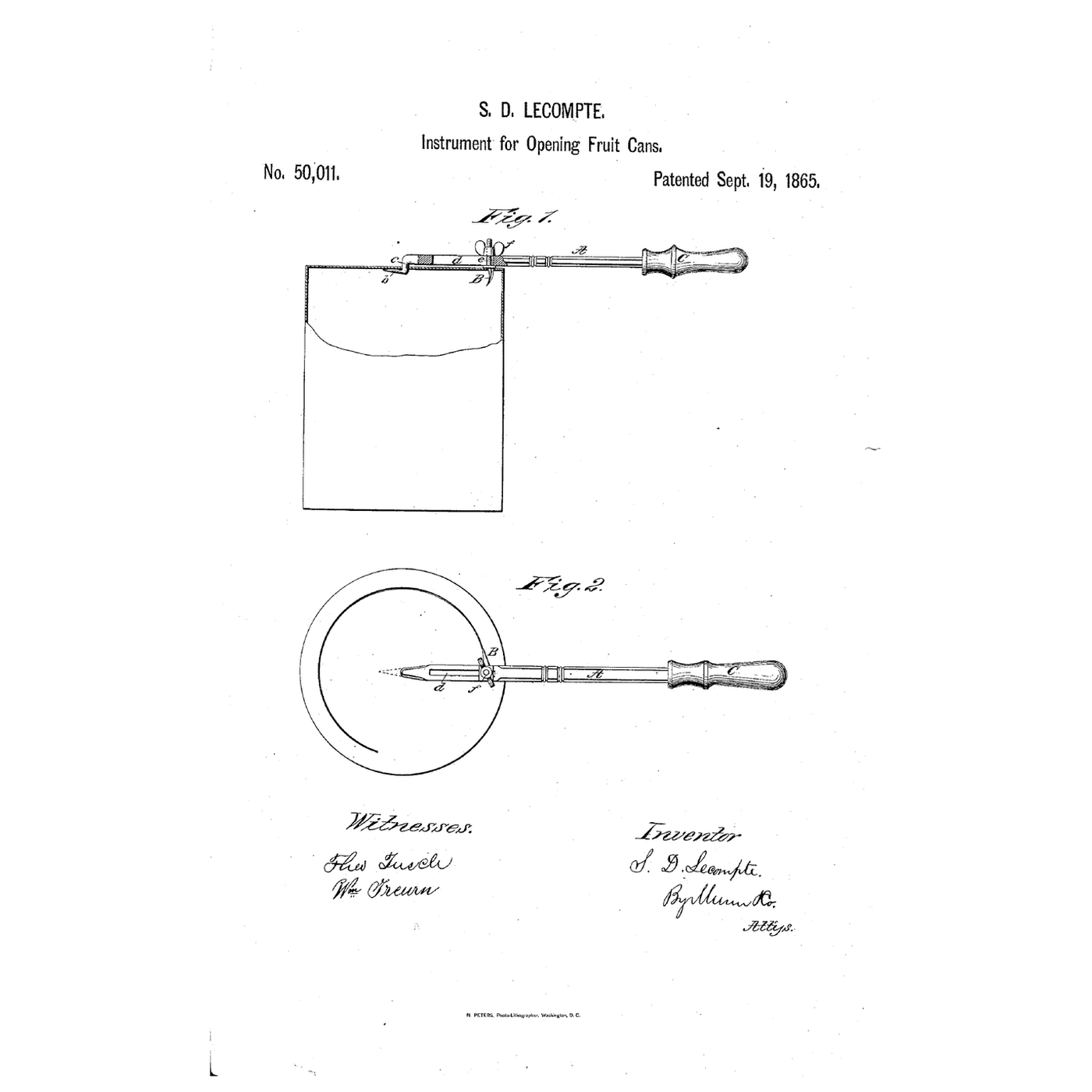


Crank-Point Can Opener: A Bent Point to Turn On, a Knife Set in a Slot
A can opened with a lever knife leaves a jagged hole of any size.
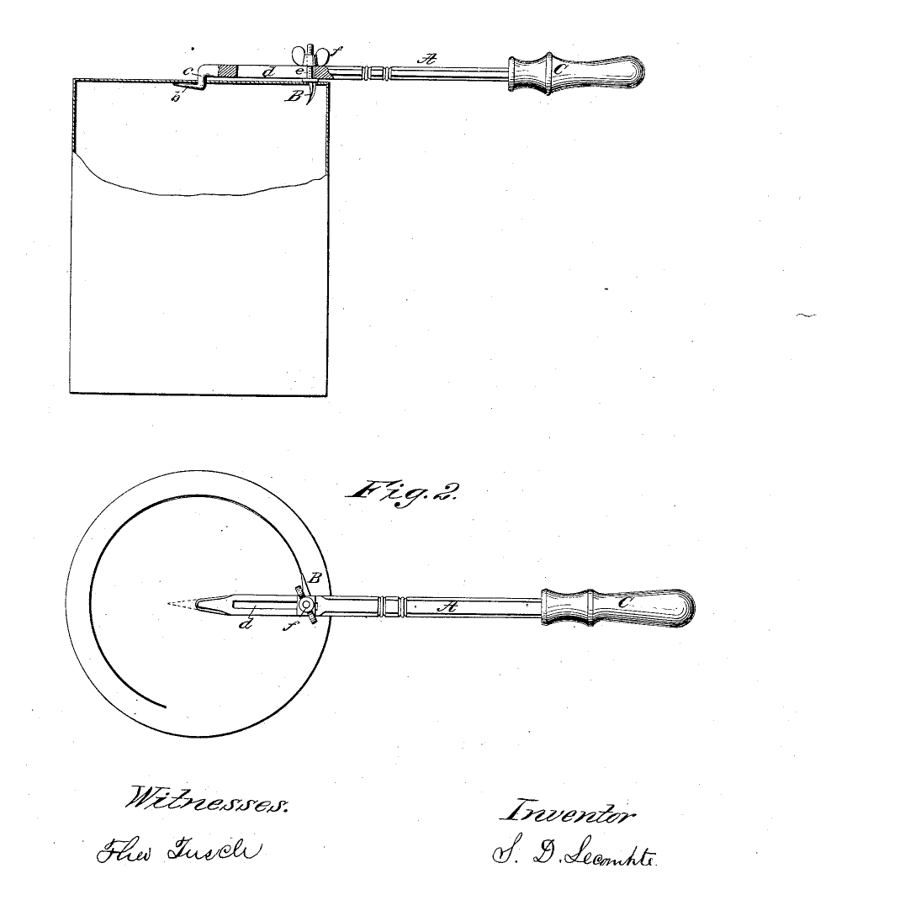
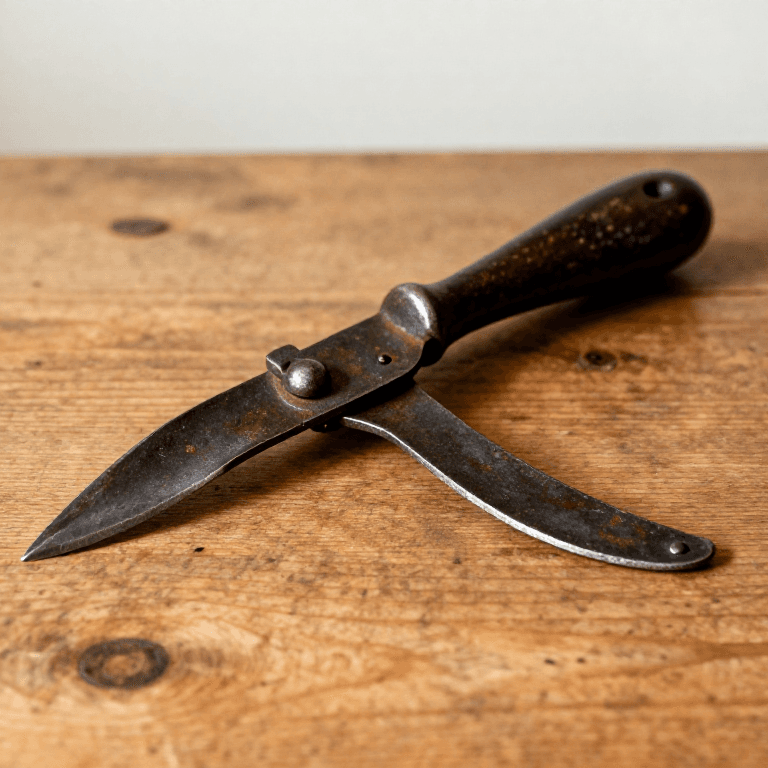
Samuel D. Lecompte of Leavenworth, Kansas, received US 50,011, dated 19 September 1865, for an instrument for opening fruit and other sealed cans: a bar with a handle, its end bent like a crank and pointed so that, thrust through the top, the bent part is held by the edges of the hole as a bearing; a knife slides along a slot in the bar on a set screw, and the instrument is turned round to cut.
This rung works out where to set the knife for each can, then forges the bar, crank and knife and cuts a round opening.
Menengah
About 3 hours
Instruksi
1
1
Knife position for each can
Knife position for each can
Memuat notebook Jupyter…
2
2
A lever opener before it
A lever opener before it
The embedded blueprint saws round a can with a lever knife. Lecompte gives the knife a centre to turn about and a slot to set its radius.
3
3
Read US 50,011
Read US 50,011
"The end of the instrument is bent somewhat in the form of a crank, and pointed, as shown by the letters b c in Fig. 1. This enables the instrument to be thrust into the top of the can in such manner that the part c, which is bent at right angles to the bar A, will be encircled by the edges of the hole made in the top of the can, thus insuring a good and sufficient bearing to enable the instrument to be operated."
4
4
Slot the bar
Slot the bar
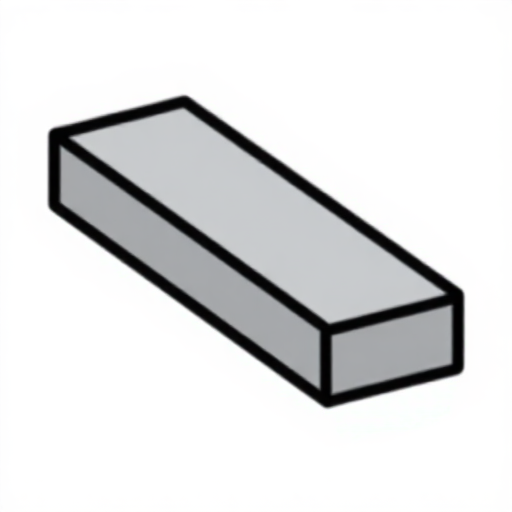
Cut 170 mm of 25 × 3 mm flat bar. Drill a row of 5 mm holes along its centre from 25 to 70 mm from one end and file them into a slot.
Material untuk langkah ini:
 Besi Strip Baja Lunak1 buah
Alat yang dibutuhkan:
 Gergaji Besi
 Ragum Meja
 Penitik
 Bor Tanpa Kabel
 Set Mata Bor
 Set Kikir Jarum
 Penggaris
5
5
Forge the crank point
Forge the crank point
File the bar's slotted end down to 6 mm wide for its last 30 mm. Bend it down 15 mm, along 10 mm, and down again 15 mm in the vice, and file the end to a sharp point.
Alat yang dibutuhkan:
 Kikir (Kikir Tangan)Ragum Meja
 Palu
Palu Kacamata Pengaman Bening
6
6
Make the knife
Make the knife
Cut a 6 × 25 mm knife from 1 mm steel sheet with a pointed lower end and a 5 mm hole at the top. Hone its edge.
Material untuk langkah ini:
 Pelat Baja Lunak1 buah
Alat yang dibutuhkan:
 Gunting sengBor Tanpa KabelSet Mata BorKikir (Kikir Tangan)
 Batu asah
7
7
Fit the knife and handle
Fit the knife and handle
Bolt the knife under the slot with an M5 screw, washer and nut as the set screw. Fit a hardwood handle to the bar's other end with epoxy.
Material untuk langkah ini:
 Sekrup mesin1 buah
 Ring Rata1 buah
 Mur Segi Enam1 buah
 Pasak kayu keras1 buah
 Epoksi dua komponen1 buah
Alat yang dibutuhkan:
 Kunci InggrisBor Tanpa KabelSet Mata Bor
8
8
The patent drawing
The patent drawing
US 50,011 drawing sheet, public domain (expired patent).
9
9
Cut a round opening
Cut a round opening
Set the knife for the can and tighten it. Stand a sealed can on the kitchen scale, thrust the point through the top's centre, press the knife in and turn round; read the peak load, time it, and measure the hole.
Material untuk langkah ini:
 Kaleng1 buah
Alat yang dibutuhkan:
 Timbangan Dapur Digital
 Stopwatch
 Jangka Sorong Digital 6 Inci
 Sarung Tangan Kerja Kulit
10
10
A point that tears out, a knife that slips
A point that tears out, a knife that slips
Crank-point can opener troubleshooting.
Flow
Loading...
11
11
History and honest limits
History and honest limits
**Samuel D. Lecompte** of Leavenworth, Kansas, received US 50,011, dated 19 September 1865, for cans used for fruits, preserves and oysters. He did not limit himself to one knife shape, having adopted various styles. The patent was reissued on 4 February 1868 (No. 2,851). F. S. Wyman's 1868 patent names it as the circular opener he added a side knife to.
**Honest limits.** A bolt and nut stand in for his set screw, and the knife is unhardened. Your loads and times are the result.
Bahan
8- 1 buahPlaceholder
- 1 buahPlaceholder
- 1 buahPlaceholder
- 1 buahPlaceholder
- 1 buahPlaceholder
- 1 buahPlaceholder
- 1 buahPlaceholder
- 1 buahPlaceholder
Alat yang Diperlukan
17- Placeholder
- Placeholder
- Placeholder
- 1 vendor sell this, none ship to you yetPlaceholder
- Placeholder
- Placeholder
- Placeholder
- Placeholder
- Placeholder
- Placeholder
- Placeholder
- Placeholder
- Placeholder
- Placeholder
- Placeholder
- Placeholder
- Placeholder
Blueprint terkait
Blueprint ini berbagi pengetahuan — teknik, bahan, atau prinsip



CC0 Domain Publik
Cetak biru ini dirilis di bawah CC0. Anda bebas untuk menyalin, memodifikasi, mendistribusikan, dan menggunakan karya ini untuk tujuan apa pun, termasuk komersial, tanpa meminta izin.
Dukung Maker dengan membeli produk melalui Cetak Biru mereka di mana mereka mendapatkan Komisi Pembuat yang ditetapkan oleh Penjual, atau buat iterasi baru dari Cetak Biru ini dan masukkan sebagai koneksi di milik Anda sendiri.