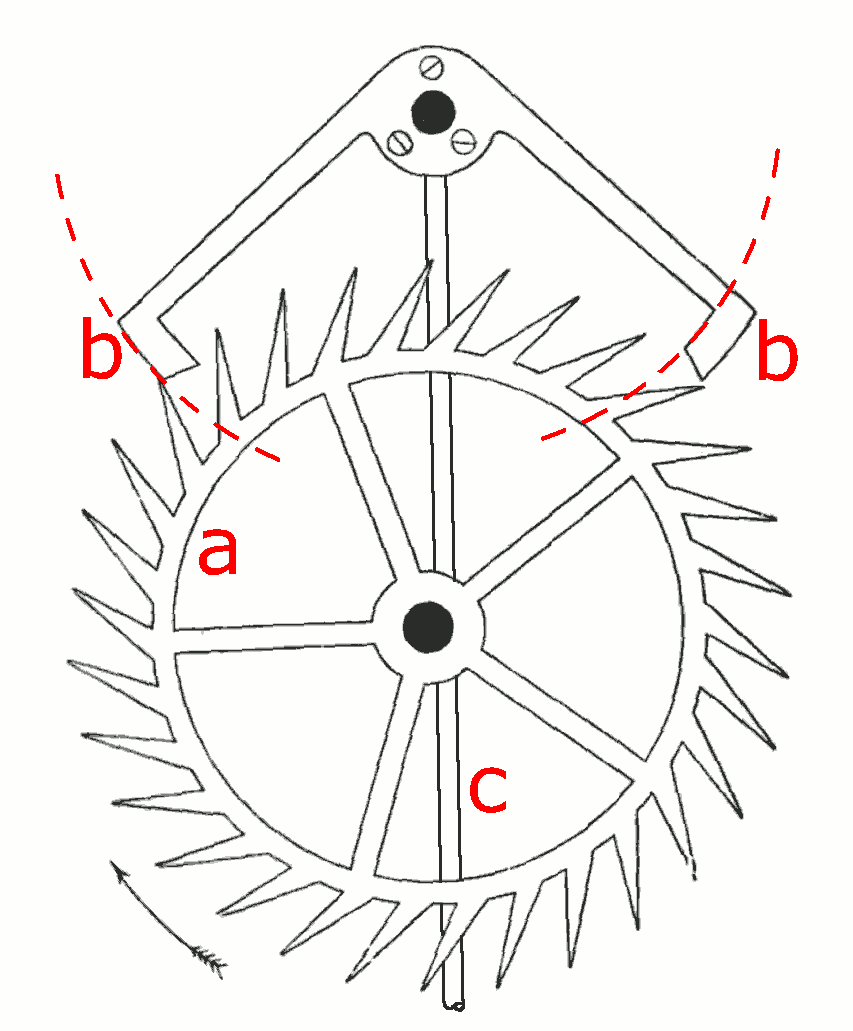


The Deadbeat Escapement
The anchor escapement bought a small pendulum arc, and left one fault behind. After a tooth of the escape wheel lands on a pallet, the pendulum keeps travelling, and because the pallet face is angled it drives the wheel — and the whole gear train, and the weight — backwards.
That recoil is expensive in three separate ways. It wastes the drive. It wears the teeth. And, worst for a timekeeper, it means the pendulum is being pushed on both halves of every swing, so the driving force is meddling with the thing it is supposed to be counting.
Graham's fix is a change of geometry so slight it is hard to see. Each pallet gets two distinct faces: a locking face and an impulse face. The locking face is shaped as an arc centred on the pallet's own pivot — so while the tooth rests on it and the pendulum swings on, the tooth neither advances nor retreats. It is a dead stop, hence deadbeat.
Only during a brief moment at the bottom of the swing does the tooth slide onto the impulse face and give its push, near the pendulum's centre — the point where a disturbance does least harm to the period.
Push at the bottom, and the rest of the time do nothing at all.
Instruksi
See the wheel go backwards
See the wheel go backwards
Take your anchor escapement from the previous blueprint, fix a long paper pointer to the escape wheel, and run it slowly.
Watch one full pendulum swing.
Expect the pointer to step forward, then visibly reverse before the next release.
Measure the reversal as a fraction of one tooth's advance.
Write down what it costs: energy taken from the weight and given back, wear on the teeth, and — the one that matters — a force acting on the pendulum throughout the swing rather than briefly.
Material untuk langkah ini:
 Lembaran tembaga C110 0,025 mm1 lembar
Find the arc that goes nowhere
Find the arc that goes nowhere
On paper, mark the pallet's pivot. Now draw an arc centred exactly on that pivot.
Cut a pallet whose locking face follows that arc, and swing it against a fixed pointer.
Expect the face to slide along the pointer without pushing it either way.
That is the whole trick, and it is pure geometry: a surface that is everywhere the same distance from the pivot presents no slope, so it can hold a tooth without moving it. Draw the locking face from the pivot, not from the wheel.
Cut both faces and watch recoil vanish
Cut both faces and watch recoil vanish
Give each pallet the dead arc for locking and a short angled face for impulse, then run the escapement and watch the pointer again.
Expect the wheel to stop dead and stay stopped during most of the swing, then advance once.
Compare the drive weight needed to keep it going with the anchor's.
Expect it to be less.
Note the trade you have just accepted: the locking faces now slide under load for most of every swing, so they must be hard, smooth and well made or they will wear into recoil anyway. This escapement demands better workmanship than the one it replaces.
Push where it does least harm
Push where it does least harm
Give your pendulum a small identical push at different points in its swing — at the extreme, a quarter of the way, and at the very bottom — and measure the effect on the period each time.
Expect a push at the bottom of the swing to change the period least, and a push near the extremes to change it most.
That result justifies the design. An impulse delivered near the centre mostly adds amplitude; the same impulse near the turning point mostly shifts the timing.
When you must disturb an oscillator, disturb it where it is least sensitive — a rule that turns up again in the detent escapement and in how a modern oscillator is driven.
Measure how little it now cares about the drive
Measure how little it now cares about the drive
Run the deadbeat clock with the drive weight, then with noticeably more, and measure arc and rate. Repeat with the recoil anchor.
Expect the anchor's rate to move clearly with the driving force and the deadbeat's to move much less.
This is the number that mattered to astronomers. A clock whose rate ignores its own drive can be trusted between windings, in winter and summer, as oil ages.
Immunity to your own power source is what makes a measuring instrument out of a machine — the same claim the loading coil and the relay make in their own domains.
History & Context
History & Context
George Graham introduced it around 1715, building on Thomas Tompion's work, and it became the standard for precision regulators for the next two hundred years. Graham also gave away the mercury pendulum without patenting it, and was by all accounts more interested in accurate clocks existing than in owning them — the same posture as Joseph Henry with the relay.
Observatories ran on these. A Graham regulator with a compensated pendulum, in a sealed case at constant temperature, could hold to a fraction of a second a day, and astronomy of the eighteenth and nineteenth centuries was built on such clocks. Transit timings, star catalogues and the determination of longitude on land all depended on a box in a basement doing nothing but ticking honestly.
It did not win everywhere, and that is the interesting part. Domestic clocks kept the recoil anchor, because recoil is forgiving: it damps disturbances and tolerates a rough, dirty train. The deadbeat is more accurate and less tolerant. The same decision recurs whenever a mechanism is asked to leave the laboratory — the precise version needs conditions, the crude version needs nothing.
The endpoint of the argument was to stop touching the pendulum almost entirely. If disturbance is the enemy, impulse less often: the Riefler and then the Shortt free-pendulum clocks of the early twentieth century let a pendulum swing almost undisturbed, with a second slave clock doing the work of driving and counting. The Shortt reached about a second a year — good enough to reveal that the Earth's own rotation is irregular. A clock became accurate enough to catch the standard it was set by.
Honest limits. The locking faces slide under load, so friction there is constant and demands hard, polished pallets — often jewelled. It is unforgiving of poor workmanship and of dirt, and wears into recoil if neglected. It still touches the pendulum every swing. And it does nothing about temperature, barometric pressure or the pendulum suspension itself, all of which limit a regulator long before the escapement does.
Bahan
1- 1 lembarPlaceholder
Bahan cetak biru terhubung
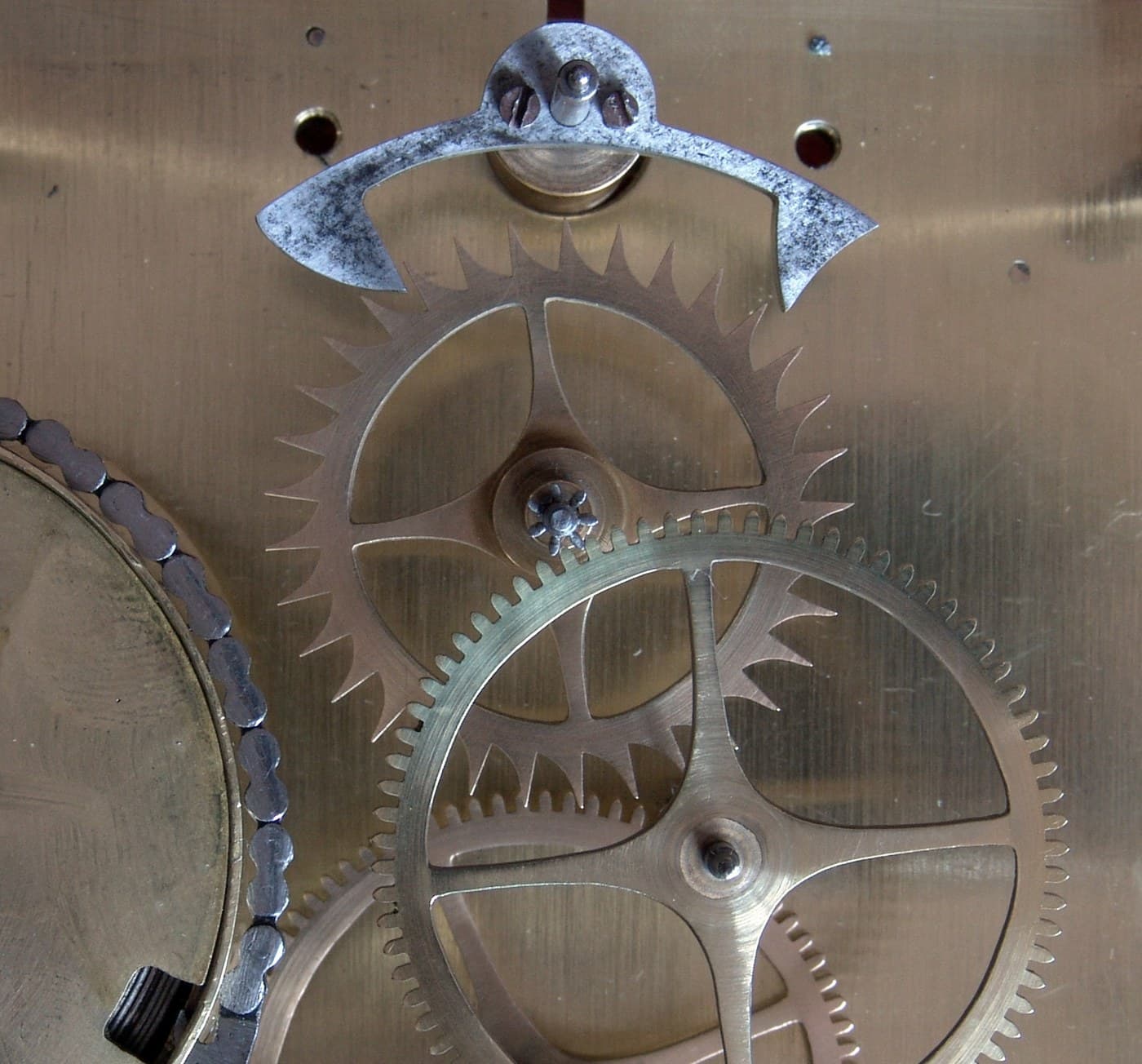

Blueprint terkait
Blueprint ini berbagi pengetahuan — teknik, bahan, atau prinsip

CC0 Domain Publik
Cetak biru ini dirilis di bawah CC0. Anda bebas untuk menyalin, memodifikasi, mendistribusikan, dan menggunakan karya ini untuk tujuan apa pun, termasuk komersial, tanpa meminta izin.
Dukung Maker dengan membeli produk melalui Cetak Biru mereka di mana mereka mendapatkan Komisi Pembuat yang ditetapkan oleh Penjual, atau buat iterasi baru dari Cetak Biru ini dan masukkan sebagai koneksi di milik Anda sendiri.