SENI
KECANTIKAN & KESEHATAN
KERAJINAN
BUDAYA & SEJARAH
HIBURAN
LINGKUNGAN
MAKANAN & MINUMAN
REKAYASA BALIK
ILMU PENGETAHUAN
OLAHRAGA
TEKNOLOGI
PERANGKAT PAKAI
Diterjemahkan


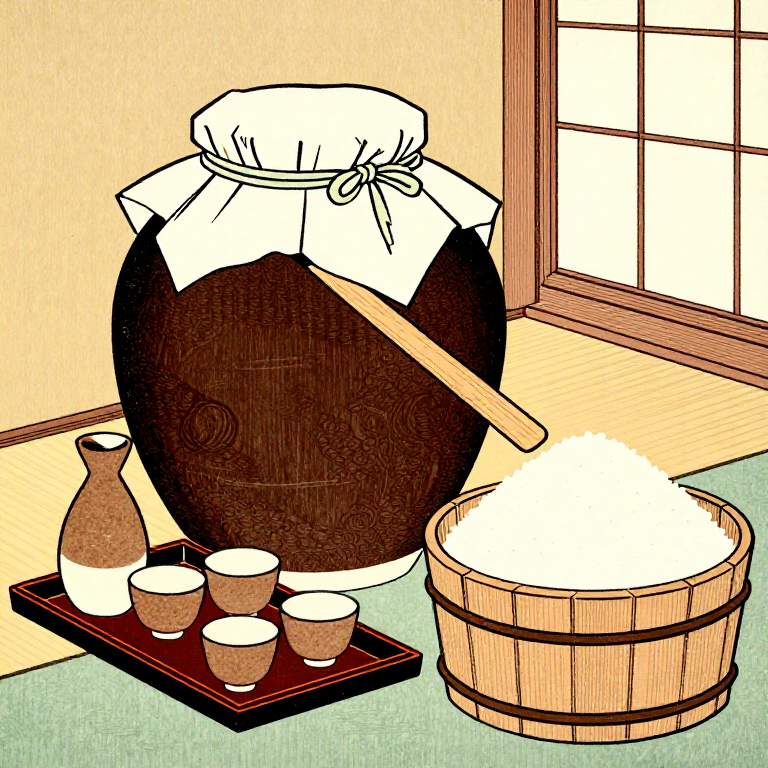
Membuat Sake Wine Beras — Fermentasi Paralel dengan Koji
Membuat sake (nihonshu) menggunakan proses fermentasi paralel unik di mana jamur koji mengubah pati beras menjadi gula sementara ragi secara bersamaan memfermentasi gula tersebut menjadi alkohol, semuanya dalam satu wadah. Proses ini menghasilkan kadar alkohol 18-20%, tertinggi dari semua minuman fermentasi alami.
Lanjutan
3-4 minggu (fermentasi aktif), 2-3 bulan (pematangan)
Instruksi
1
1
Siapkan pemula koji (spora koji + beras kukus)
Siapkan pemula koji (spora koji + beras kukus)
Campurkan spora koji (koji-kin atau kultur koji) dengan beras kukus pada suhu 30–32°C di lingkungan yang hangat dan lembab (kamar koji atau kotak terisolasi dengan lapisan kain basah). Biarkan koji menjajah beras (koji-mai) selama 40–48 jam hingga beras tertutup miselium putih dan berbau manis seperti kastanye. Koji mengubah pati beras menjadi glukosa dan maltosa (koji mengurangi pati → gula). Gunakan 0,5–1 kg koji-mai per batch.
Material untuk langkah ini:
 Beras Jepang berbulir pendek2 kg buah
 Airfor washing and soaking buah
Alat yang dibutuhkan:
 Keranjang kukus
2
2
Buat moromi (bubur utama) — penambahan pertama
Buat moromi (bubur utama) — penambahan pertama
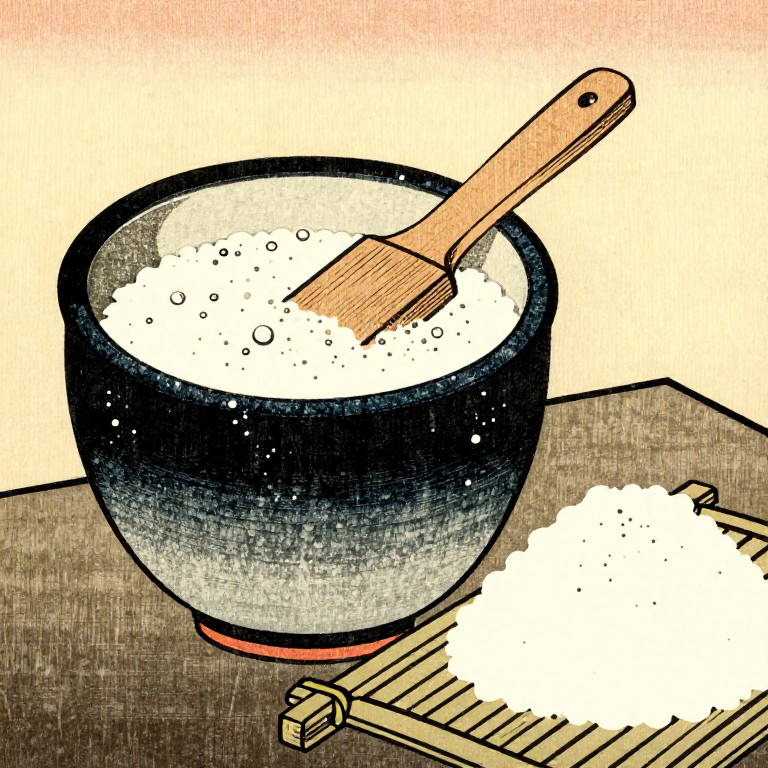
Dalam demijohn kaca bersih atau toples besar, gabungkan: beras kukus (cuci terlebih dahulu untuk menghilangkan pati berlebih), koji-mai, pemula ragi (ragi sake atau ragi anggur, 5–10 g per 10 L), dan air (yang dilunakkan atau suling, pH 6–7). Ini adalah moromi (bubur). Rasio awal (berdasarkan berat): 30% koji-mai, 35% beras kukus, 35% air. Pertahankan pada 18–22°C. Aduk perlahan sekali sehari. Fermentasi paralel dimulai segera: koji melepaskan gula, ragi memfermentasi gula tersebut menjadi alkohol dan CO2. Harapkan aktivitas yang kuat dalam 24–48 jam.
Material untuk langkah ini:
 Beras koji (Aspergillus oryzae)initial portion buah
 Ragi sake1 packet buah
 Asam laktat (mutu pangan)5-10 ml buahAiras needed buah
Alat yang dibutuhkan:
 Wadah fermentasi (galon kaca)
 Termometer Oven
3
3
Beri makan moromi — penambahan bertahap (hari 3–9)
Beri makan moromi — penambahan bertahap (hari 3–9)
Pada hari 3, 6, dan 9, tambahkan lebih banyak beras kukus dan koji-mai (rasio yang sama seperti langkah 2). Penyebaran selama beberapa hari (sandan-jikomi) mencegah syok osmotik dan mempertahankan momentum fermentasi. Setiap penambahan menambahkan enzim segar dan gula yang dapat difermentasi, memperpanjang jendela fermentasi aktif menjadi 2–3 minggu. Aduk perlahan setelah setiap penambahan. Suhu: 18–22°C (lebih dingin = lebih lambat, rasa lebih kompleks; lebih hangat = lebih cepat, hasil lebih kering). Perhatikan tutup koji yang habis dan padatan beras yang naik ke atas — jaga tetap terendam dengan mengaduk atau menutupi dengan kain.
Material untuk langkah ini:
Beras Jepang berbulir pendekremaining batches buahBeras koji (Aspergillus oryzae)remaining portions buahAiras needed buahAlat yang dibutuhkan:
Keranjang kukus4
4
Pantau dan pertahankan fermentasi (hari 10–21)
Pantau dan pertahankan fermentasi (hari 10–21)
Lanjutkan pengadukan lembut harian. Lacak gravitasi spesifik (menggunakan hidrometer jika tersedia): dimulai ~1.060–1.080, turun ke ~1.020 pada hari 14, dan mencapai ~0.990–1.010 pada hari 21 (atau ketika laju gelembung melambat secara dramatis). Bau: harapkan aroma koji manis di awal, kemudian aroma alkohol saat ragi mengambil alih. Jika jamur (hijau, oranye, atau merah muda) muncul, buang batch — sake sensitif terhadap kontaminan. Jaga suhu tetap stabil (18–22°C). Setelah hari 14–21, fermentasi akan melambat — koji akan hampir habis dan sebagian besar gula diubah menjadi alkohol (potensi 18–20% ABV).
Alat yang dibutuhkan:
 Penyekat udara fermentasiTermometer Oven
 Hidrometer
5
5
Tekan & matangkan (minggu 3–12)
Tekan & matangkan (minggu 3–12)
Setelah fermentasi hampir berhenti (hari ke-21 dan seterusnya, SG ~0.990–1.010), saring padatan melalui kain tipis atau saringan halus. Tekan dengan lembut untuk mengekstrak cairan (sake), buang koji yang habis dan padatan beras. Transfer sake ke botol kaca bersih atau demijohn dan tutup dengan longgar (tutup dengan kain) untuk memungkinkan CO2 yang tersisa untuk keluar. Biarkan matang pada suhu ruangan yang sejuk (15–18°C) selama 2–3 bulan. Selama pematangan, rasa melemah, warna sedikit lebih dalam (emas pucat), dan rasa yang tidak diinginkan menghilang. Setelah pematangan, botolkan dalam kaca gelap untuk melindungi dari cahaya. Alkohol akhir: 18–20%. Sajikan dengan es (5–10°C). Daya tahan rak: 1–2 tahun disegel, lebih lama jika didinginkan.
Alat yang dibutuhkan:
 Kain Muslin KejuTermometer Oven
Bahan
5- 2 kg buahPlaceholder
- for washing and soaking buahPlaceholder
- initial portion buahPlaceholder
- 1 packet buahPlaceholder
- 5-10 ml buahPlaceholder
Alat yang Diperlukan
7- Placeholder
- Placeholder
- Placeholder
- Placeholder
- Placeholder
- Placeholder
- Placeholder
Cetak biru ini membuat


CC0 Domain Publik
Cetak biru ini dirilis di bawah CC0. Anda bebas untuk menyalin, memodifikasi, mendistribusikan, dan menggunakan karya ini untuk tujuan apa pun, termasuk komersial, tanpa meminta izin.
Dukung Maker dengan membeli produk melalui Cetak Biru mereka di mana mereka mendapatkan Komisi Pembuat yang ditetapkan oleh Penjual, atau buat iterasi baru dari Cetak Biru ini dan masukkan sebagai koneksi di milik Anda sendiri.