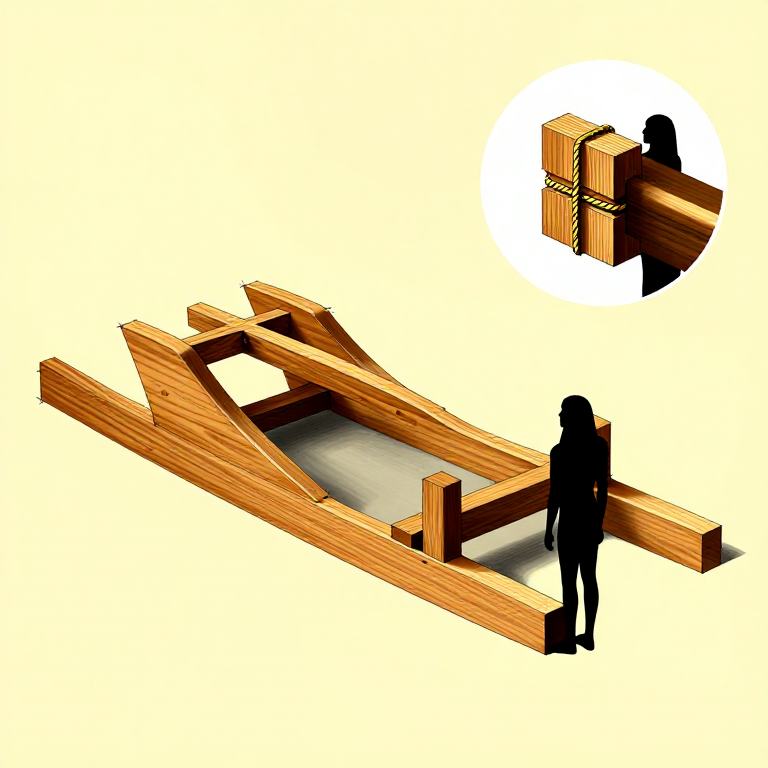


Egyptian Ramp Sledge — Building a Wooden Sledge for Stone Transport
Instruksi
Shape the Runner Beams
Shape the Runner Beams
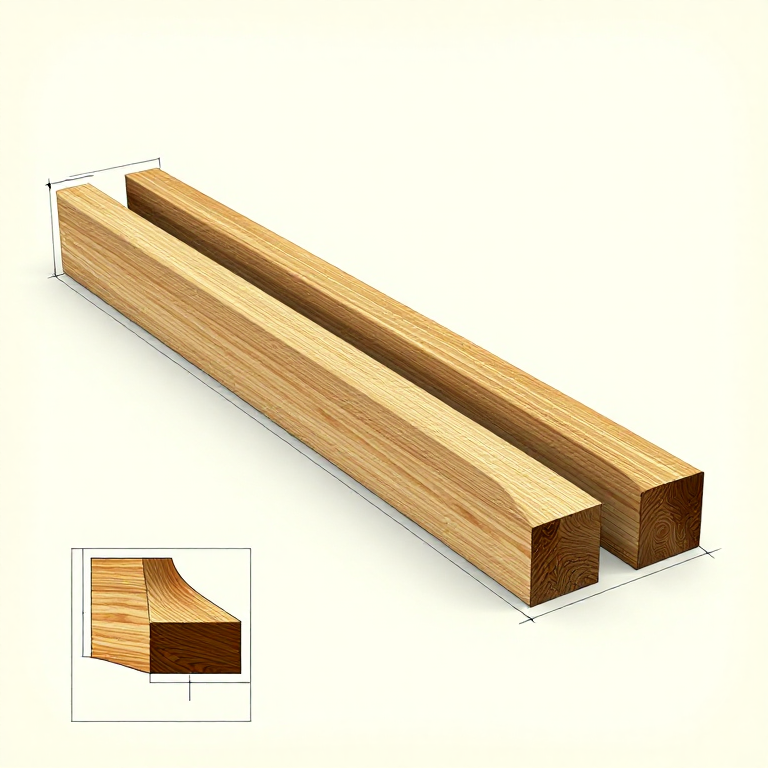
Select two straight-grained hardwood planks for the runners. Ancient Egyptians preferred native acacia (Acacia nilotica) or imported cedar from Lebanon for structural woodworking. Shape each runner to approximately 150 cm long, 20 cm wide, and 8 cm thick. The front ends should be cut to a gentle upward curve (approximately 15-20 degrees over the last 20 cm) to prevent the sledge from digging into sand or catching on obstacles. Smooth the bottom surfaces with an adze or plane to reduce friction — the smoother the runner surface, the less force required to drag the loaded sledge. The surviving Deir el-Bahari sledge (now in the Cairo Museum) shows this characteristic upturned front profile.
Cut Mortise Joints in the Runners
Cut Mortise Joints in the Runners
Mark the positions for 4-6 cross-beams evenly spaced along the length of both runners. At each position, cut a rectangular mortise (slot) approximately 10 cm wide, 8 cm deep, and 4 cm in the direction of the runner length. Use a chisel and mallet to chop out the waste wood, keeping the mortise walls clean and square. Egyptian woodworkers were master joiners despite the scarcity of large timber in the Nile Valley — they developed sophisticated mortise-and-tenon joints, dovetails, and butterfly joints to maximize the use of small and irregular pieces of native acacia. Ensure all mortises are aligned precisely so the cross-beams will sit square to the runners.
Fit the Cross-Beams with Tenons
Fit the Cross-Beams with Tenons
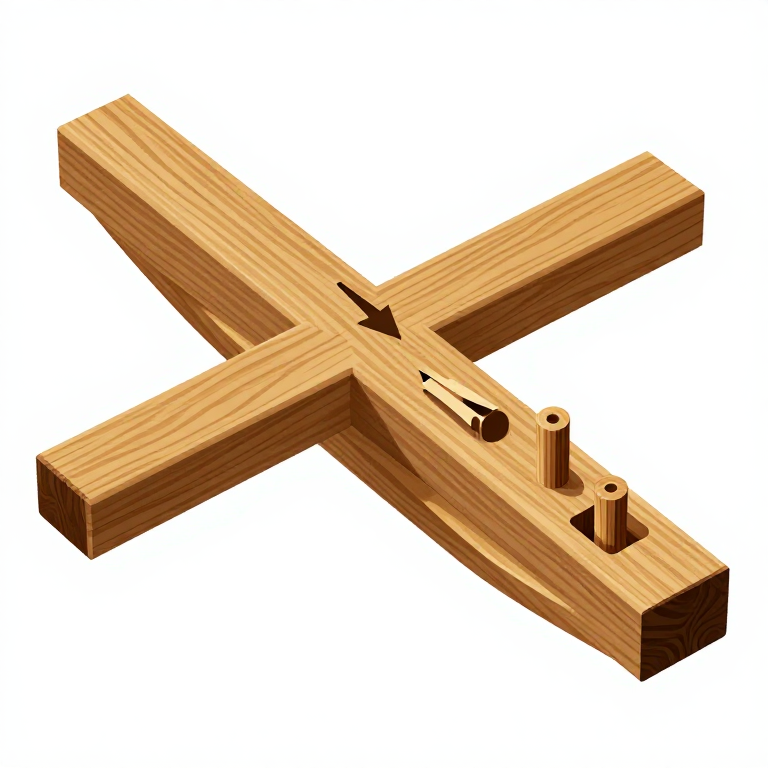
Cut tenons on both ends of each cross-beam to match the mortises in the runners. Each tenon should be a snug friction fit — tight enough to hold but not so tight it splits the runner. The cross-beams should protrude slightly (2-3 cm) beyond the outer face of each runner to provide anchor points for the lashing ropes that secure the cargo. Dry-fit all joints before final assembly. Drill a hole through each mortise-and-tenon joint for a wooden locking peg. This peg prevents the tenon from pulling out under the enormous lateral forces generated when dragging heavy stone blocks. The basic frame should now resemble a flat ladder lying on its side.
Assemble and Peg the Frame
Assemble and Peg the Frame
Assemble the sledge by inserting all cross-beam tenons into their corresponding mortises in both runners simultaneously. Drive the wooden locking pegs through the pre-drilled holes to secure each joint. The pegs should be made from a hard, dense wood and driven in firmly with a mallet. Do not use glue — Egyptian heavy-duty construction relied entirely on mechanical joints and rope lashing for structural integrity. Check that the assembly sits flat on a level surface without rocking. If one runner is higher than the other, trim the bottom of the high runner until both sit evenly. The frame must be rigid and flat to distribute the load of heavy stone blocks evenly.
Material untuk langkah ini:
 Hardwood Ash2 planks, each 150x20x8 cm for runners buah
 Rope15-20 m m
Add Rope Lashing and Hauling Points
Add Rope Lashing and Hauling Points
Wrap strong rope tightly around each mortise-and-tenon joint in a figure-eight pattern to reinforce the mechanical connection. Egyptian rope was typically made from halfa grass, palm fiber, or flax, and was remarkably strong — tested replicas of ancient Egyptian rope have sustained loads exceeding 500 kg. Attach hauling ropes to the front of the sledge through holes drilled in the upturned runner tips, or by lashing to the front cross-beam. A painting in the tomb of Djehutihotep at Deir el-Bersha (circa 1880 BCE) shows 172 workers hauling a colossal statue on a sledge while one worker pours water ahead of the runners. Experimental studies confirm that wetting sand in front of the runners reduces sliding friction by approximately 50 percent by stiffening the sand surface.
Bahan
4- 2 planks, each 150x20x8 cm for runners buahPlaceholder
- 15-20 m mPlaceholder
- 4-6 beams, each 60x10x8 cm buahPlaceholder
- 12-16 pieces, 2 cm diameter, 12 cm long buahPlaceholder
Alat yang Diperlukan
5- Placeholder
- Placeholder
- Placeholder
- Placeholder
- Placeholder
CC0 Domain Publik
Cetak biru ini dirilis di bawah CC0. Anda bebas untuk menyalin, memodifikasi, mendistribusikan, dan menggunakan karya ini untuk tujuan apa pun, termasuk komersial, tanpa meminta izin.
Dukung Maker dengan membeli produk melalui Cetak Biru mereka di mana mereka mendapatkan Komisi Pembuat yang ditetapkan oleh Penjual, atau buat iterasi baru dari Cetak Biru ini dan masukkan sebagai koneksi di milik Anda sendiri.