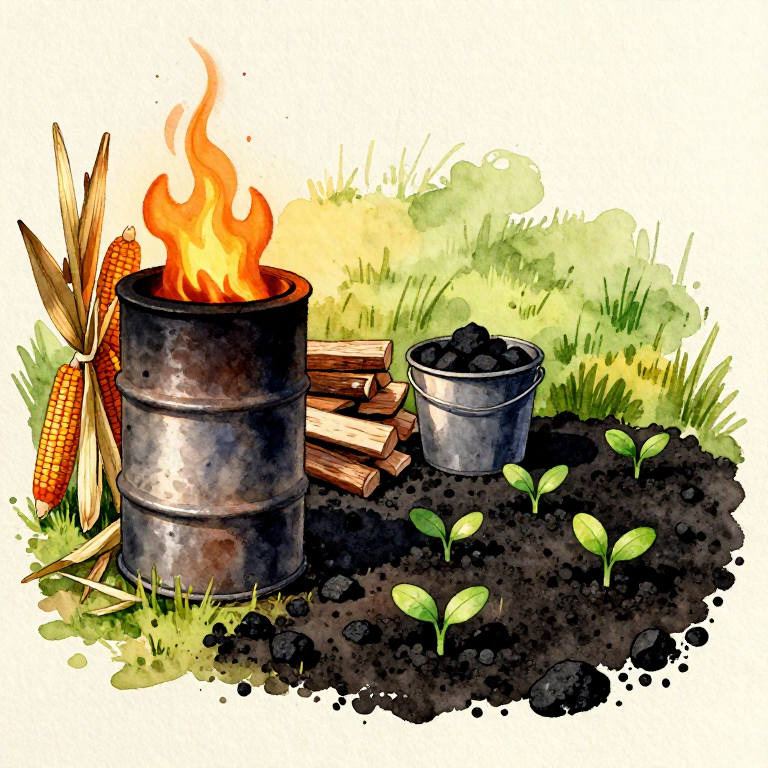


Membuat Biochar dari Limbah Pertanian — Sekuestrasi Karbon yang Dapat Anda Pegang
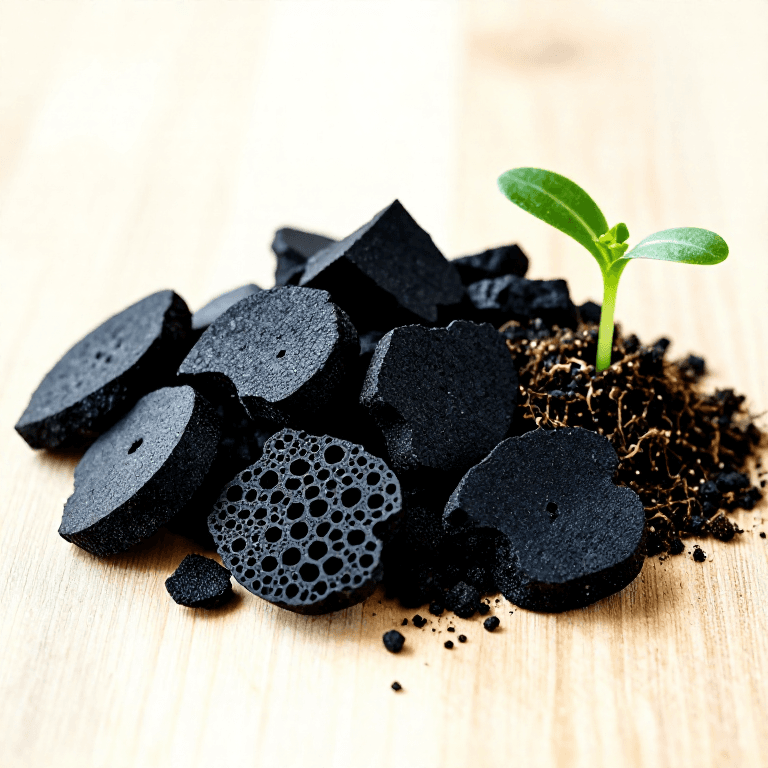
Biochar is charcoal produced specifically for soil amendment rather than fuel. When agricultural waste (wood chips, corn stalks, nut shells, prunings) is heated in the absence of oxygen (pyrolysis), the volatile organic compounds burn off as gas, leaving behind a porous carbon skeleton that is extraordinarily stable — biochar persists in soil for hundreds to thousands of years, effectively locking atmospheric carbon into a solid form.
The concept is ancient. The terra preta (dark earth) soils of the Amazon basin, created by indigenous peoples over 2,500 years ago, still contain abundant charcoal that continues to improve soil fertility today. Modern biochar research rediscovered this practice and demonstrated that biochar improves soil water retention, nutrient holding capacity, microbial habitat, and crop yields — while simultaneously sequestering carbon.
Unlike industrial carbon capture, biochar can be made by anyone with agricultural waste and a simple kiln. The process converts a disposal problem (crop residues that would otherwise decompose and release CO₂) into a permanent soil improvement. Each kilogram of biochar sequesters approximately 2.5-3 kg of CO₂ equivalent.
Instruksi
Pilih dan siapkan umpan
Pilih dan siapkan umpan
Almost any dry organic material can be converted to biochar: wood chips, prunings, nut shells, corn cobs and stalks, straw, bamboo, coconut husks, coffee grounds, or fruit pits. The key requirement is that the feedstock must be dry — moisture wastes energy that should go into pyrolysis. Aim for less than 20% moisture content.
Cut or break feedstock into relatively uniform pieces (5-15 cm for wood, smaller for crop residues). Uniform size ensures even pyrolysis — oversized pieces leave an undercooked center while small pieces turn to ash. Avoid treated wood, painted material, or anything containing plastics or chemicals — these produce toxic emissions and contaminated biochar.
Alat yang dibutuhkan:
 Kacamata Pelindung Tertutup
 Parang
Bangun kiln TLUD (tiupan ke atas berlampu atas)
Bangun kiln TLUD (tiupan ke atas berlampu atas)
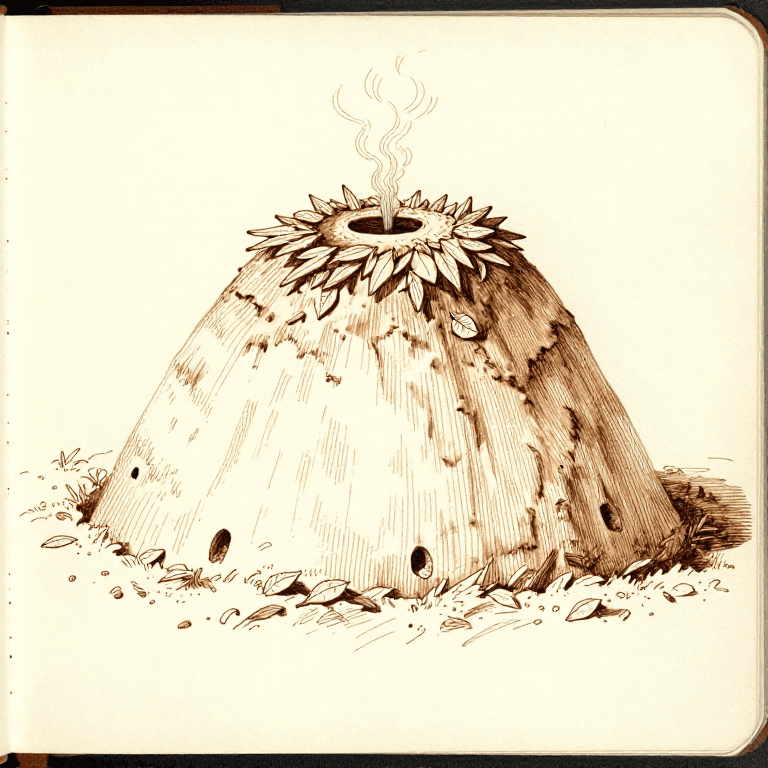
The simplest effective biochar kiln is the TLUD (Top-Lit UpDraft) design — a metal barrel or drum with air holes at the bottom and a restricted opening at the top. The principle: fire is lit on top of the feedstock and burns downward, pyrolyzing the material below while the updraft carries combustible gases upward through the flame front, where they burn cleanly.
Take a 200-liter steel drum: punch or drill 15-20 holes (2 cm diameter) around the base for primary air intake. Place the drum on three bricks or stones for air circulation underneath. Fill with dry feedstock, leaving 10 cm headspace. For the chimney, use a smaller drum or metal sheet as a concentrator on top — this improves combustion of the pyrolysis gases and reduces smoke dramatically.
Material untuk langkah ini:
 Drum baja (200 liter)1 buah
 Bata3 buah
Alat yang dibutuhkan:
Kacamata Pelindung Tertutup Sarung Tangan Karet Nitril
 Bor listrik berkabel
Nyalakan kiln dan kelola pembakaran
Nyalakan kiln dan kelola pembakaran
Light a small fire on top of the feedstock using kindling and paper. Once the surface is burning well, place the chimney concentrator on top. Within 10-15 minutes, you should see the pyrolysis gases igniting — clean flames appearing above the feedstock that burn with a blue or yellow color and very little smoke. Heavy white smoke indicates incomplete combustion and waste of the volatile gases.
The burn progresses downward through the feedstock at approximately 5-10 cm per hour, depending on feedstock density and moisture. The pyrolysis front is visible as a glowing zone moving down through the char. The process is self-sustaining once established — the heat from burning pyrolysis gases drives the pyrolysis of material below. A full 200-liter drum takes 2-4 hours.
Alat yang dibutuhkan:
 Penjepit KowiKacamata Pelindung Tertutup
Padamkan biochar
Padamkan biochar
When the pyrolysis front reaches the bottom of the drum (visible by the glow reaching the air holes and the cessation of pyrolysis gas flames at the top), the biochar must be quenched immediately with water. Without quenching, the char continues to burn and converts to ash — you want carbon, not ash.
Pour water over the top until the hissing stops and no more steam rises. Alternatively, seal the drum (close all air holes with mud or metal plates, place a lid on top) and allow it to cool overnight without air. Both methods work — water quenching is faster but produces wet biochar that needs drying; sealing preserves dry char but requires patience. A successful burn yields 20-30% of the original feedstock weight as biochar.
Alat yang dibutuhkan:
 EmberKacamata Pelindung Tertutup
Hancurkan dan isi biochar
Hancurkan dan isi biochar
Good biochar is black, lightweight, porous, and rings with a metallic sound when pieces are tapped together. It should be completely black throughout — any brown or uncharred centers indicate incomplete pyrolysis. Crush the biochar to 1-5 cm pieces for soil application (a shovel in a bucket works well).
Raw biochar should be 'charged' before adding to soil. Uncharged biochar initially absorbs nutrients from the soil, temporarily reducing fertility. Charging saturates the biochar's pore structure with nutrients. Simple method: soak crushed biochar in compost tea, dilute urine (1:10 with water), or liquid fertilizer for 24-48 hours. The porous structure absorbs the nutrient solution, and when added to soil, releases it slowly to plant roots while providing habitat for beneficial soil microorganisms.
Material untuk langkah ini:
 Kompos5 kg
Alat yang dibutuhkan:
Ember Sekop
SekopTerapkan biochar ke tanah
Terapkan biochar ke tanah
Apply charged biochar at 5-10% by volume of the top 15-20 cm of soil. Mix thoroughly — biochar sitting on the surface blows away and doesn't interact with the root zone. For garden beds: spread 1-2 cm of crushed, charged biochar over the surface and dig it in with a fork or tiller. For potting mix: replace 10-15% of the compost component with charged biochar.
The effects are permanent. Unlike compost (which decomposes in 1-3 years), biochar remains in the soil for centuries, continuing to improve water retention, cation exchange capacity, and microbial habitat. Each application builds on the previous one — the Amazonian terra preta soils that inspired modern biochar research received charcoal inputs over hundreds of years and remain the most fertile soils in the Amazon today, 2,500 years after their creators abandoned them.
Alat yang dibutuhkan:
SekopBahan cetak biru terhubung

Blueprint terkait
Blueprint ini berbagi pengetahuan — teknik, bahan, atau prinsip

CC0 Domain Publik
Cetak biru ini dirilis di bawah CC0. Anda bebas untuk menyalin, memodifikasi, mendistribusikan, dan menggunakan karya ini untuk tujuan apa pun, termasuk komersial, tanpa meminta izin.
Dukung Maker dengan membeli produk melalui Cetak Biru mereka di mana mereka mendapatkan Komisi Pembuat yang ditetapkan oleh Penjual, atau buat iterasi baru dari Cetak Biru ini dan masukkan sebagai koneksi di milik Anda sendiri.