SENI
KECANTIKAN & KESEHATAN
KERAJINAN
BUDAYA & SEJARAH
HIBURAN
LINGKUNGAN
MAKANAN & MINUMAN
REKAYASA BALIK
ILMU PENGETAHUAN
OLAHRAGA
TEKNOLOGI
PERANGKAT PAKAI
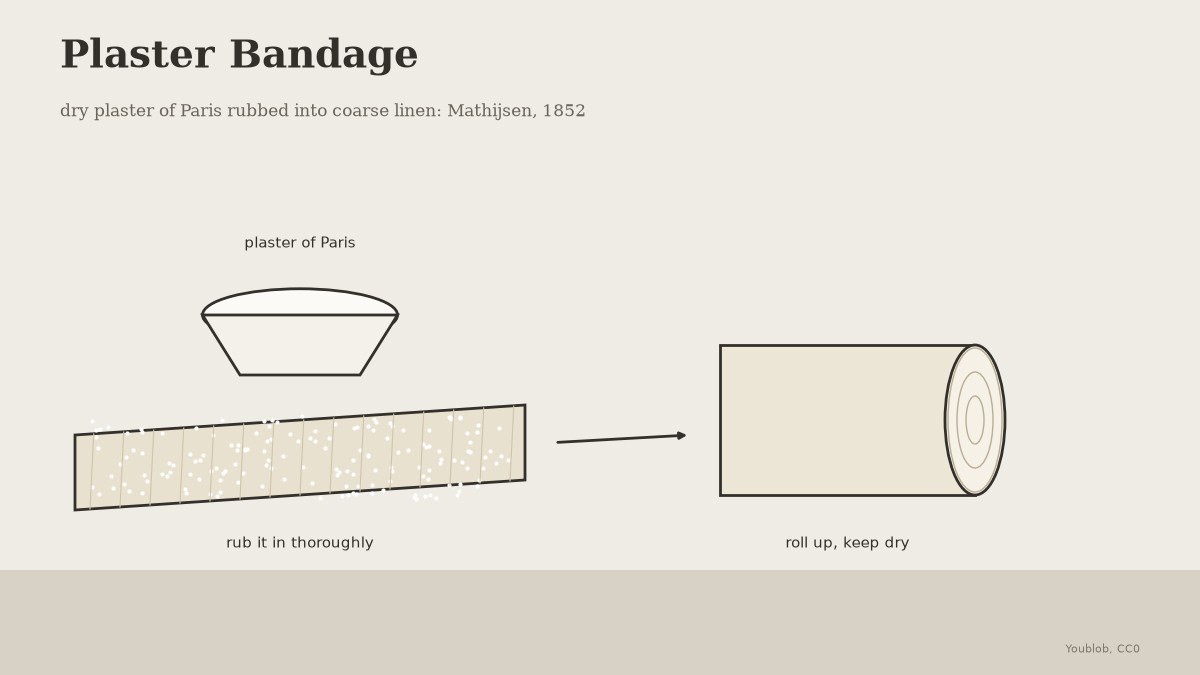


Plaster Bandage: Dry Plaster of Paris Rubbed into Coarse Linen, Mathijsen 1852
The plaster bandage of the Dutch army surgeon Antonius Mathijsen (1852): coarse linen with dry plaster of Paris rubbed well into it. Wetted as it goes on and rubbed by hand, it sets hard within minutes. Until 1931 hospitals made their own this way.
The picture: our own drawing.
Pemula
1 hour
Instruksi
1
1
Cut coarse linen strips
Cut coarse linen strips
Cut a coarsely woven linen into long strips, bandage width.
Material untuk langkah ini:
 Kain linen1 sqm
Alat yang dibutuhkan:
 Gunting kain
2
2
Rub the plaster in
Rub the plaster in
Lay a strip flat and rub dry plaster of Paris thoroughly into the weave, working along its length. Do it slowly so the dust stays down.
Material untuk langkah ini:
 Gips (Plaster of Paris)500 g
Alat yang dibutuhkan:
 Mangkuk
 Masker respirator N95
3
3
Roll and keep dry
Roll and keep dry
Roll each strip loosely and store it closed and dry: any damp sets the plaster. To use, wet it as it goes on and rub it smooth by hand.
Alat yang dibutuhkan:
 Toples Kaca Bertutup
Bahan
2- 1 sqmPlaceholder
- Placeholder
Alat yang Diperlukan
4- Placeholder
- Placeholder
- Placeholder
- Placeholder
Cetak biru ini membuat

CC0 Domain Publik
Cetak biru ini dirilis di bawah CC0. Anda bebas untuk menyalin, memodifikasi, mendistribusikan, dan menggunakan karya ini untuk tujuan apa pun, termasuk komersial, tanpa meminta izin.
Dukung Maker dengan membeli produk melalui Cetak Biru mereka di mana mereka mendapatkan Komisi Pembuat yang ditetapkan oleh Penjual, atau buat iterasi baru dari Cetak Biru ini dan masukkan sebagai koneksi di milik Anda sendiri.