Kolaborasi
SENI
KECANTIKAN & KESEHATAN
KERAJINAN
BUDAYA & SEJARAH
HIBURAN
LINGKUNGAN
MAKANAN & MINUMAN
REKAYASA BALIK
ILMU PENGETAHUAN
OLAHRAGA
TEKNOLOGI
PERANGKAT PAKAI
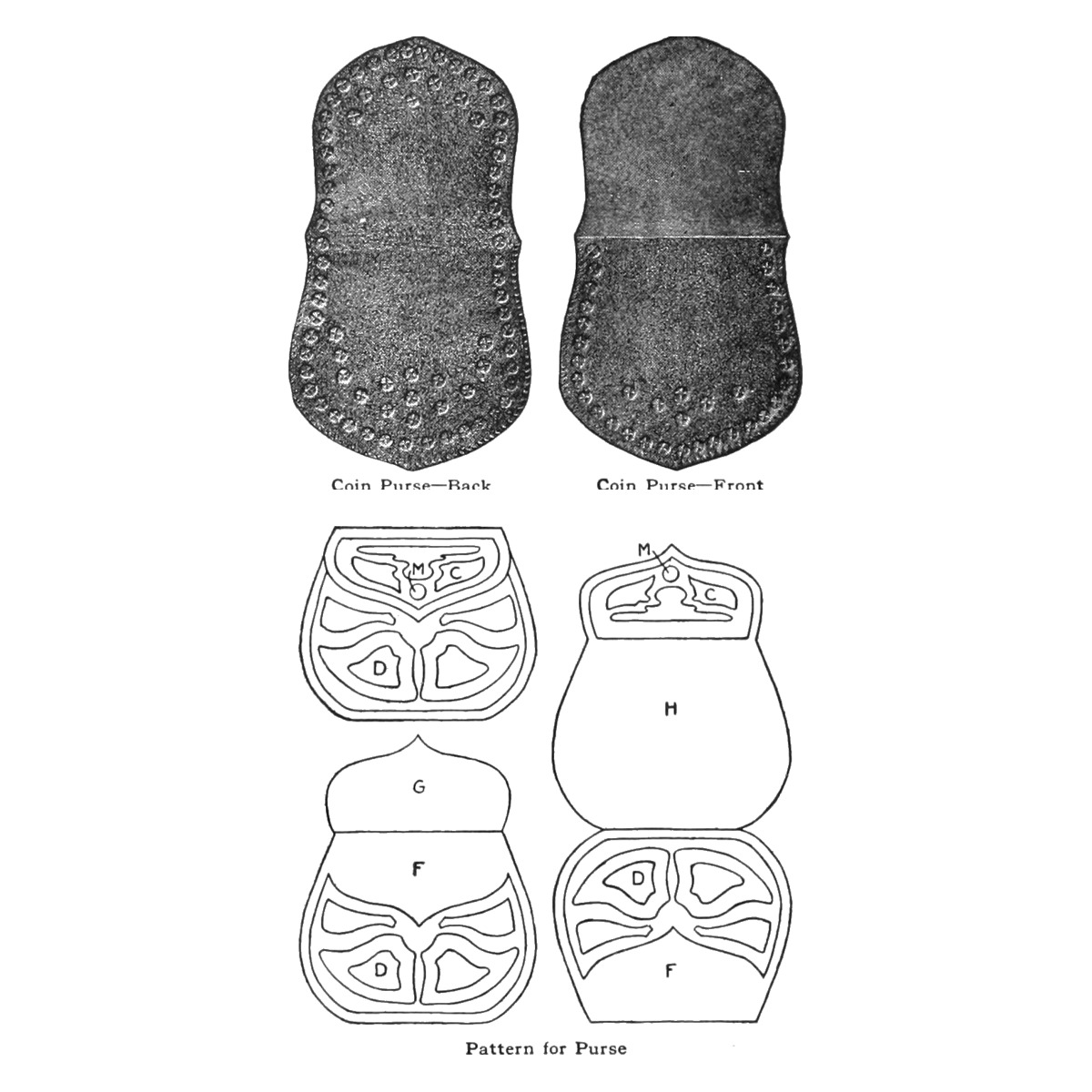


Tooled Calfskin Coin Purse: Lined, Flap Over Front, Design Split Between Flap and Front (Boy Mechanic, 1915)
The first piece in Mary C. Scovel's leather course (The Boy Mechanic, Book 2, 1915): a coin purse of Russian calfskin from a 4 by 8 in piece, its design traced, lined and tooled or stamped, split so half sits on the flap and half on the front below it, then lined with silk and stitched.
Pemula
About 3 hours
Instruksi
1
1
Her sizes in centimetres
Her sizes in centimetres
Memuat notebook Jupyter…
2
2
Read The Boy Mechanic, Book 2
Read The Boy Mechanic, Book 2
Her outfit: "two special tools costing 50 cents each, one with a narrow edge for lining patterns, and one with broad ends for tooling; and a piece of tin, plate glass, or very smooth hard wood, which should not be smaller than 9 by 12 in. A soft sponge, a triangle, a rule, tracing paper and a hard pencil are also needed." Russian calfskin is best for tooling and stamping.
3
3
Make the paper pattern
Make the paper pattern
The purse has three parts: front, back and flap. Fold paper to the proportions you want, with the design for the front D on the same side of the paper as the flap C; the space F under the flap has no design. Fold F behind H, then C behind H and F, and turn the pattern over to see the purse. Cut a piece of leather 4 by 8 in, which leaves 1/4 in outside the pattern for pinning.
Material untuk langkah ini:
 Kulit anak sapi1 buah
Alat yang dibutuhkan:
 Kertas kalkir
 Pensil
 Gunting
 Penggaris
4
4
Damp the leather and transfer the design
Damp the leather and transfer the design
Draw the whole design for the purse on tracing paper. Wet the leather on the wrong (unfinished) side with a soft sponge: pat it to moisten, not soak, it; too wet and the tool sticks and leaves an uneven background. Pin the design firmly on the leather, tack the leather down on its outer margin to the glass or board, and go over every line with a hard pencil, with firm, even pressure. Lift the paper and go over the lines with the narrow lining tool, with a strong, firm stroke. A line design can stop here.
Material untuk langkah ini:
Kulit anak sapi1 buahAlat yang dibutuhkan:
 Bunga karangKertas kalkirPensil
 Paku payung (kotak isi 50)
 Lembaran kaca
 Alat ukir kulit
5
5
Tool or stamp the background
Tool or stamp the background
Leave at least 1/8 in between the edge of the pattern and the design. To tool, press the background down with the broad end in even, long strokes; if it will not go down, the leather is too dry, so take it off and damp the back again. Keep the edges sharp between pressed and raised parts. To stamp instead, strike a small carpenter's nail set lightly with a wooden mallet in rows of circles; too hard a blow cuts the leather.
Alat yang dibutuhkan:
Alat ukir kulit Penenggelam paku
 Palu KayuBunga karang
6
6
Line and stitch
Line and stitch
Fold the parts together, line with silk to match the leather, and stitch the front and back parts close to the edge. Stitch on a sewing machine with a long stitch, a large needle and silk as heavy as the needle takes; try it on a scrap first, and put tissue paper over the leather if the foot marks it. Without a machine, prick holes with an awl and sew with needle and silk, running or over-and-over; going over-and-over to the end and back gives an X stitch. She has the catch M put on by a shoemaker or trunk store; a snap fastener is used here.
Material untuk langkah ini:
 Kain Sutra1 buah
 Benang jahit sutra1 buah
 Lem kanji terigu1 buah
 Kancing jepret1 buah
Alat yang dibutuhkan:
Gunting Mesin jahit
 Penusuk (Uncek)
 Dua jarum pelana
7
7
Troubleshooting
Troubleshooting
Tooled leather troubleshooting.
Flow
Loading...
8
8
History and honest limits
History and honest limits
From Mary C. Scovel, "Arts-Crafts Leather Work", in **The Boy Mechanic, Book 2**, Popular Mechanics, 1915 (Project Gutenberg 44585; checked on the archive.org scan boymechanicbook200chic2, pp. 432-441), Part I. She gives the piece size but no finished purse size; the shape comes from her pattern. The snap fastener, tools and metric figures are ours.
Bahan
5- 2 buahPlaceholder
- 1 buahPlaceholder
- 1 buahPlaceholder
- 1 buahPlaceholder
- 1 buahPlaceholder
Alat yang Diperlukan
13- Placeholder
- 1 vendor sell this, none ship to you yetPlaceholder
- Placeholder
- Placeholder
- Placeholder
- Placeholder
- Placeholder
- Placeholder
- Placeholder
- Placeholder
- Placeholder
- Placeholder
- Placeholder
Cetak biru ini membuat
Blueprint terkait
Blueprint ini berbagi pengetahuan — teknik, bahan, atau prinsip
CC0 Domain Publik
Cetak biru ini dirilis di bawah CC0. Anda bebas untuk menyalin, memodifikasi, mendistribusikan, dan menggunakan karya ini untuk tujuan apa pun, termasuk komersial, tanpa meminta izin.
Dukung Maker dengan membeli produk melalui Cetak Biru mereka di mana mereka mendapatkan Komisi Pembuat yang ditetapkan oleh Penjual, atau buat iterasi baru dari Cetak Biru ini dan masukkan sebagai koneksi di milik Anda sendiri.