Peleburan Tembaga dari Malasit — Dari Bijih Hijau ke Logam Merah
Instruksi
Memahami kimia
Memahami kimia
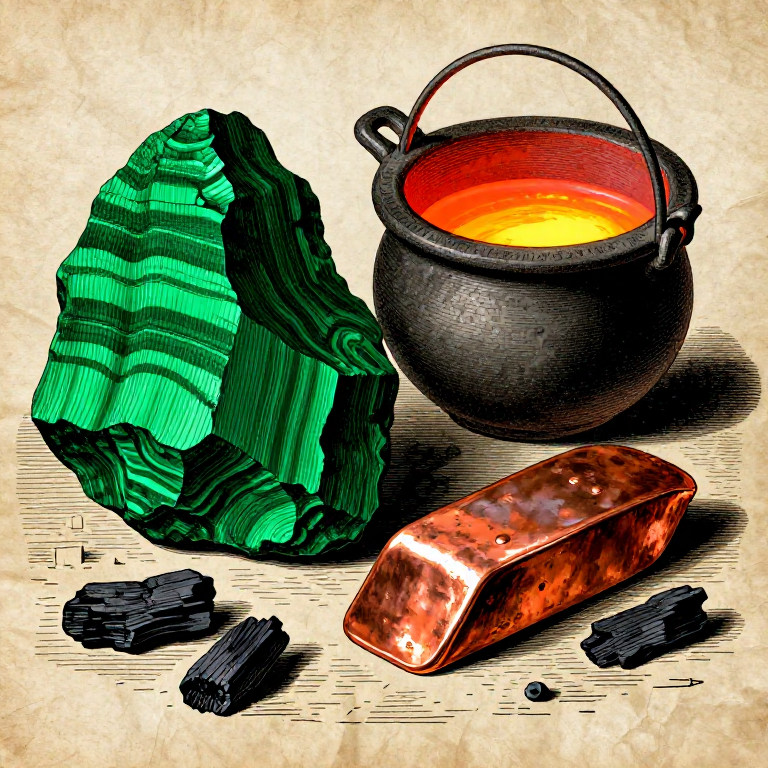
Malasit terdekomposisi saat dipanaskan: Cu₂CO₃(OH)₂ → 2CuO + CO₂ + H₂O (pada ~300°C). Oksida tembaga yang dihasilkan (CuO) kemudian direduksi oleh karbon monoksida dari pembakaran arang: CuO + CO → Cu + CO₂. Tembaga melebur pada 1085°C. Total hasil tembaga murni dari malasit murni adalah sekitar 57,5%.
Crush the malachite
Crush the malachite
Break malachite into pieces smaller than 1 cm using a hammer and anvil. The finer the crush, the faster and more complete the reduction. Use a mortar and pestle for the final crush if available. Aim for pea-sized or smaller fragments.
Material untuk langkah ini:
 Bijih malakit2 kilogram
Alat yang dibutuhkan:
 Palu Geologi
 Lumpang dan Alu
Prepare the crucible
Prepare the crucible
Use a clay crucible that can withstand 1200°C+. A graphite-clay crucible is ideal. The crucible should hold at least 500 ml. If making your own, mix fireclay with sand (2:1 ratio) and fire it slowly in a kiln to 1000°C before use. Pre-fired crucibles crack less.
Material untuk langkah ini:
 Kowi Tanah Liat Tahan Api1 buah
Layer ore and charcoal in the crucible
Layer ore and charcoal in the crucible
Place a 2 cm layer of charcoal pieces at the bottom of the crucible. Add a layer of crushed malachite (2-3 cm). Top with another layer of charcoal. The charcoal both provides carbon for reduction and protects the copper from re-oxidation. Fill to about 2/3 full.
Material untuk langkah ini:
 Arang Bongkahan5 kilogram
Build or prepare the forge
Build or prepare the forge
You need a forge or furnace capable of reaching 1100-1200°C. A simple charcoal forge with forced air (bellows or blower) works well. The crucible sits in a bed of burning charcoal with additional charcoal piled around and above it. The air supply must be controllable.
Material untuk langkah ini:
 Cakram arang20 kilogram
Alat yang dibutuhkan:
 Ubub (Pengembus)
Put on safety equipment
Put on safety equipment
Copper smelting involves extreme heat, toxic fumes, and molten metal. Wear: leather apron, leather gauntlet gloves, face shield, safety boots (no synthetic materials). Work outdoors or in a well-ventilated space. Copper oxide fumes cause metal fume fever if inhaled. Keep a bucket of dry sand nearby for spill containment.
Alat yang dibutuhkan:
 Celemek Kulit
 Sarung Tangan Kulit Lengan Panjang
 Pelindung Wajah
 Ember pasir kering
Light the forge and preheat
Light the forge and preheat
Light the forge charcoal and bring it to full heat over 30-45 minutes with gentle bellows action. Place the loaded crucible into the forge once the coals are glowing white-hot. Pack charcoal tightly around the crucible. Increase bellows speed gradually.
Maintain temperature for 2-3 hours
Maintain temperature for 2-3 hours
Keep the forge at 1100-1200°C for 2-3 hours. The malachite first decomposes (green changes to black CuO at ~300°C), then the CuO reduces to copper as temperature climbs. Add charcoal to the forge as needed to maintain heat. The crucible contents will shrink as CO₂ gas escapes.
Check for completion
Check for completion
After 2-3 hours, carefully lift the crucible lid with tongs and peek inside. You should see a bright orange-red pool of molten copper beneath a layer of slag (glassy dark material). If you see unmelted green or black chunks, continue heating for another 30 minutes.
Alat yang dibutuhkan:
 Tang Bergagang Panjang
Prepare the ingot mold
Prepare the ingot mold
While the copper melts, prepare a sand mold or a flat stone depression for pouring. Preheat the mold with a torch to prevent thermal shock cracking. A simple bar-shaped mold carved into a sandstone block works well. Ensure the mold is completely dry — any moisture causes explosive splattering of molten metal.
Alat yang dibutuhkan:
 Cetakan batangan dari batu pasir
Pour the copper
Pour the copper
Using crucible tongs, lift the crucible from the forge. Tilt slowly to pour molten copper into the mold. The dark glassy slag floats on top and can be held back with a stick while the copper flows under it. Pour steadily — interrupted pours create cold shuts (weak seams).
Alat yang dibutuhkan:
 Penjepit Kowi
Let the ingot cool
Let the ingot cool
Allow the copper ingot to cool in the mold for at least 30 minutes. Do not quench in water — rapid cooling makes copper brittle with internal stresses. Air cooling produces a softer, more workable metal. The copper surface oxidizes to a dark red-brown as it cools.
Remove and clean the ingot
Remove and clean the ingot
Once cool enough to handle (below 100°C), remove the ingot from the mold. Brush off adhering sand and slag with a wire brush. The ingot should have the characteristic salmon-pink color of fresh copper on freshly exposed surfaces. Any dark patches are trapped slag or oxide inclusions.
Alat yang dibutuhkan:
 Set sikat kawat
Weigh and assess yield
Weigh and assess yield
Weigh the clean copper ingot. From 2 kg of good malachite ore, expect 800-1000 g of copper (40-50% yield, accounting for slag losses and impurities). Pure malachite would yield 1150 g, but field-collected ore is rarely pure. Record the yield for future optimization.
Alat yang dibutuhkan:
 Timbangan Dapur Digital
Test the copper quality
Test the copper quality
Hammer the edge of the ingot on an anvil. Good copper deforms plastically without cracking — it is one of the most malleable metals. If it cracks, it contains too much slag or oxide. File a small area to expose fresh metal — pure copper is salmon-pink. A green tinge indicates incomplete reduction.
Alat yang dibutuhkan:
 Kikir Logam
Store the copper ingot
Store the copper ingot
Copper oxidizes slowly in air (forming green patina over months). For short-term storage, keep dry. For long-term, coat with a thin layer of oil. Label with date, source ore, and weight. This copper is ready for casting, hammering into sheet, or alloying with tin to make bronze.
Bahan
4- 2 kilogramPlaceholder
- Placeholder
- 5 kilogramPlaceholder
- 20 kilogramPlaceholder
Alat yang Diperlukan
15- Placeholder
- Placeholder
- Placeholder
- Placeholder
- Placeholder
- Placeholder
- Placeholder
- Placeholder
- Placeholder
- Placeholder
- Placeholder
- Placeholder
- Placeholder
- Placeholder
Bahan cetak biru terhubung
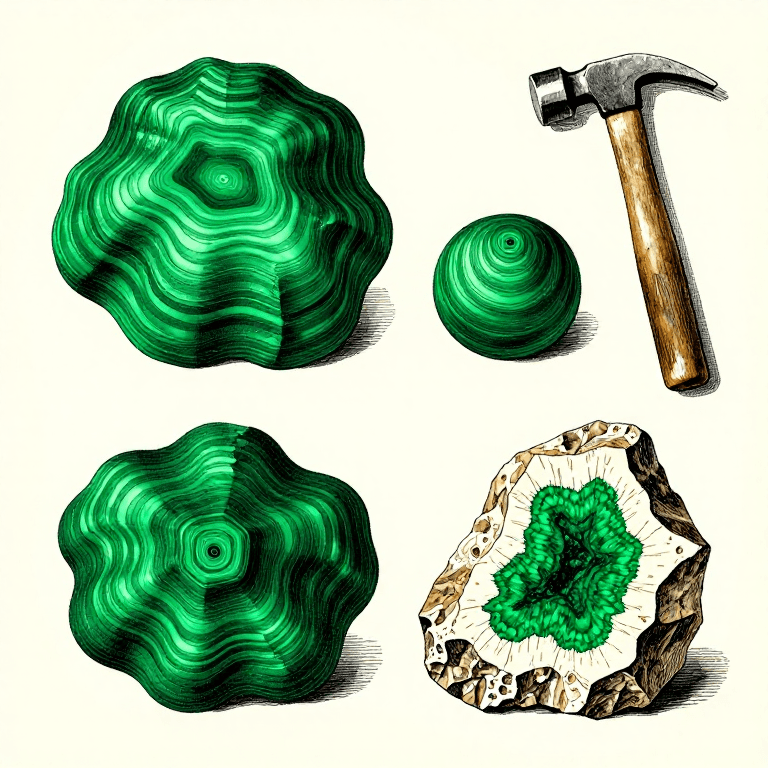
Identifying and Collecting Malachite — Copper Carbonate Ore from the Earth
oleh Peter
Pengerjaan Logam
Recovering Selenium from Copper Refinery Anode Slime — The Photoconductor That Sees Light
oleh Peter
Pertambangan
Making Malachite Green Pigment — Grinding the Copper Mineral into Painter's Green
oleh Charlie
SENI
Blueprint terkait
Blueprint ini berbagi pengetahuan — teknik, bahan, atau prinsip
CC0 Domain Publik
Cetak biru ini dirilis di bawah CC0. Anda bebas untuk menyalin, memodifikasi, mendistribusikan, dan menggunakan karya ini untuk tujuan apa pun, termasuk komersial, tanpa meminta izin.
Dukung Maker dengan membeli produk melalui Cetak Biru mereka di mana mereka mendapatkan Komisi Pembuat yang ditetapkan oleh Penjual, atau buat iterasi baru dari Cetak Biru ini dan masukkan sebagai koneksi di milik Anda sendiri.