SENI
KECANTIKAN & KESEHATAN
KERAJINAN
BUDAYA & SEJARAH
HIBURAN
LINGKUNGAN
MAKANAN & MINUMAN
REKAYASA BALIK
ILMU PENGETAHUAN
OLAHRAGA
TEKNOLOGI
PERANGKAT PAKAI


Stiffness Out of Shape: Corrugating, Beading and the Turned Edge
Thin sheet is strong and floppy at the same time, and the two facts are easy to confuse. The metal in a roofing sheet will happily carry a tonne in tension. Lay it flat across two trestles and it will not carry its own weight.
The fix is not thicker metal. It is **shape**. Roll waves into the sheet, or turn its edges up, or press a bead down the middle of a panel, and the bending stiffness multiplies by hundreds without adding a gram per square metre of coverage.
This is the cheapest thing in engineering and it is why almost every sheet metal object you own has ribs, flanges, swages and folded edges on it. This rung rolls corrugations by hand, measures what they are worth on a real span, and does the integral that explains it.
Pemula
About 3 hours
Instruksi
1
1
Measure how bad a flat sheet is, so you have a baseline
Measure how bad a flat sheet is, so you have a baseline
Cut two identical strips of 0.7–1.0 mm sheet, about 300 mm long and 100 mm wide. Deburr both. Keep one flat.
Support the flat one on two blocks 250 mm apart and hang a known weight from the middle — a bag of washers on a hook, weighed on the digital scale, is fine. Measure the sag at mid-span with the steel rule against a straightedge, or with a dial indicator if you have one.
Write down three numbers: **span**, **load**, **deflection**. Deflection is the thing you are going to divide into later; everything in this rung is a ratio against this first measurement.
Do not be gentle. Use enough weight that the sag is millimetres rather than tenths, because you are about to compare it against something that barely moves and you need the flat reading to be big enough to measure honestly.
Note also what the sheet does when you take the load off. If it stays bent, you passed its yield and the comparison is spoiled — start again with less weight. Stiffness is an *elastic* property; a permanent set is a different measurement altogether.
Material untuk langkah ini:
 Lembaran baja lapis seng 0,9 mm1 buah
 Lembaran aluminium1 buah
Alat yang dibutuhkan:
 Gunting seng
 Alat penghilang duri sisa
 Penggaris
 Jangka Sorong Digital 6 Inci
 Timbangan Digital
 Ragum Meja
 Kacamata Pengaman Bening
 Sarung Tangan Kerja Kulit
 Buku catatan laboratorium (dengan salinan)
2
2
Put waves in the second strip and measure it again
Put waves in the second strip and measure it again
Now corrugate the other strip. Three ways, in order of what a small shop is likely to have:
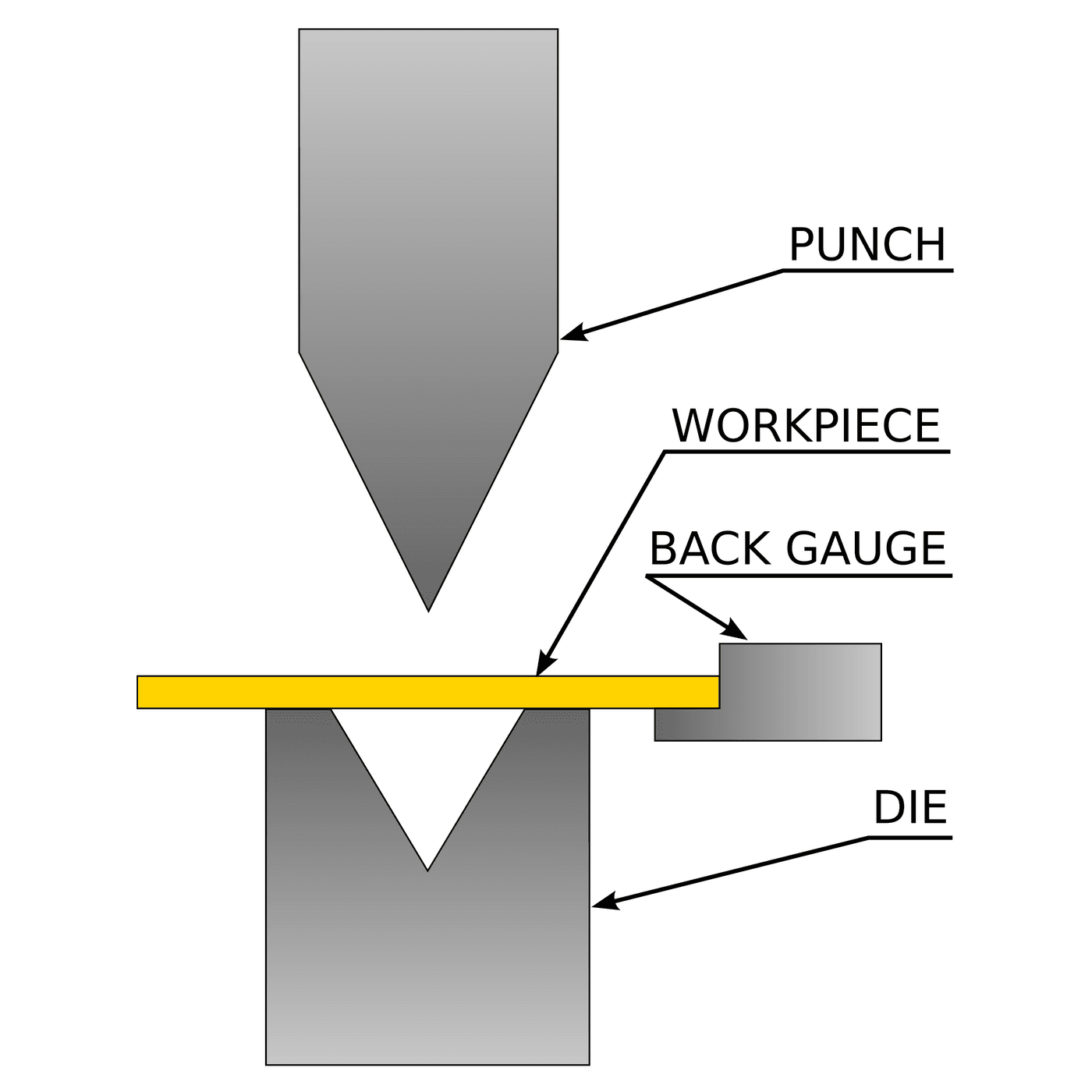
**A brake.** Fold alternate creases across the strip at a regular pitch — 25 mm is convenient — each to about 30°, alternating up and down. This gives a folded profile rather than a rounded one, and it works just as well; the notebook's sinusoid is a convenience, not a requirement.
**A vise and a bar.** Clamp the strip between the vise jaws with a round bar laid along the line and press it over with a second bar. Slow, and the pitch wanders, which is itself worth seeing.
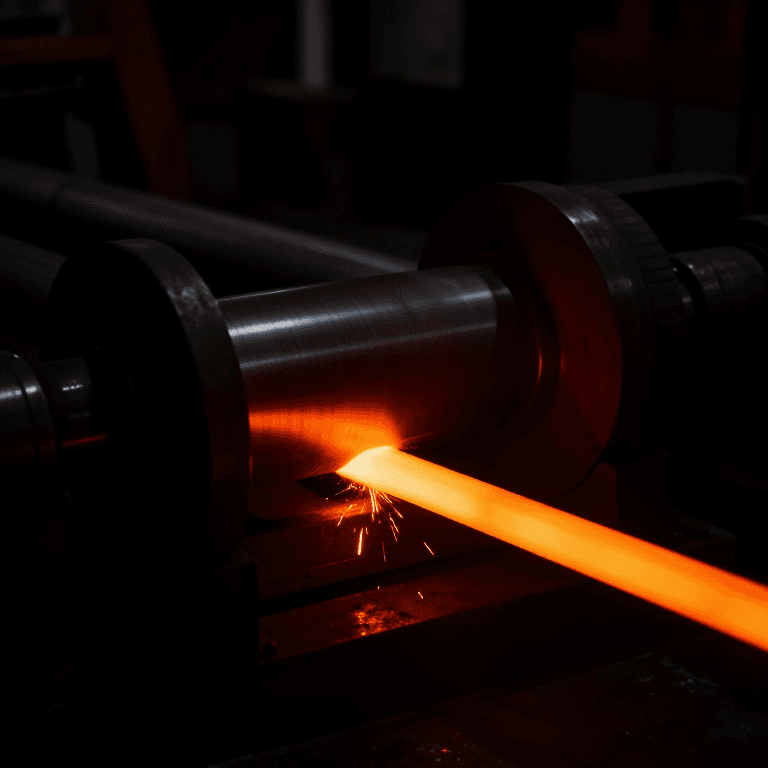
**Rollers.** If you have a bead roller or a corrugating roller like the one in the photograph on this page, run the strip through. Note how little force it takes compared with the brake: the rolls form a short length at a time, exactly as the nibbler did in rung 1.
Measure the finished strip. It is now **shorter in plan** than it was flat, because the metal went into the waves — measure how much, because that is the metal cost the notebook computes. Measure the depth of the corrugation with the calipers.
Then repeat the deflection test from step 1: same span, same load, same method. Compare.
Be ready for the result to be difficult to measure at all, because the corrugated strip may not visibly move under a load that bent the flat one by ten millimetres. If so, increase the load until you can read it, and record the new load — the ratio you want is (load/deflection) for each, not deflection alone.
Material untuk langkah ini:
Lembaran baja lapis seng 0,9 mm1 buahAlat yang dibutuhkan:
 Mesin tekuk hidraulik (12 ton)Ragum Meja
 Kelengkapan pres untuk ragum meja
 Landasan Tempa
 Palu kepala bulat
 Palu karetPenggarisJangka Sorong Digital 6 InciTimbangan DigitalKacamata Pengaman BeningSarung Tangan Kerja KulitBuku catatan laboratorium (dengan salinan)
3
3
The integral behind it
The integral behind it
Memuat notebook Jupyter…
Alat yang dibutuhkan:
 Kertas Milimeter
4
4
The small versions: a bead, a swage, a turned edge
The small versions: a bead, a swage, a turned edge
Corrugating a whole panel is the extreme case. Most sheet metal parts use the same physics in small doses, and each has a name worth knowing because each solves a different problem.
**A flange.** Turn the edge up 90°. Step 3 computed what this does — a 10 mm flange on a 200 mm panel is a large multiple — and it is the reason the lid of almost every box you own has a turned rim.
**A hem.** Fold the edge flat back on itself, 180°. It stiffens the edge a little; what it really does is **bury the sheared edge** from rung 1, so the part is safe to handle and cannot cut anyone. On a part that will be touched, a hem is not optional.
**A bead or swage.** A rounded rib rolled into the middle of a flat panel, where there is no edge to turn. It works the same way — it moves metal off the neutral axis — and it has a second job: it breaks up the flat area so the panel cannot drum or oil-can. That click-clack a cheap panel makes when you press it is a flat area with no bead in it.
Make one of each on scrap, 100 mm long, and test each one by hand against the plain strip. You will feel the difference without instruments; that is how large the effect is.
One thing to notice: a bead **shortens** the panel across its width, exactly as the corrugation did. If a beaded panel has to be a particular size, the bead's metal has to be in the flat blank — same arithmetic as rung 2's bend allowance, applied to a curve. Roll the bead on a test piece and measure the shrinkage before you cut the real blank.
Material untuk langkah ini:
Lembaran baja lapis seng 0,9 mm1 buahLembaran aluminium1 buah Lembaran Kuningan1 buah
Alat yang dibutuhkan:
Mesin tekuk hidraulik (12 ton) Tang lipat tukang pelatRagum Meja
 Landasan pembentukLandasan TempaPalu kepala bulatPalu karet
 Palu tanpa pantulJangka Sorong Digital 6 InciPenggarisAlat penghilang duri sisaKacamata Pengaman BeningSarung Tangan Kerja Kulit
5
5
History and context
History and context
**Attribution, stated honestly.** Corrugated iron is credited to **Henry Robinson Palmer**, engineer to the London Dock Company, who was granted a **British patent in 1829** for indented or corrugated metallic sheets. No United States patent number is asserted here: the sources reachable from this bench give the British filing without a number that can be checked, and an unverified number is worse than none. The mechanism is not in doubt, and the mechanism is what this rung teaches.
Its timing is the interesting part. Palmer's patent is 1829; **hot-dip galvanising** — already in the catalogue as its own rung — arrives in the 1830s. Corrugation made thin sheet stiff enough to span, and zinc made thin sheet last outdoors. Neither is much use without the other, and together they produced a building material that could be shipped flat, rolled on site and put up by two people. Within twenty years it was roofing the goldfields of Australia and California, and it has never stopped.
**What makes it a great piece of engineering** is that it is free. It adds no material per square metre of coverage, needs no new alloy, requires one pass through a set of rolls, and is completely reversible in the sense that you can see exactly why it works. The whole effect is the $y^2$ in the integral.
**Honest limits.** A corrugation is stiff in **one direction only** — along the waves. Across them, a corrugated sheet is *less* stiff than flat, because the profile can open and close like a concertina. That is why corrugated roofing needs purlins running across the waves and why a corrugated wall panel is not a shear panel. Nor can it be walked on between purlins, however stiff it feels.
It also costs metal for coverage, and the notebook prices that honestly: the 18 mm profile needs about **13 %** more sheet than flat to cover the same roof, and a 35 mm one needs over **40 %**. The stiffness is nearly free at shallow depths and stops being free well before the profile runs out of useful depth.
Bahan
3- Placeholder
- 1 buahPlaceholder
- 1 buahPlaceholder
Alat yang Diperlukan
18- Gunting sengkomisi 10%Placeholder
- Placeholder
- Placeholder
- Placeholder
- Placeholder
- Placeholder
- Placeholder
- Placeholder
- Placeholder
- Mesin tekuk hidraulik (12 ton)komisi 10%Placeholder
- Kelengkapan pres untuk ragum mejakomisi 10%Placeholder
- Placeholder
- Placeholder
- Placeholder
- Placeholder
- Placeholder
- Placeholder
- Palu tanpa pantulkomisi 10%Placeholder
Blueprint terkait
Blueprint ini berbagi pengetahuan — teknik, bahan, atau prinsip
Bending: Where the Metal Goes, and How Much Comes Back
oleh Emma
Pengerjaan Logam
5
0
0
0
0
0
Grooved Rolling Mill
oleh Forge
KERAJINAN
44
0
0
0
0
0

Galvanizing Iron with Zinc — A Coat That Rusts So the Iron Will Not
oleh Krennic
Pengerjaan Logam
31
0
0
0
4
0

Blanking: The Punch, the Die, and the Gap Between Them
oleh Forge
Pengerjaan Logam
5
0
0
0
0
0
CC0 Domain Publik
Cetak biru ini dirilis di bawah CC0. Anda bebas untuk menyalin, memodifikasi, mendistribusikan, dan menggunakan karya ini untuk tujuan apa pun, termasuk komersial, tanpa meminta izin.
Dukung Maker dengan membeli produk melalui Cetak Biru mereka di mana mereka mendapatkan Komisi Pembuat yang ditetapkan oleh Penjual, atau buat iterasi baru dari Cetak Biru ini dan masukkan sebagai koneksi di milik Anda sendiri.