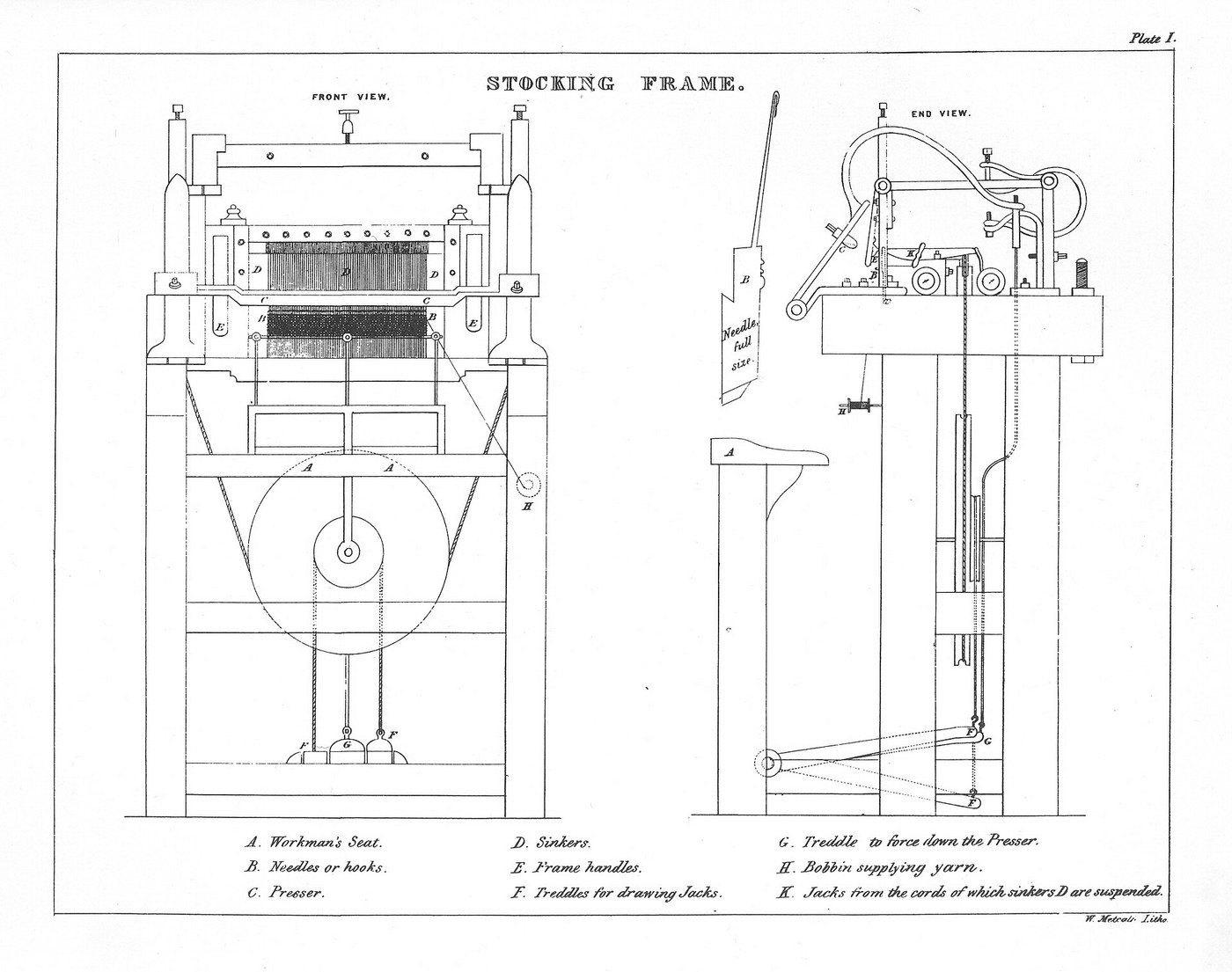


Stocking Frame
Instruksi
Knit a row by hand and count the motions
Knit a row by hand and count the motions
You cannot see what the machine saved until you have done it the slow way.
- Cast on twenty stitches on two needles.
- Knit one full row, counting the separate hand motions.
- Time it.
Material untuk langkah ini:
 Tali Katun1 gulung
Make bearded needles
Make bearded needles
The bearded needle is the piece of cleverness that makes machine knitting possible.
- Take stiff steel wire and form a hook at one end.
- Bend the hook back on itself so its tip nearly touches the shank — that curved tip is the beard.
- Make a row of them, identical, and mount them parallel in a bar.
Material untuk langkah ini:
 Kawat Tembaga1 length
Add sinkers to form the loops
Add sinkers to form the loops
Something must push the yarn down between the needles to make loops of equal size.
- Cut thin flat blades — sinkers — that drop between adjacent needles.
- Lay a straight length of yarn across all the needles.
- Drop the sinkers so the yarn is pushed down into even loops between the needles.
Press, land and knock over
Press, land and knock over
This four-motion sequence is the machine's whole cycle. Work it slowly by hand.
- Press — a bar comes down on the beards, closing each hook so the old loop cannot escape into it.
- Land — the old loops are drawn up over the closed beards.
- Knock over — the old loops slide off the needle ends, over the new yarn.
- Release the press; the new loops sit in the open hooks.
History and context
History and context
William Lee (c.1563-1614) was curate at Calverton, Nottinghamshire. The frame he built around 1589 knitted at eight needles to the inch — coarse worsted stockings rather than the fine silk the court wore. The story that he was refused a patent by Elizabeth I because she feared unemployment among hand knitters is the traditional account; a related version has her objecting that the fabric was too coarse for royal wear, after which Lee built a finer twenty-gauge frame and was refused again. The details rest on later retellings and should be held loosely. What is solid is that he got no English patent, went to France under the protection of Henri IV, and died in Paris.
It was the longest-lived machine of the industrial revolution. Frames were still in commercial use in the nineteenth century essentially unchanged in principle. The trade was organised around framework knitters who rented their frames from middlemen — a system that turned economic downturns into personal ruin, because the frame rent was owed whether there was work or not.
The Luddites, correctly described. The framework knitters who broke machines around Nottingham from 1811 were not opposed to machinery as such — most of them worked frames for a living. Their grievances were frame rent, wage cuts and the use of wide frames to make cheap cut-up goods that undercut properly fashioned work. Machine-breaking was a bargaining tactic in a trade with no legal means of collective negotiation. Calling any objection to new technology Luddism gets the history backwards.
What survives: the loop-forming sequence. A modern circular knitting machine making a T-shirt performs the same four motions, thousands of times a minute, with self-closing latch needles instead of beards and pressers.
Bahan
2- 1 gulungPlaceholder
- 1 lengthPlaceholder
CC0 Domain Publik
Cetak biru ini dirilis di bawah CC0. Anda bebas untuk menyalin, memodifikasi, mendistribusikan, dan menggunakan karya ini untuk tujuan apa pun, termasuk komersial, tanpa meminta izin.
Dukung Maker dengan membeli produk melalui Cetak Biru mereka di mana mereka mendapatkan Komisi Pembuat yang ditetapkan oleh Penjual, atau buat iterasi baru dari Cetak Biru ini dan masukkan sebagai koneksi di milik Anda sendiri.