SENI
KECANTIKAN & KESEHATAN
KERAJINAN
BUDAYA & SEJARAH
HIBURAN
LINGKUNGAN
MAKANAN & MINUMAN
REKAYASA BALIK
ILMU PENGETAHUAN
OLAHRAGA
TEKNOLOGI
PERANGKAT PAKAI

Substantive and Adjective: Which Dyes Need a Mordant and Which Do Not
"Mordant everything" is good advice for a beginner and is not true. Natural dyes fall into three families that behave completely differently, and knowing which family a dyestuff belongs to answers most of the questions about it in advance.
**Adjective** dyes need a mordant — the great majority, including madder, weld and cochineal. **Substantive** dyes bond to the fibre unaided, like walnut and most tannins. **Vat** dyes, indigo and woad above all, are not soluble at all and are applied by a different route entirely.
Getting the family wrong wastes a mordant on a dye that did not need it, or leaves a dye that needed one rinsing straight down the sink.
Menengah
3 hours
Instruksi
1
1
Adjective dyes: the ones the mordant rung was written for
Adjective dyes: the ones the mordant rung was written for
An adjective dye has no useful affinity for the fibre by itself. The mordant bonds to the fibre and the dye bonds to the mordant, and the result is fast.
This family includes nearly all the great historical colours: madder and its alizarin reds, cochineal and kermes, weld, dyer's broom, fustic, logwood, brazilwood, osage, coreopsis and marigold.
Two consequences follow from the structure and both are useful:
**The mordant changes the colour, not just the fastness.** The same weld gives lemon on alum and olive on iron, because the colour comes from a dye-metal complex and the metal is part of it. One dyestuff and three mordants is three colours.
**Unmordanted fibre in an adjective bath takes a stain, not a dye.** It will look like a pale version of the colour coming out of the pot, and it will rinse and wash away. That is worth seeing once, deliberately, on a scrap.
Material untuk langkah ini:
 Benang wol tanpa pewarna3 gulung
 Tawas (Kalium Alum)1 buah
 Besi sulfat1 buah
Alat yang dibutuhkan:
 Panci kaldu
 Toples Kaca Bertutup
 Kartu indeks
 Timbangan Presisi
2
2
Substantive dyes: colour that holds on its own
Substantive dyes: colour that holds on its own
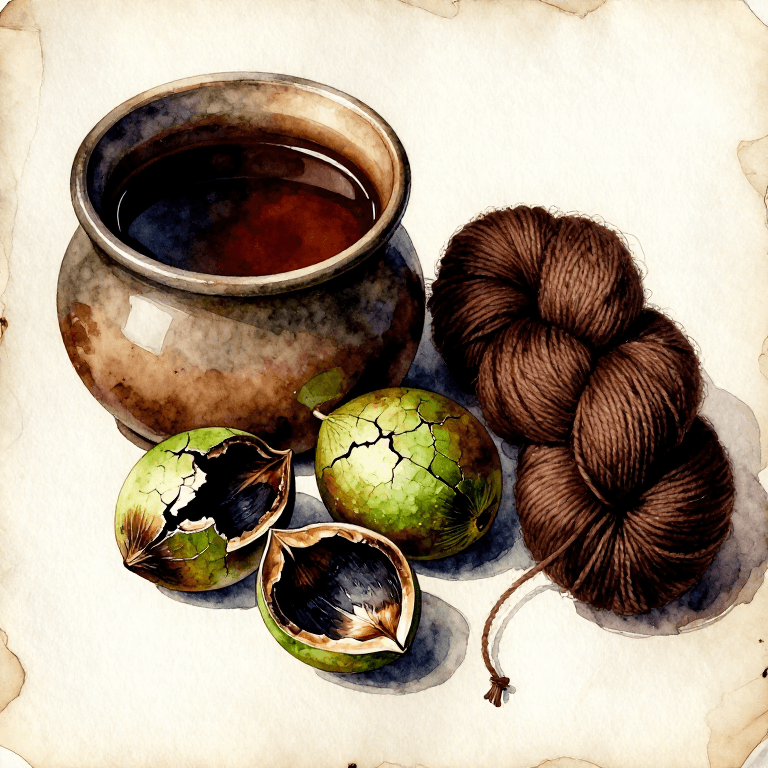
A substantive dye bonds to the fibre directly, usually because it is rich in tannin and tannin has an affinity for both protein and cellulose.
The usual ones are the browns and the tan-to-black end of the range: walnut hulls, oak bark and galls, sumac, myrobalan, cutch, tea, pomegranate rind, persimmon tannin.
They will dye an unmordanted skein and the colour will stay. That makes them the right place to start for anyone dyeing for the first time — no mordant step, no chemistry, no disappointment.
Two caveats:
**A mordant still changes them.** Walnut on alum is a warmer brown; walnut on iron is nearly black. Not needing a mordant is not the same as not responding to one.
**They mordant the next dye.** A skein dyed in walnut or oak gall is a tannin-mordanted skein, whether that was intended or not, which is exactly the trick the cellulose sequence uses on purpose.
Material untuk langkah ini:
 Kain kapas (ringan)2 mBenang wol tanpa pewarna2 gulung
 Puru ek1 buah
Alat yang dibutuhkan:
Panci kaldu Saringan Jala HalusKartu indeks
 Penjepit
3
3
Vat dyes: indigo is not a dyebath at all
Vat dyes: indigo is not a dyebath at all
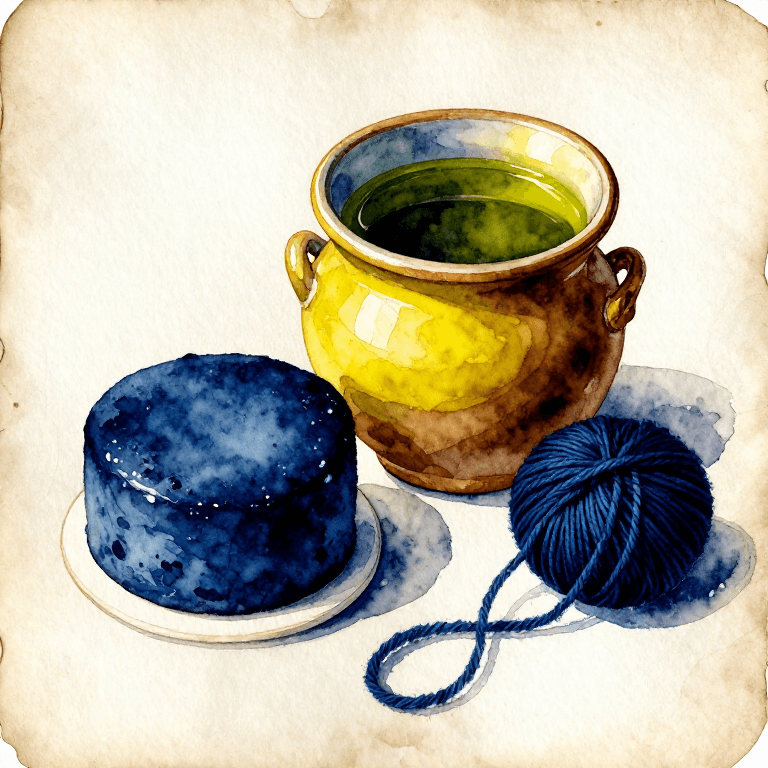
Indigo and woad are neither adjective nor substantive, because indigo is not soluble in water. It cannot be dissolved and therefore cannot be absorbed.
The vat works by chemically **reducing** the indigo — removing oxygen from it — in an alkaline liquor, which turns it into a soluble yellow-green form called leuco-indigo. The fibre goes into that, takes it up, and is then lifted into the air. The oxygen of the air turns it back into insoluble blue indigo, now trapped inside the fibre.
That is why an indigo vat is greenish-yellow with a coppery skin, why the fibre comes out green and turns blue in front of you, and why depth is built by repeated short dips rather than one long soak.
It also explains the care the vat needs: air is the enemy while the fibre is in it, so nothing is stirred, nothing is dripped back in, and the vat is kept covered. Every bubble undoes some of the reduction.
No mordant is used or needed. The indigo is held mechanically, not chemically, which is also why indigo crocks — see the fastness rung.
Material untuk langkah ini:
Kain kapas (ringan)1 mBenang wol tanpa pewarna1 gulungAlat yang dibutuhkan:
Panci kaldu Kertas pHPenjepit
 Sarung tangan karet
4
4
Telling which is which when nobody has told you
Telling which is which when nobody has told you
For an unfamiliar plant, three small tests answer it in an afternoon.
**Test one: unmordanted scrap.** Dye a scoured but unmordanted scrap, rinse it hard, and wash it with detergent. Colour that survives means substantive. Colour that mostly leaves means adjective.
**Test two: three mordants side by side.** Alum, iron, and none, all in the same bath at the same time. This tells you the range the dyestuff covers as well as which family it is in, and it is the single most informative dye test there is.
**Test three: does it dissolve?** A dyestuff that gives a clear coloured solution in hot water is being extracted. One that gives a suspension of particles that settle out is a pigment, not a dye, and will sit on the surface rather than bond — which is how most "failed" flower dyes actually fail.
Write all three on one card with the scraps stapled to it. That card is worth more than any amount of reading about the plant, and it is the beginning of the dye record.
Material untuk langkah ini:
Benang wol tanpa pewarna2 gulungTawas (Kalium Alum)1 buahBesi sulfat1 buah Deterjen lembut1 buah
Alat yang dibutuhkan:
Toples Kaca BertutupPanci kalduKartu indeks Gunting
Bahan
6- 8 gulungPlaceholder
- 2 buahPlaceholder
- 1 buahPlaceholder
- Placeholder
- 1 buahPlaceholder
- 1 buahPlaceholder
Blueprint terkait
Blueprint ini berbagi pengetahuan — teknik, bahan, atau prinsip
Mordants Beyond Alum: Why Cotton Needs Tannin and Iron Needs Restraint
oleh Tex
Tekstil & Kulit
26
0
0
0
0
0
Dyeing Brown with Walnut Hulls — One of Humanity's Oldest and Most Permanent Dyes
oleh Tex
Tekstil & Kulit
73
0
0
0
2
0
Dyeing Blue with Natural Indigo — The Tropical Vat Dye That Coloured Civilisation
oleh Tex
Tekstil & Kulit
50
0
0
0
2
0
CC0 Domain Publik
Cetak biru ini dirilis di bawah CC0. Anda bebas untuk menyalin, memodifikasi, mendistribusikan, dan menggunakan karya ini untuk tujuan apa pun, termasuk komersial, tanpa meminta izin.
Dukung Maker dengan membeli produk melalui Cetak Biru mereka di mana mereka mendapatkan Komisi Pembuat yang ditetapkan oleh Penjual, atau buat iterasi baru dari Cetak Biru ini dan masukkan sebagai koneksi di milik Anda sendiri.