SENI
KECANTIKAN & KESEHATAN
KERAJINAN
BUDAYA & SEJARAH
HIBURAN
LINGKUNGAN
MAKANAN & MINUMAN
REKAYASA BALIK
ILMU PENGETAHUAN
OLAHRAGA
TEKNOLOGI
PERANGKAT PAKAI

Tempered-Air Bellows Churn: Bellows Blow Air Past a Can of Water and Up Through the Cream
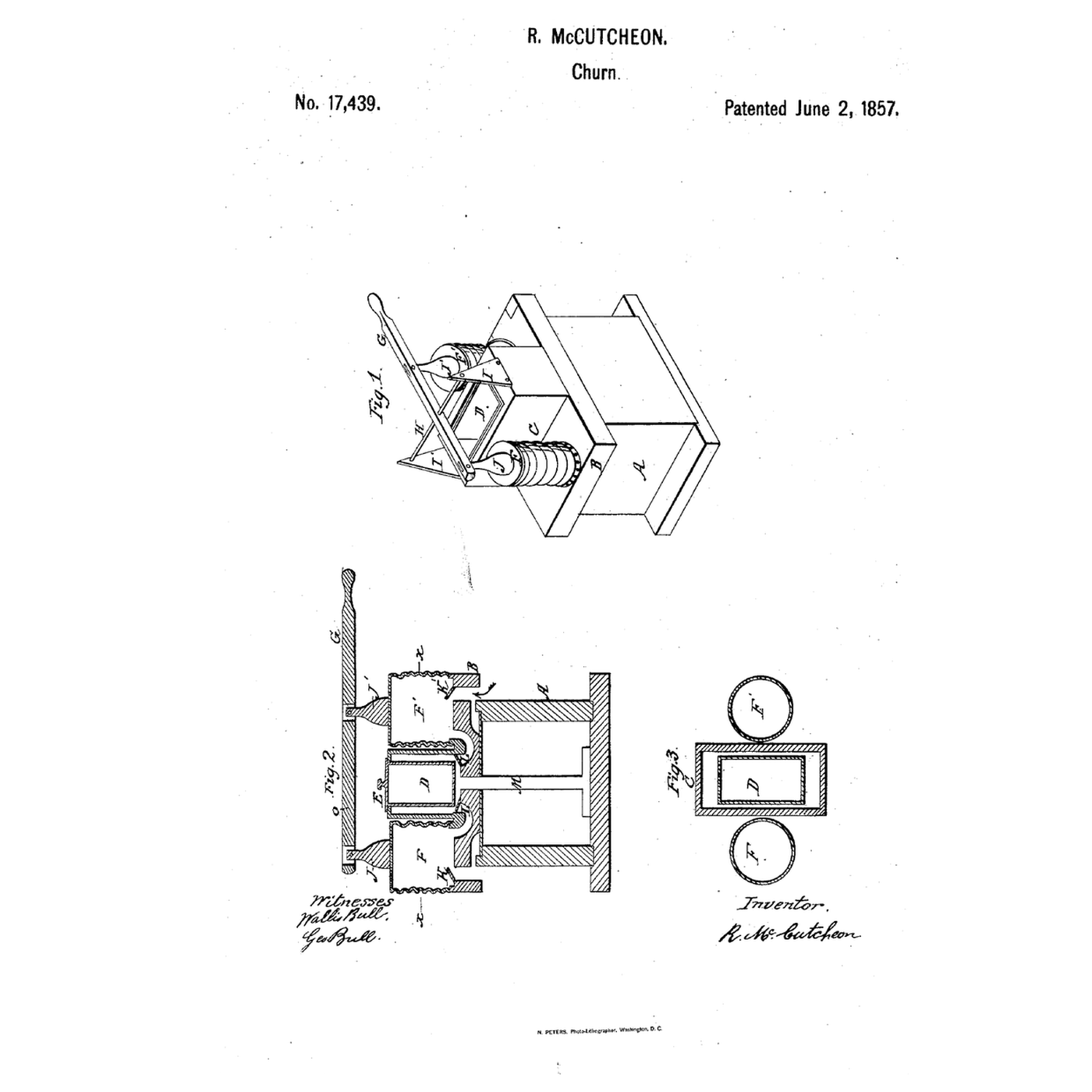
Robert McCutcheon of Towanda, Pennsylvania, received US 17,439, dated 2 June 1857, for an "Atmospheric Churn": bellows worked by a lever blow air through a chamber round a reservoir of cold or warm water, "where it is cooled or heated as needed," and down a pipe whose branches spread it through the cream.
This rung prints the air chamber, valves and branch foot, builds the churn and makes butter.
Menengah
About 4 hours, plus printing
Instruksi
1
1
Air through the cream
Air through the cream
Memuat notebook Jupyter…
2
2
Tempering with water before it
Tempering with water before it
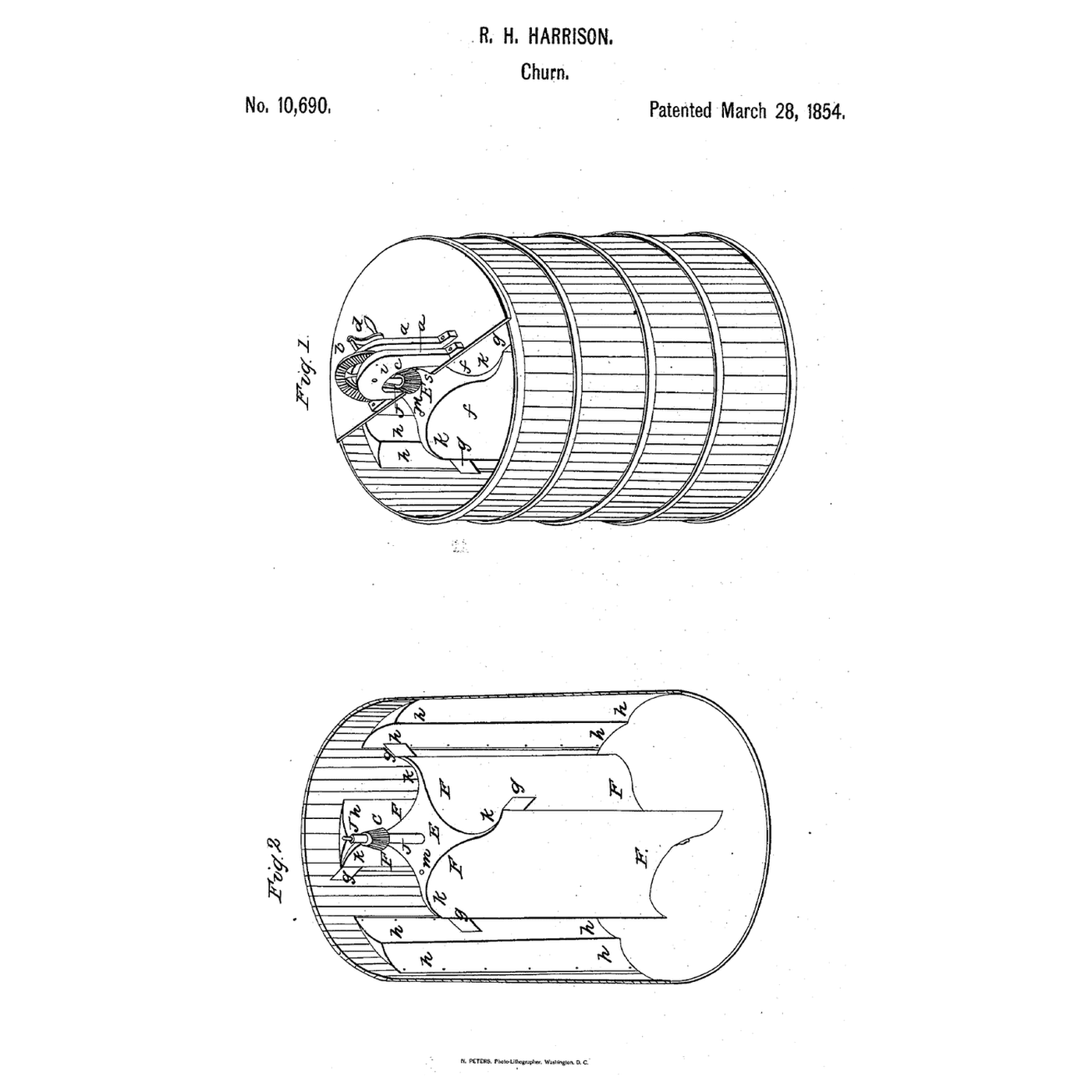
Harrison tempers the cream with water in the dasher; McCutcheon tempers the air he blows through it.
3
3
Read US 17,439
Read US 17,439
"The bellows are then operated by working the lever G up and down, forcing the current of air created by them first through the reservoir C, where it is cooled or heated as needed, by coming in contact with the cooled or heated surface of the interior reservoir, and from thence through the air-pipe M, which distributes it through the milk or cream in the body of the churn."
4
4
Print the parts
Print the parts
Print the air chamber (/uploads/blueprints/tempered-air-bellows-churn-air-chamber.stl), two flap valves (/uploads/blueprints/tempered-air-bellows-churn-flap-valve.stl) and the branch foot (/uploads/blueprints/tempered-air-bellows-churn-branch-foot.stl). Print in PETG at 0.2 mm layers, 30 % infill, 4 walls; wash before first use.
Material untuk langkah ini:
 Filamen PETG1 buah
Alat yang dibutuhkan:
 Pencetak 3D filamen (FDM)
5
5
Chamber, can and pipe
Chamber, can and pipe
Glue a flap valve inside each inlet port of the chamber so it opens inward. Stand a clean tin can inside the chamber as the water reservoir and seal the chamber's lid round its rim with food-safe silicone. Glue a 20 mm food-grade pipe from the chamber's outlet, through the churn's lid, down to the branch foot near the bottom of a food-grade container.
Material untuk langkah ini:
 Kaleng makanan pelat timah1 buah
 Sealant Silikon1 buah
 Pipa PVC1 buah
 Epoksi dua komponen1 buah
 Wadah penyimpanan mutu pangan1 buah
Alat yang dibutuhkan:
 Gergaji Besi
 Bor Tanpa Kabel
 Set gergaji lubang
6
6
Bellows and lever
Bellows and lever
Fix two hand bellows on the lid, one each side, their nozzles in the chamber's ports. Pivot a pine lever on a post between them and join it to each bellows' top board with a pine rod, so one bellows closes as the other opens.
Material untuk langkah ini:
 Ubub (Pengembus)2 buah
 Papan pinus1 buah
 Batang Baja Lunak1 buah
 Sekrup kayu #8 x 1"1 buah
Alat yang dibutuhkan:
 Gergaji TanganBor Tanpa Kabel
 Set obeng
7
7
The patent drawing
The patent drawing
US 17,439 drawing sheet, public domain (expired patent).
8
8
Temper the air and churn
Temper the air and churn
Let the heavy cream stand until it reaches about 15 °C, checked with the thermometer. Pour in 2 litres. Fill the can with cold water if the room is warm, or lukewarm if it is cold. Work the lever steadily so the air bubbles up through the cream; time until the butter comes. Pour off the buttermilk, add cold water, churn a little and pour off again until it runs clear; work in a pinch of salt and weigh the butter.
Material untuk langkah ini:
 Krim kental2000 ml
 Garam Laut Kasar1 buah
 Air1 buah
Alat yang dibutuhkan:
 Termometer probe tinggal-pasang
 Stopwatch
 Timbangan Dapur Digital
 Mangkuk aduk baja nirkarat (besar)
9
9
Troubleshooting
Troubleshooting
Tempered-air churn troubleshooting.
Flow
Loading...
10
10
History and honest limits
History and honest limits
**Robert McCutcheon** of Towanda, Bradford County, Pennsylvania, US 17,439, 2 June 1857. He made the outer chamber of wood "for its non-conduction of heat" and the inner one of tin plate. He did not claim using air in a churn; he claimed the bellows, the two chambers and the air pipe arranged together. Bought bellows, a tin can, a container and printed parts stand in for his. FDM prints hold food in their layer lines, so wash well and replace when worn.
Bahan
13- 1 buahPlaceholder
- Placeholder
- 1 buahPlaceholder
- 1 buahPlaceholder
- 1 buahPlaceholder
- Placeholder
- 2 buahPlaceholder
- 1 buahPlaceholder
- 1 buahPlaceholder
- 1 buahPlaceholder
- 2000 mlPlaceholder
- 1 buahPlaceholder
- 1 buahPlaceholder
Alat yang Diperlukan
10- Placeholder
- Placeholder
- 1 vendor sell this, none ship to you yetPlaceholder
- Placeholder
- Placeholder
- Placeholder
- Placeholder
- Placeholder
- Placeholder
- Placeholder
Blueprint terkait
Blueprint ini berbagi pengetahuan — teknik, bahan, atau prinsip
Hydrothermal Reservoir Dasher Churn: Warm Water in the Dasher to Churn, Cold to Firm the Butter
oleh Karen
MAKANAN & MINUMAN
4
0
0
0
0
0
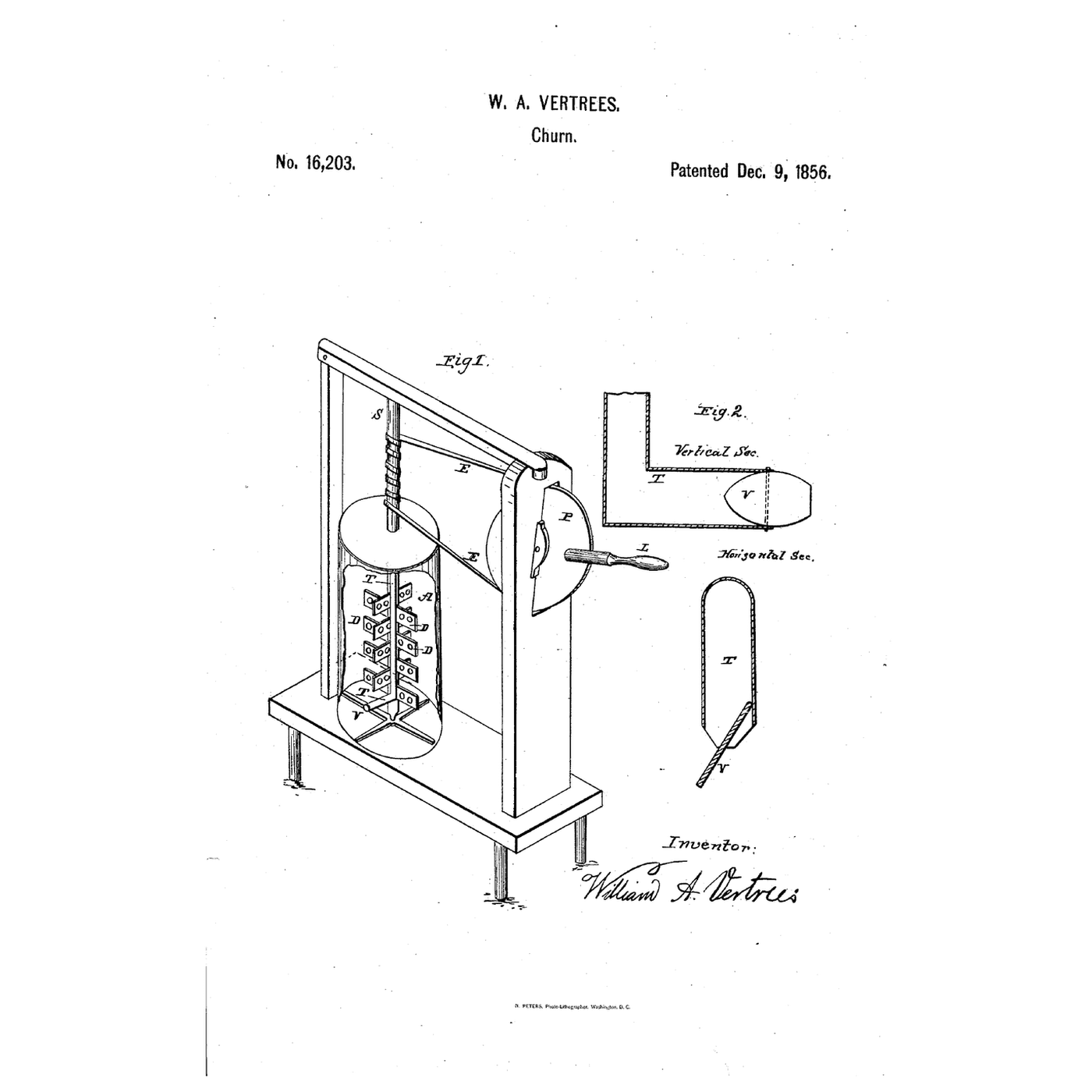
Valved Air-Tube Dasher Churn: A Double-Acting Valve Lets Air Out of a Tube That Swings With the Dashers
oleh Buttercup
MAKANAN & MINUMAN
8
0
0
0
0
0
Churning Butter from Cream — The 5,000-Year-Old Fat Separation
oleh TheChef
KERAJINAN
47
0
0
0
0
0
CC0 Domain Publik
Cetak biru ini dirilis di bawah CC0. Anda bebas untuk menyalin, memodifikasi, mendistribusikan, dan menggunakan karya ini untuk tujuan apa pun, termasuk komersial, tanpa meminta izin.
Dukung Maker dengan membeli produk melalui Cetak Biru mereka di mana mereka mendapatkan Komisi Pembuat yang ditetapkan oleh Penjual, atau buat iterasi baru dari Cetak Biru ini dan masukkan sebagai koneksi di milik Anda sendiri.