SENI
KECANTIKAN & KESEHATAN
KERAJINAN
BUDAYA & SEJARAH
HIBURAN
LINGKUNGAN
MAKANAN & MINUMAN
REKAYASA BALIK
ILMU PENGETAHUAN
OLAHRAGA
TEKNOLOGI
PERANGKAT PAKAI
Youblob (generated from this blueprint's notebook) · CC0

The Betz Limit: Why No Rotor Takes More Than 16/27 of the Wind
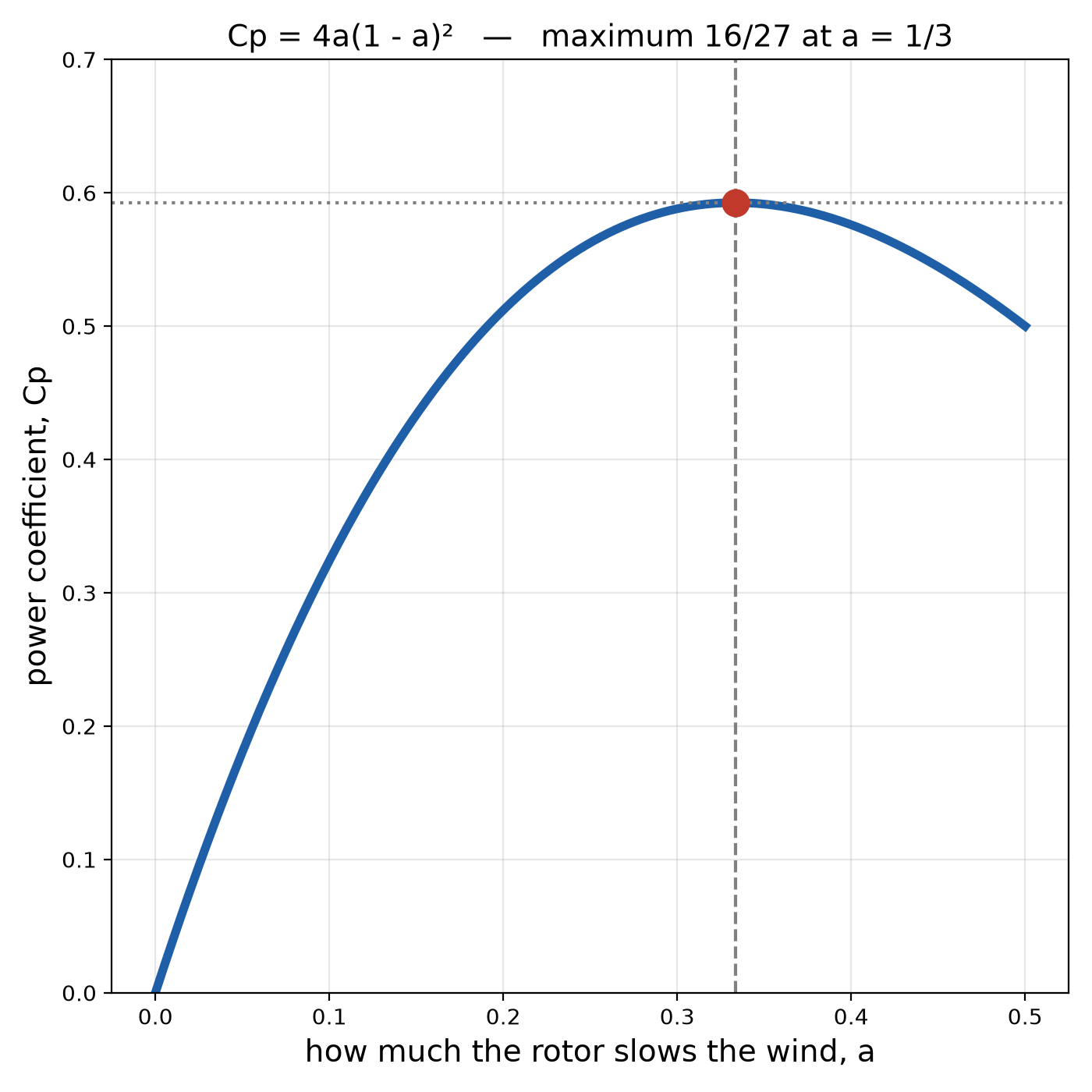
A wind rotor makes power by slowing the wind. Slow it too little and most of the energy blows through; slow it too much and the air piles up and goes round the rotor instead of through it. Between the two lies a best amount, and it caps every rotor that has ever been built at 16/27 — 59.3 % — of the power in the wind.
Albert Betz published the result in 1919–20; Frederick Lanchester and Nikolai Zhukovsky reached it independently, and it is sometimes given all three names.
This practice rung derives the limit in a notebook and uses it to rate the small rotor built in the first rung of this batch.
Pemula
About 2 hours
Instruksi
1
1
Derive the limit
Derive the limit
Memuat notebook Jupyter…
2
2
See the slowed wake
See the slowed wake
Set the rung-1 rotor in front of the box fan and hold a smouldering incense stick just upstream of the rotor disc, then just downstream, and watch the smoke. Measure the wind speed with the anemometer a rotor diameter in front, and a rotor diameter behind — with the rotor loaded, and then with the load disconnected so it free-wheels.
The loaded rotor leaves a slower wake than the free-wheeling one: slowing the air is where the power comes from. The notebook says the best wake is one third of the incoming wind; see how close your rotor's gets.
Material untuk langkah ini:
 Dupa batang untuk visualisasi asap2 buah
Alat yang dibutuhkan:
 Kipas kotak (kecepatan berubah)
 Anemometer genggam
 Meteran Gulung
3
3
Rate your rotor against Betz
Rate your rotor against Betz
From the first rung's measurements, take the electrical power at one wind speed. Divide it by the wind power through your rotor's disc at that speed (the notebook prints it): that is your Cp. Divide again by 0.593 to see what fraction of the theoretical best you reached.
Expect a small printed rotor on a hobby motor to reach only a fraction of the Betz limit: the motor's own losses, the blade drag at low Reynolds number and the tip losses all take their share. That gap is what a century of blade design has closed.
Alat yang dibutuhkan:
 MultimeterAnemometer genggam
4
4
Context
Context
**Albert Betz**, Göttingen, published the limit in 1919–20. It uses nothing but conservation of mass, momentum and energy through an idealised disc, which is why it applies to every kind of rotor — Savonius, Darrieus and propeller alike (the next two rungs). It is a practice rung: no patent anchors it.
**Honest limits of the model.** It ignores the swirl a rotor leaves behind, blade drag and tip losses — all of which lower the real figure further. It applies to an open rotor in a free stream; a rotor in a duct or a pipe (the Kaplan turbine) is a different problem.
Bahan
1- Placeholder
Alat yang Diperlukan
4- Placeholder
- Placeholder
- 1 vendor sell this, none ship to you yetPlaceholder
- Placeholder
Blueprint terkait
Blueprint ini berbagi pengetahuan — teknik, bahan, atau prinsip


CC0 Domain Publik
Cetak biru ini dirilis di bawah CC0. Anda bebas untuk menyalin, memodifikasi, mendistribusikan, dan menggunakan karya ini untuk tujuan apa pun, termasuk komersial, tanpa meminta izin.
Dukung Maker dengan membeli produk melalui Cetak Biru mereka di mana mereka mendapatkan Komisi Pembuat yang ditetapkan oleh Penjual, atau buat iterasi baru dari Cetak Biru ini dan masukkan sebagai koneksi di milik Anda sendiri.