SENI
KECANTIKAN & KESEHATAN
KERAJINAN
BUDAYA & SEJARAH
HIBURAN
LINGKUNGAN
MAKANAN & MINUMAN
REKAYASA BALIK
ILMU PENGETAHUAN
OLAHRAGA
TEKNOLOGI
PERANGKAT PAKAI
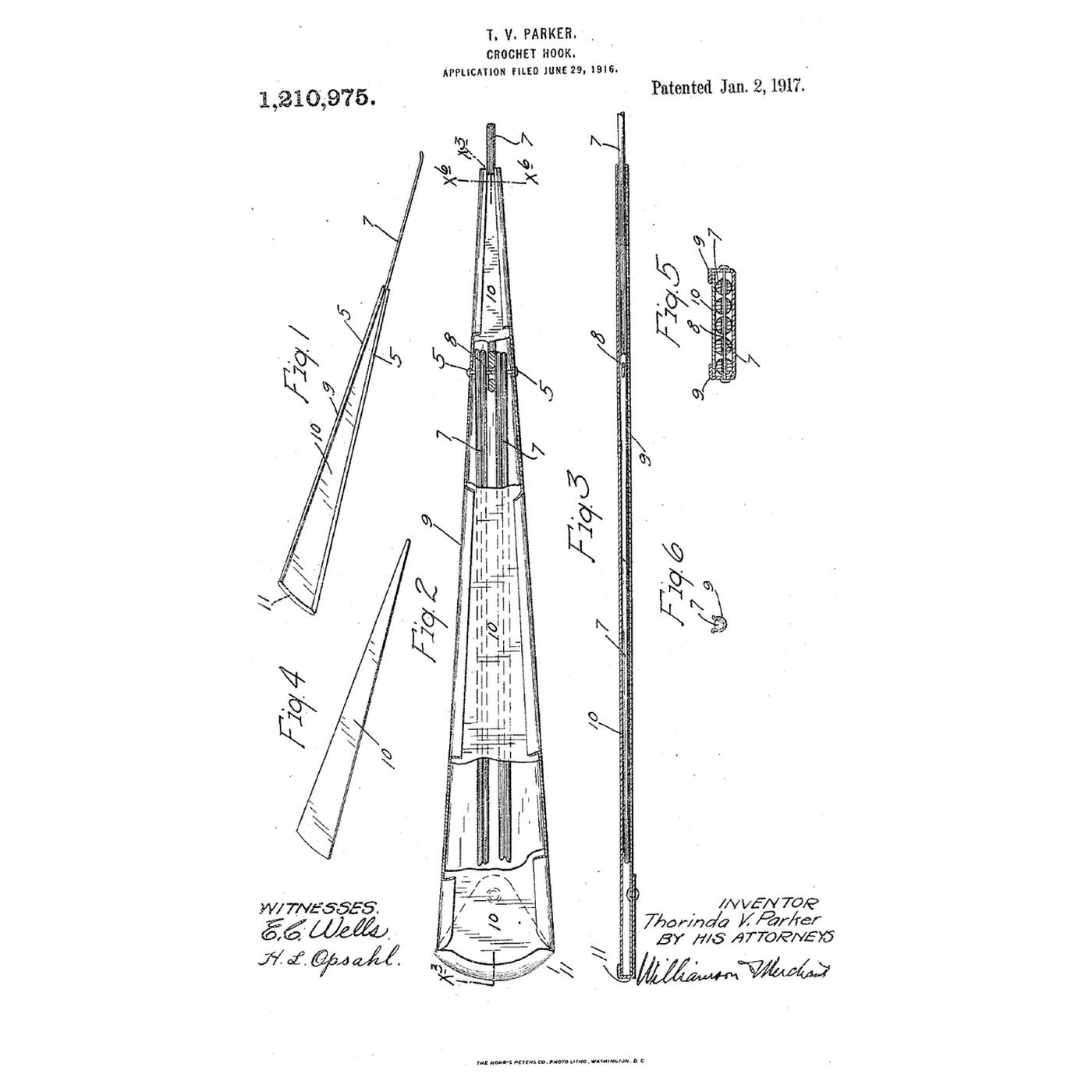


The Hook-Case Crochet Set: Hooks of Every Size Swing From One Rivet in Their Own Case
Crochet hooks of different sizes are separate tools, easily lost.
Thorinda V. Parker of Minneapolis, Minnesota, received US 1,210,975, patented 2 January 1917, for an interchangeable crochet hook "in which a multiplicity of crochet hooks proper of different size are operatively connected to a single or common handle or holder that serves as a casing therefor." The hooks swing on one rivet in a tapered channel of sheet metal; its contracted end lets out one hook at a time, a wedge plate slid in closes the case and holds the hook out, and a lock segment keeps the wedge plate in.
This rung works out why the rivet sits far from the mouth, then bends the case, files three hooks and fits the wedge plate and lock, and measures how well the mouth holds a hook.
Lanjutan
About 5 hours
Instruksi
1
1
Load at the mouth and the rivet
Load at the mouth and the rivet
Memuat notebook Jupyter…
2
2
A hook that folds into its handle before it
A hook that folds into its handle before it
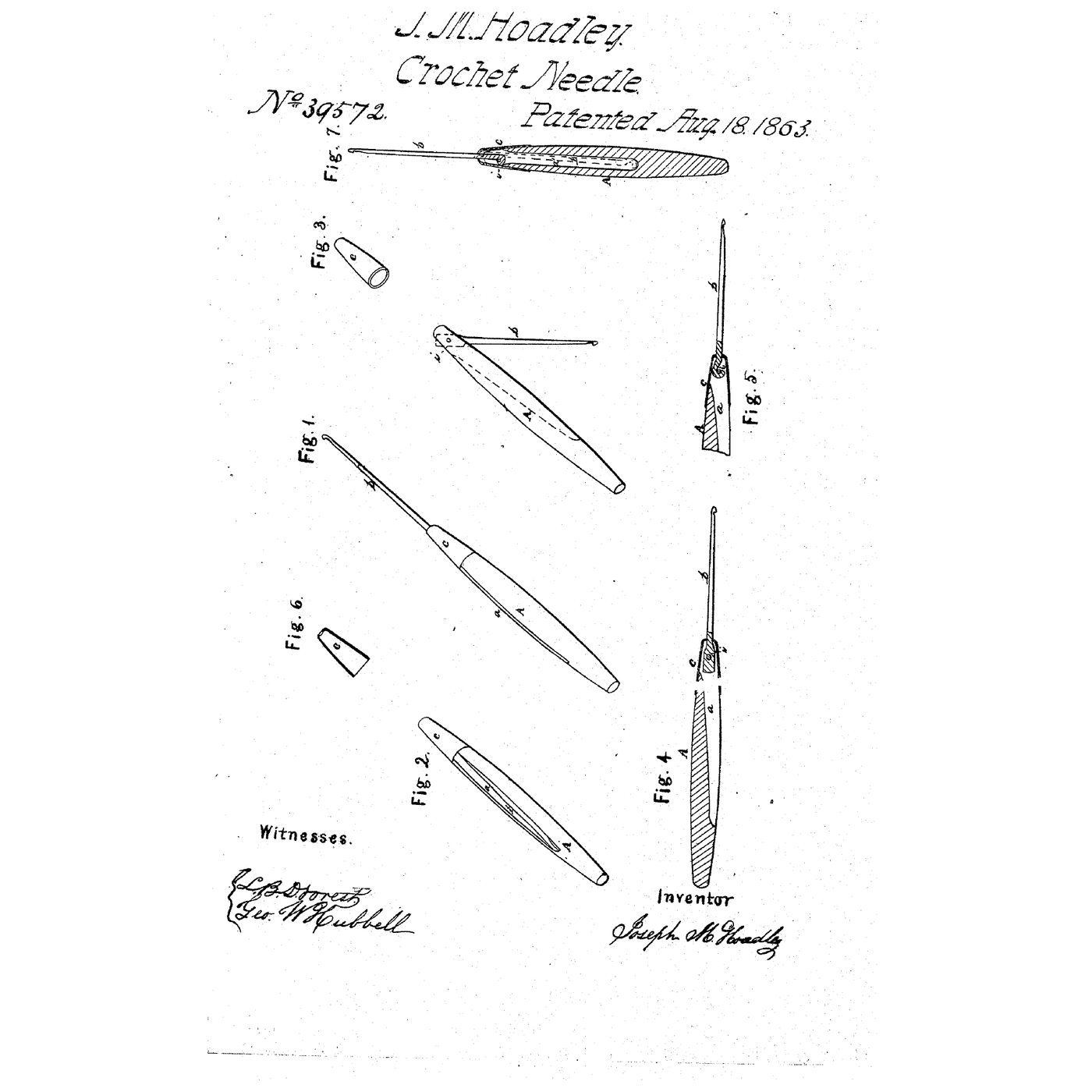
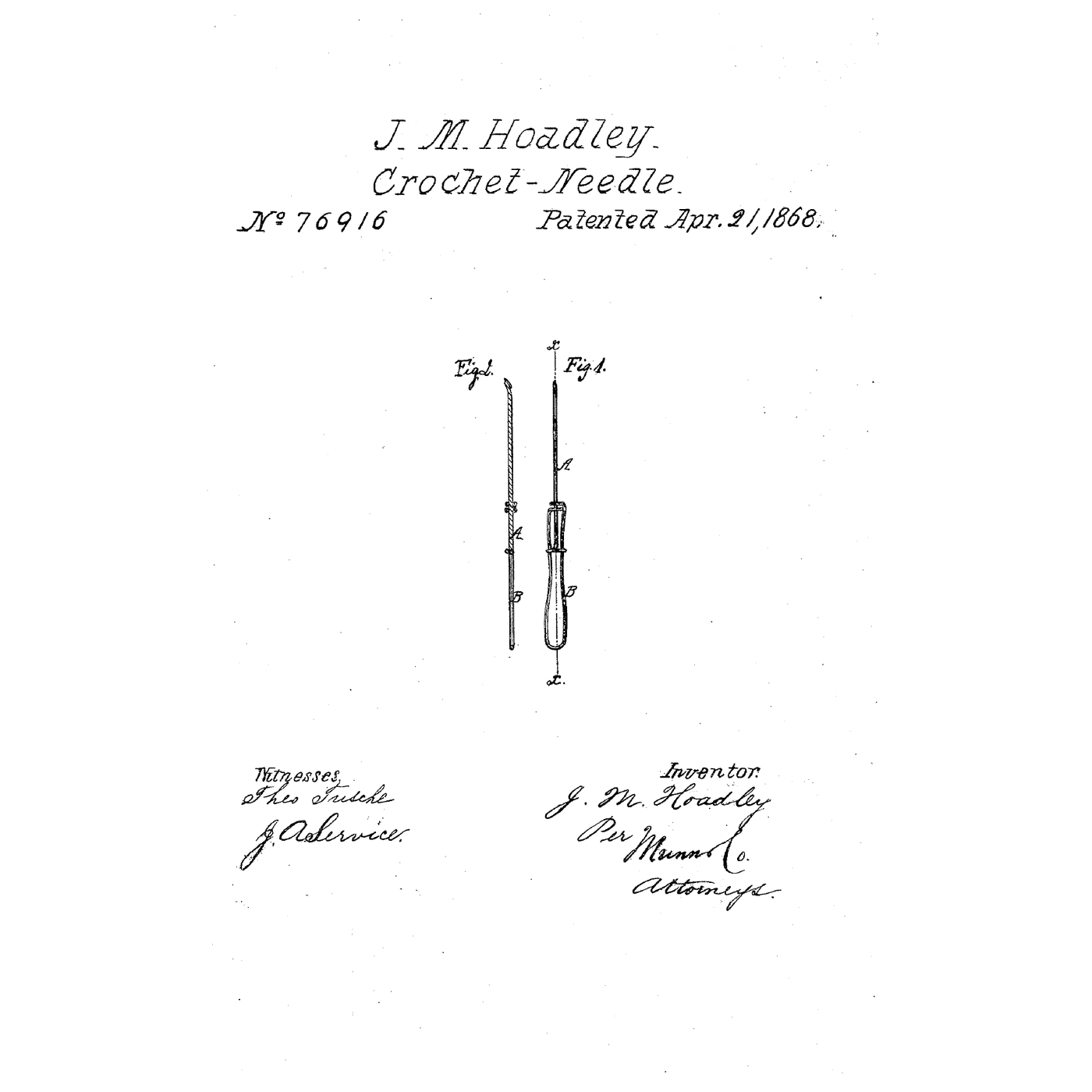
The embedded blueprint pivots one needle in a slotted handle so it folds away. Parker pivots several hooks of different sizes on one rivet in a sheet-metal case, turned out one at a time.
3
3
Read US 1,210,975
Read US 1,210,975
"At their other ends, the hook needles 7 are perforated and loosely pivoted on the transverse pin or rivet 8 extended through and fastened to the edges of a tapered sheet metal handle or case 9. This handle 9 is channel-shaped in cross section, and has inturned edges on one face."
"The contracted end of the handle 9 has a U-shaped form of such size that but one hook needle 7 at a time can be turned outward into an operative position."
4
4
Make the case and the hooks
Make the case and the hooks
**Case.** Cut brass sheet to a tapered strip 15 cm long that will fold into a channel 8 mm deep, 25 mm wide at the large end and 8 mm at the small end. Fold the sides up in the vise, then turn their edges in 2 mm along the open face. At the small end squeeze the channel into a U that a 4 mm rod just springs into.
**Hooks.** Cut three 10 cm lengths of 4 mm steel rod. File the front 3 cm of two of them down to 2.5 and 3 mm, and file a hook at the end of each of the three, copying bought hooks of the same sizes. Hammer the other 8 mm flat on the anvil and drill each for a 3 mm pin.
**Rivet.** A quarter of the way from the small end, as in the patent drawing, drill both sides of the case 3 mm. Pass a piece of 3 mm brass rod through the case and all three hooks and peen both ends over.
**Wedge and lock.** Cut a tapered brass plate that slides in from the large end under the turned-in edges and closes the case. Rivet a small brass segment to the closed side at the large end so it turns, with its edge bent over to catch the wedge plate's end.
**Test.** Turn out each hook in turn through the U, slide the wedge plate in and lock it. Hang the spring scale on the hook's tip and pull across it until it moves; then crochet 20 stitches with each size.
Material untuk langkah ini:
 Lembaran Kuningan1 buah
 Batang Baja Lunak0.3 meter
 Batang Kuningan0.05 meter
 Benang1 buah
Alat yang dibutuhkan:
 Gunting seng
 Ragum Meja
 Tang Berujung Rata
 Kikir (Kikir Tangan)
 Set Kikir Jarum
 Palu
Palu Landasan Tempa
 Bor Tanpa Kabel
 Set Mata Bor
 Gergaji Besi
 Set jarum rajut hakpen
 Neraca Pegas
 Penggaris
 Kacamata Pengaman Bening
5
5
A case that lets hooks wobble, stick or fall out
A case that lets hooks wobble, stick or fall out
Hook-case crochet set troubleshooting.
Flow
Loading...
6
6
History and honest limits
History and honest limits
**Thorinda V. Parker** of Minneapolis, Hennepin County, Minnesota, filed US 1,210,975 on 29 June 1916; it was patented 2 January 1917. The flat wedge plate 10 slides into the case just below the inturned edges and closes its open side; a lock segment 11, pivoted to the closed side, turns its inturned flange over the wedge plate's outer end. The spring of the contracted end may itself hold the outturned needle, but with the wedge plate in it is held positively; the pivot 8 is a considerable distance from the contracted end, and the other hooks stay inside. Folded in, the case encloses them all. Her claims cover the hollow handle with its displaceable side plate, the hooks projected one at a time, and the lock piece; and the tapered handle with flanged edges and wedge plate, the hooks pivoted far from the contracted end, and the lock segment.
**Honest limits.** A hand-folded brass case and hand-filed steel hooks stand in for hers; she gives no sizes, and the rivet's place is taken from her drawing. The notebook treats the case and hook as rigid; its lengths and force are examples. The pull you read is the result.
Bahan
4- 1 buahPlaceholder
- 0.3 meterPlaceholder
- 0.05 meterPlaceholder
- 1 buahPlaceholder
Alat yang Diperlukan
14- Placeholder
- Placeholder
- Placeholder
- Placeholder
- Placeholder
- Placeholder
- Placeholder
- 1 vendor sell this, none ship to you yetPlaceholder
- Placeholder
- Placeholder
- Placeholder
- Placeholder
- Placeholder
- Placeholder
Blueprint terkait
Blueprint ini berbagi pengetahuan — teknik, bahan, atau prinsip



CC0 Domain Publik
Cetak biru ini dirilis di bawah CC0. Anda bebas untuk menyalin, memodifikasi, mendistribusikan, dan menggunakan karya ini untuk tujuan apa pun, termasuk komersial, tanpa meminta izin.
Dukung Maker dengan membeli produk melalui Cetak Biru mereka di mana mereka mendapatkan Komisi Pembuat yang ditetapkan oleh Penjual, atau buat iterasi baru dari Cetak Biru ini dan masukkan sebagai koneksi di milik Anda sendiri.