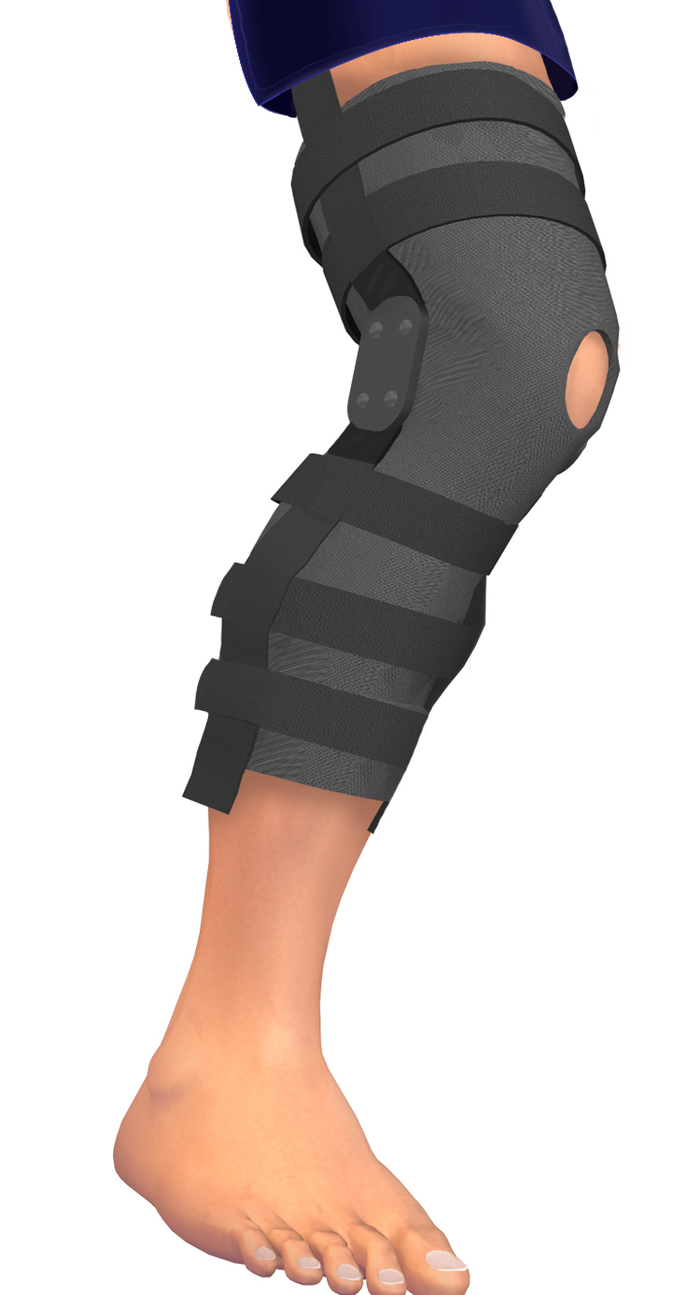


The Knee Brace
Strap a simple hinge to the outside of a knee and bend it, and the brace will slide down your leg. Every time. That single, annoying observation is the whole engineering problem, and it has a precise cause.
The knee is not a hinge. A hinge turns about one fixed axis. The knee rolls and glides — the femur rolls back on the tibia while sliding forward on it — so the point it is momentarily turning about, its instantaneous centre of rotation, is not fixed. It travels backwards as the knee flexes, tracing a curved path.
Put a single-pivot hinge beside a joint whose centre moves, and the two disagree by a growing distance through the range of motion. Something has to give: either the strap slips, or the brace migrates, or it drags on the leg. Brace migration is not poor strapping. It is a kinematic mismatch.
There are two honest answers. Accept it and design the straps to tolerate small motion. Or use a polycentric hinge — a four-bar linkage whose own instantaneous centre moves along a path approximating the knee's.
This blueprint builds both, on a wooden leg model, and measures the migration so you can see the difference rather than take it on trust. It is a wearable-device build, not medical advice — a brace for an actual injury is a clinician's call.
Instruksi
Build a leg model with a realistic joint
Build a leg model with a realistic joint
Cut two lengths of timber for thigh and shank. Join them not with a bolt but with two short cords crossed between them, anchored front and back — the cords stand in for the cruciate ligaments.
Bend it.
Expect the upper piece to roll and slide on the lower rather than pivot in place.
The crossed cords ARE the four-bar linkage, and they are why the knee's centre of rotation moves.
Material untuk langkah ini:
 Kayu pinus1 buah
 Tali pengikat2 meter
Alat yang dibutuhkan:
 Gergaji Tangan
Find the moving centre of rotation
Find the moving centre of rotation
Tape paper behind the model. Mark two points on the shank, then flex by 15° and mark their new positions.
For each point, draw the line joining old to new, then its perpendicular bisector. Where the two bisectors cross is the instantaneous centre for that increment.
Repeat across the range and join the crossings.
Expect a curve, not a point, drifting backwards as flexion increases. That curve is the thing every brace has to live with.
Material untuk langkah ini:
 Kertas Milimeter1 buah
Alat yang dibutuhkan:
 Busur Derajat
Fit a single-pivot hinge and measure the mismatch
Fit a single-pivot hinge and measure the mismatch
Make two aluminium or steel side bars joined by one bolt. Strap them to the model with the pivot set at the centre you measured at full extension.
Flex through the full range and measure how far the lower bar's end slides along the shank.
Expect measurable migration, growing with flexion.
Nothing is loose and nothing is badly made — the geometry simply cannot agree at both ends of the range.
Material untuk langkah ini:
 Baja lunak profil L 38 x 38 mm1 buah
 Baut elevator 1/4"-20 x 1"2 buah
Alat yang dibutuhkan:
 Jangka Sorong Digital 6 Inci
 Gergaji Besi
Build a polycentric hinge and measure it again
Build a polycentric hinge and measure it again
Replace the single bolt with a four-bar linkage: two short links joining the upper and lower bars at two pivots each, so the bars move relative to each other rather than turning about one point.
Repeat the measurement from step 3.
Expect markedly less migration across the range.
The linkage has its own moving instantaneous centre, and you have tuned it to approximate the knee's — you have not eliminated the mismatch, you have matched two moving curves.
Add the soft parts and fit them properly
Add the soft parts and fit them properly
Cut a neoprene sleeve and stitch pockets to carry the side bars. Add hook-and-loop straps above and below the joint — never across it.
Anchor the upper strap on the wide part of the thigh and the lower one below the calf swell.
Straps work by resting on a taper, not by being tightened. A strap over a cylinder slides down however hard you pull it, and pulling harder buys pressure injury rather than grip.
Material untuk langkah ini:
 Kit pembuat penyangga lutut1 kit
 Perekat kait dan gelung (velcro)1 meter
Set a range-of-motion stop and verify it
Set a range-of-motion stop and verify it
Add a removable stop that limits extension, flexion or both. Set it, then measure the achieved angle with a protractor against the model.
Test that the stop holds under hand force.
Expect the set angle and the measured angle to differ unless the hinge axis is aligned with the joint.
A range limit is only as accurate as the hinge placement — which is why fitting a real brace is a measured procedure and not a guess.
Alat yang dibutuhkan:
 Busur Derajat / Pengukur Sudut
Compendium — what braces do, and what they do not
Compendium — what braces do, and what they do not
The knee is a four-bar linkage made of ligament. The anterior and posterior cruciate ligaments cross inside the joint, and together with the bones they form a closed kinematic chain — which is exactly the mechanism you built with two crossed cords in step 1. As the knee flexes, that linkage forces the femur to roll backwards while sliding forwards on the tibia, and the instantaneous centre of rotation migrates posteriorly along a curved path, often drawn as a J. Every claim in this blueprint follows from that one anatomical fact.
The three classes of brace answer three different questions. Prophylactic braces aim to prevent injury in uninjured knees in contact sport; the evidence for them is mixed and contested. Functional braces are for knees with a known instability, typically after ligament injury, and aim to restrain the specific motion the missing ligament used to restrain. Rehabilitative braces are worn after surgery, and their main job is the range-of-motion stop from step 6 — protecting a repair by making certain angles mechanically unreachable. These are not interchangeable and a brace bought for the wrong one is at best useless.
Polycentric hinges are an approximation, not a solution. A four-bar linkage can be designed so its instantaneous centre traces a path close to the knee's, and commercial functional braces do exactly this. But every knee's path differs, the path changes with load, and the brace sits outside soft tissue that moves independently of the bone underneath. Soft-tissue movement, not hinge design, sets the practical limit — which is why high-end braces are custom-moulded to the limb, and why even those migrate somewhat.
A genuinely open question worth stating plainly. Whether functional bracing meaningfully protects a reconstructed ligament during sport is not settled; several trials have found little difference in re-injury rates, while many patients report improved confidence and proprioceptive awareness. That is a real and honest finding — a device can help by changing how the wearer moves, without mechanically taking load. Presenting braces as mechanical armour overstates the evidence in both directions.
Scope, stated once and clearly. This is a build for understanding a mechanism: a wooden leg model, a hinge, a sleeve, and two measurements. It is not a medical device and must not be worn as one. A knee that is painful, swollen, unstable or recently injured needs assessment, and any brace worn for a real condition — including its type, its hinge, and its range settings — is a decision for a clinician, not a maker. Build this to learn why braces slide down; do not build it to treat a knee.
Bahan
7- 1 buahPlaceholder
- 2 meterPlaceholder
- 1 buahPlaceholder
- Placeholder
- Placeholder
- Placeholder
- Placeholder
Alat yang Diperlukan
5- Placeholder
- Placeholder
- Placeholder
- Placeholder
- Placeholder
Bahan cetak biru terhubung


Blueprint terkait
Blueprint ini berbagi pengetahuan — teknik, bahan, atau prinsip

CC0 Domain Publik
Cetak biru ini dirilis di bawah CC0. Anda bebas untuk menyalin, memodifikasi, mendistribusikan, dan menggunakan karya ini untuk tujuan apa pun, termasuk komersial, tanpa meminta izin.
Dukung Maker dengan membeli produk melalui Cetak Biru mereka di mana mereka mendapatkan Komisi Pembuat yang ditetapkan oleh Penjual, atau buat iterasi baru dari Cetak Biru ini dan masukkan sebagai koneksi di milik Anda sendiri.