SENI
KECANTIKAN & KESEHATAN
KERAJINAN
BUDAYA & SEJARAH
HIBURAN
LINGKUNGAN
MAKANAN & MINUMAN
REKAYASA BALIK
ILMU PENGETAHUAN
OLAHRAGA
TEKNOLOGI
PERANGKAT PAKAI



The Porcelain-Lined Lemon Squeezer: Cast-Iron Handles, Porcelain Where the Juice Runs
Wooden lemon squeezers soak up stale juice, and bare iron ones are eaten by the acid and stain the juice.
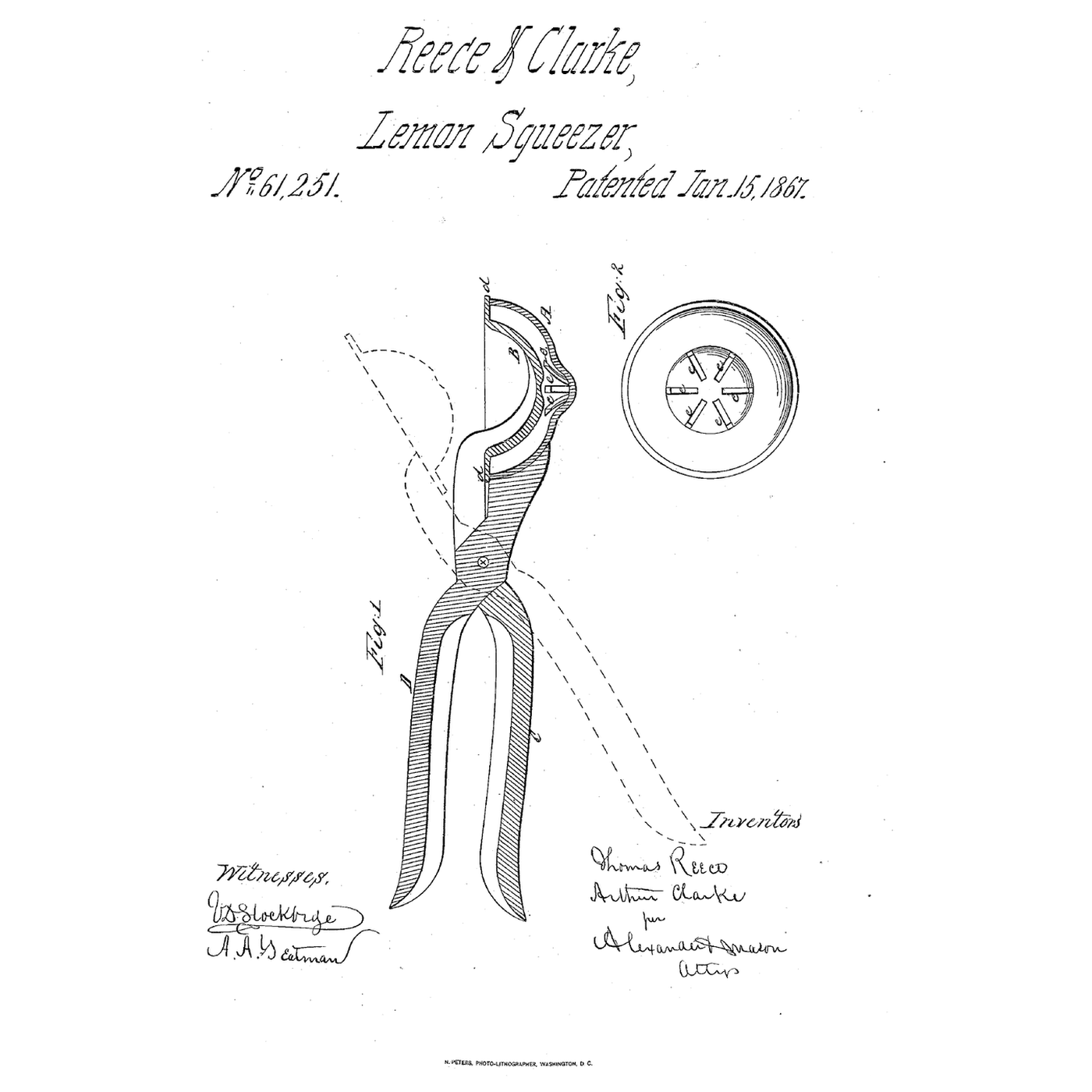
Thomas C. Smith of New York received US 76,539, dated 7 April 1868, for "having the body of the device of cast iron or other cast metal, and in the manner of applying the porcelain parts to the same". A cast-iron cup on one handle holds a porcelain concave perforated with holes, resting on a ring of india-rubber and held by lips; a plate on the other handle carries a porcelain compress screwed to it. Only porcelain touches the lemon.
This rung works out how much iron the juice could take, then makes the porcelain concave and compress, fires them, fits them to flat-bar handles with a rubber ring, and compares juice left on iron and on porcelain.
Lanjutan
About 2 days, with drying and firing
Instruksi
1
1
The acid and the iron
The acid and the iron
Memuat notebook Jupyter…
2
2
A metal squeezer before it
A metal squeezer before it
The embedded blueprint tins or galvanizes its cups against the acid. Smith lines his cast-iron squeezer with porcelain wherever the juice runs.
3
3
Read US 76,539
Read US 76,539
"G is a concave, which is the half of a hollow sphere, made also of porcelain, with a series of holes, d′, in its bottom or lower part, and having a flange, e, projecting horizontally from it all around its upper edge. This flange, e, rests or bears upon an annular piece of India rubber, f, which is placed on the shoulder a, in the interior of the cup B."
"The India-rubber ring f serves as a packing for the concave, holding it firmly in position without danger of breakage, and effectually prevents the acid juice of the lemons finding its way down between the concave and cup, as will be understood by referring to fig. 2."
4
4
Make the porcelain parts and fit them
Make the porcelain parts and fit them
**Concave.** Press porcelain clay into the inside of a small bowl to make a half-sphere about 7 cm across with a flat flange round its rim, and pierce its bottom with a ring of small holes.
**Compress.** Press a solid half-sphere of clay a few millimetres smaller, with a flat top for fixing.
**Fire.** Dry both slowly, bisque-fire them in the kiln, glaze them with clear glaze, and glaze-fire them at the clay's stated temperature.
**Frame.** Cut the bottom 4 cm off a tin can wider than the concave, cut a hole in its base, and rivet it to a flat-bar handle. Seat the concave in it on a rubber O-ring and bend three tabs of the can's rim over its flange as the lips g g. Epoxy the compress to a disc riveted on the second handle, and pivot the handles so the compress closes into the concave.
**Test.** Squeeze lemons over a glass. Then leave a spoonful of lemon juice on a pad of steel wool and another in the porcelain concave for an hour, and compare their colour and their pH with test strips.
Material untuk langkah ini:
 Tanah liat porselen1 kg
 Glasir bening1 buah
 Kaleng1 buah
 Besi Strip Baja Lunak0.5 meter
 Paku keling tembak6 buah
 Aneka baut segi enam1 buah
 Mur Segi Enam1 buah
 Set Aneka Cincin O1 buah
 Epoksi dua komponen1 buah
 Lemon3 buah
 Wol baja1 buah
 Kertas uji pH1 buah
Alat yang dibutuhkan:
 Set perkakas tanah liat
 Tungku Pembakaran
 Gergaji Besi
 Bor Tanpa Kabel
 Set Mata Bor
 Gunting seng
 Set pistol paku keling
 Tang Berujung Rata
 Pisau dapur
 Gelas minum
 Sarung Tangan Kerja Kulit
5
5
Porcelain that cracks, leaks or rattles
Porcelain that cracks, leaks or rattles
Porcelain-lined lemon squeezer troubleshooting.
Flow
Loading...
6
6
History and honest limits
History and honest limits
**Thomas C. Smith** of New York, New York, received US 76,539, dated 7 April 1868. His lower handle A was cast with the cup B, the upper A′ with a plate E holding the porcelain compress F by a screw e and nut d; the concave's flange had a notch h to pass it down past one of the lips g g before turning. He thought porcelain, glazed earthenware or other vitreous material suitable, and the metal parts japanned or silver-plated. His claims cover the shoulder, rubber ring, lips and notched flange, and the cast-metal handles with the porcelain compress and concave.
**Honest limits.** Pressed and glazed porcelain on flat-bar handles and a tin cup stand in for his cast iron and made porcelain. The notebook's iron is a ceiling, not a prediction; its volumes and acid content are examples. Your comparison is the result.
Bahan
12- Placeholder
- 1 buahPlaceholder
- 1 buahPlaceholder
- 0.5 meterPlaceholder
- 6 buahPlaceholder
- 1 buahPlaceholder
- 1 buahPlaceholder
- 1 buahPlaceholder
- 1 buahPlaceholder
- 3 buahPlaceholder
- 1 buahPlaceholder
- 1 buahPlaceholder
Alat yang Diperlukan
11- Placeholder
- Placeholder
- Placeholder
- 1 vendor sell this, none ship to you yetPlaceholder
- Placeholder
- Placeholder
- Placeholder
- Placeholder
- Placeholder
- Placeholder
- Placeholder
Blueprint terkait
Blueprint ini berbagi pengetahuan — teknik, bahan, atau prinsip



CC0 Domain Publik
Cetak biru ini dirilis di bawah CC0. Anda bebas untuk menyalin, memodifikasi, mendistribusikan, dan menggunakan karya ini untuk tujuan apa pun, termasuk komersial, tanpa meminta izin.
Dukung Maker dengan membeli produk melalui Cetak Biru mereka di mana mereka mendapatkan Komisi Pembuat yang ditetapkan oleh Penjual, atau buat iterasi baru dari Cetak Biru ini dan masukkan sebagai koneksi di milik Anda sendiri.