SENI
KECANTIKAN & KESEHATAN
KERAJINAN
BUDAYA & SEJARAH
HIBURAN
LINGKUNGAN
MAKANAN & MINUMAN
REKAYASA BALIK
ILMU PENGETAHUAN
OLAHRAGA
TEKNOLOGI
PERANGKAT PAKAI
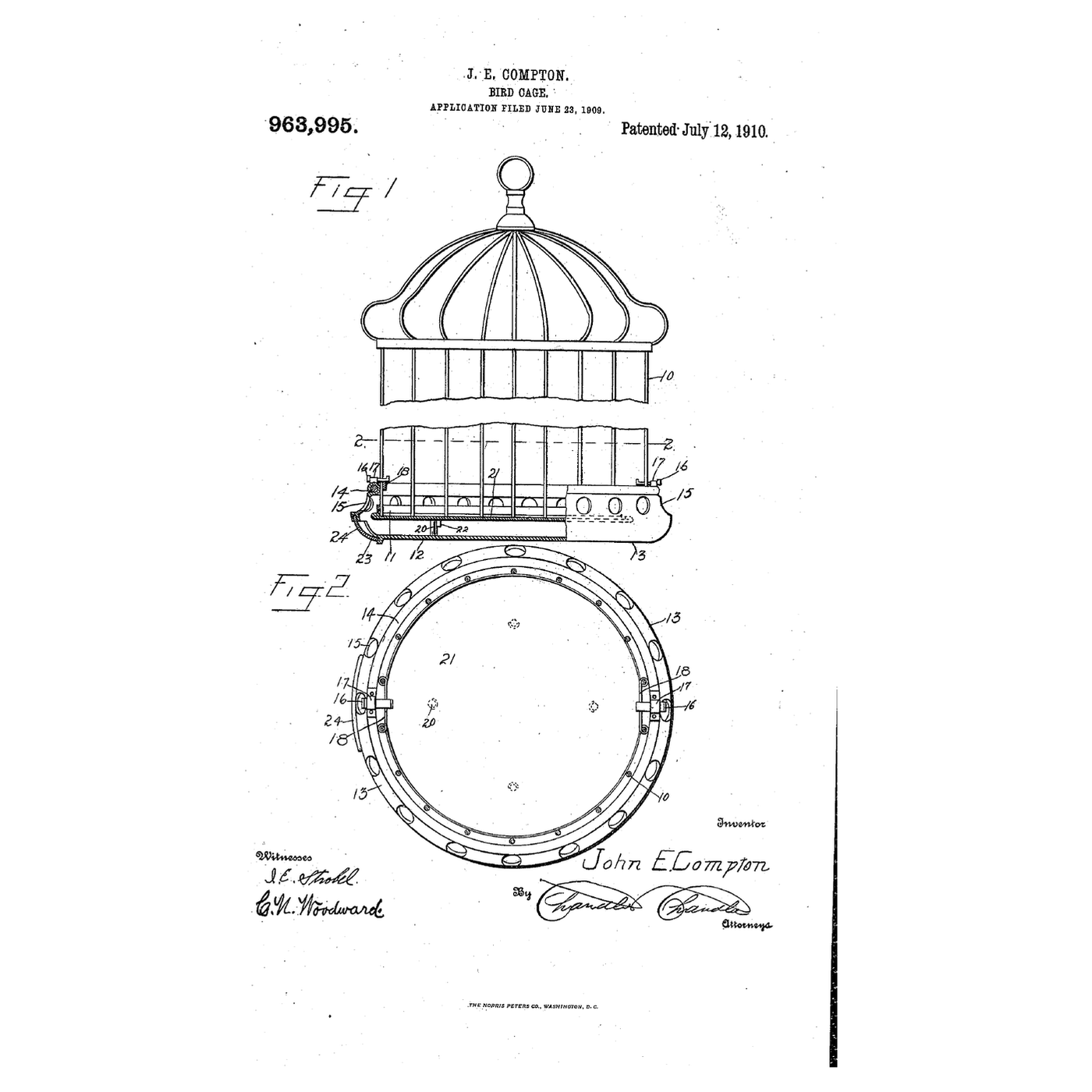


The Raised-Plate Cage Floor: Droppings Kept In, Air Let Through, a Slide to Clear It
Feathers, droppings and seed husks fly out of a bird cage into the room, and a solid pan beneath the bird traps stale air.
John E. Compton of Red Lodge, Montana, received US 963,995, patented 12 July 1910, for a bird cage whose bottom has an upward, inward margin pierced with large holes, and within it a plate on posts, spaced above the bottom and below the holes, reaching under the cage's sides; "feathers, droppings and other matter, disengaged from the birds will be prevented from flying outward into the room, but will be retained within the cage", air circulates under the plate, and a sliding closure in the side lets out what collects beneath it.
This rung works out what the holes save and open, then folds a bottom with a pierced margin, stands a plate on posts in it, fits a sliding door, and counts what leaves the cage.
Menengah
About 5 hours
Instruksi
1
1
Weight saved and air let in
Weight saved and air let in
Memuat notebook Jupyter…
2
2
A cage floor kept clean before it
A cage floor kept clean before it
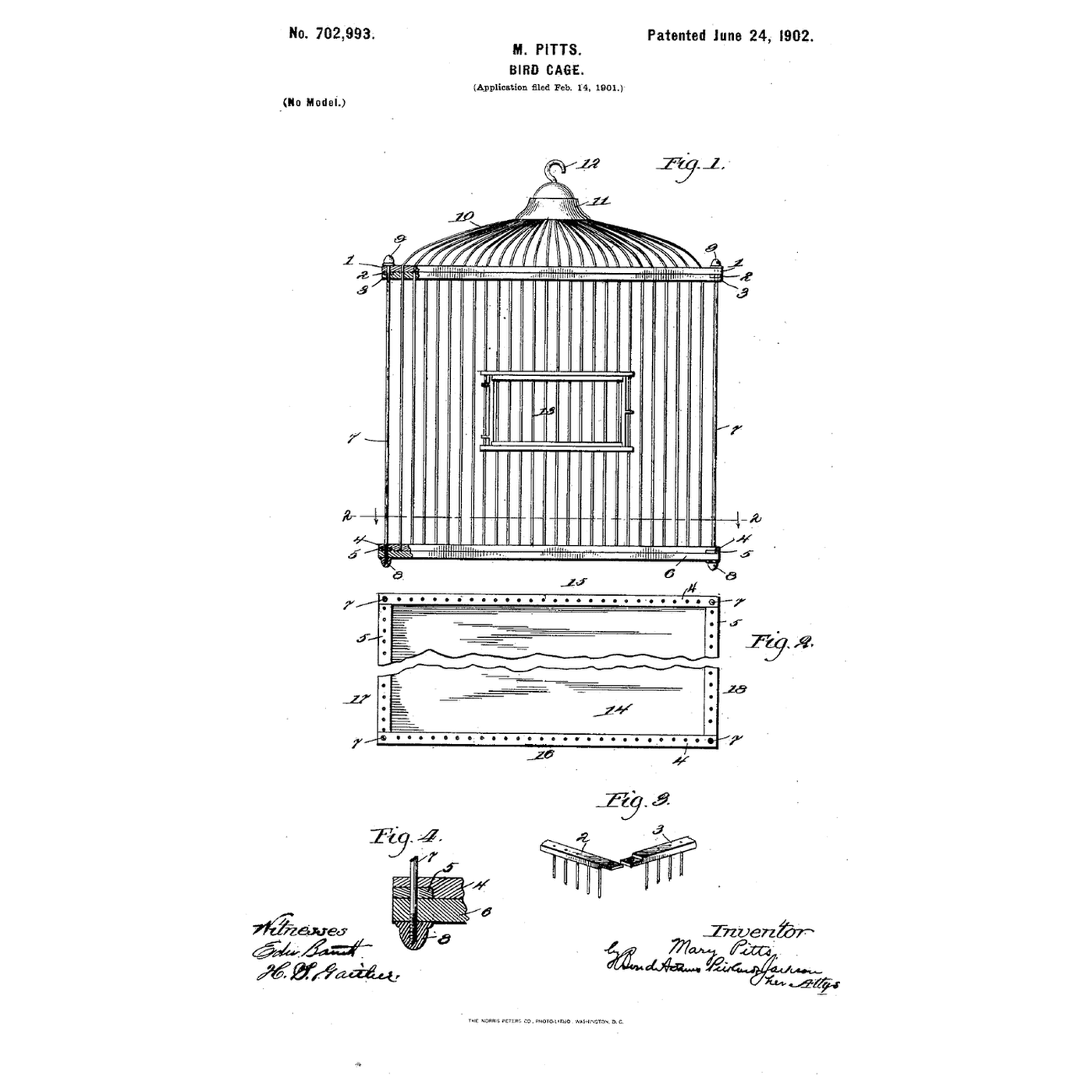
The embedded blueprint renews a cage floor from a paper roll. Compton raises a plate above a pierced bottom, so air passes under it and what falls through is cleared by a slide.
3
3
Read US 963,995
Read US 963,995
"The upwardly and inwardly directed portion 13 is provided with a plurality of relatively large apertures 15 to decrease the weight and to increase the circulation of air, as hereafter explained."
"The plate is thus spaced away from the bottom 12 a distance equal to the lengths of the posts 20, and the plate extends at its margin beneath the sides of the cage, and is spaced from the upturned margin 13 of the bottom."
"With a device thus constructed the air circulates freely beneath the plate 21 and thus materially improves the circulation and prevents the accumulation of dead or foul air."
4
4
Make the bottom, plate and slide
Make the bottom, plate and slide
**Bottom.** Measure the bought cage's bottom rim. From aluminium sheet cut a piece 16 cm longer and wider, fold 6 cm up on each side into a tray, snipping the corners, and bend the top 2 cm of each wall inward, so the tray's floor is 2 cm larger than the cage all round and its lips meet the cage's wires. Lay out a row of 20 mm holes along each wall, centred 3 cm up, below the lips, and cut them with the hole saw; file their edges smooth.
**Plate.** Cut a plate of aluminium sheet 1 cm larger all round than the cage's bottom, so it reaches under the cage's sides but stays 1 cm clear of the walls. Bolt four hex bolts through the tray's floor, with a nut run down each to 1.5 cm, and rest the plate on the nuts, below the holes; turn up its corners 5 mm as stops.
**Slide.** Cut a 6 × 1.5 cm opening in one wall at floor level, between two holes, so it opens under the plate. Bend two strips of sheet into channels and fix them with pop rivets either side of it, and slip in a small plate of sheet as the closure.
**Test.** Stand the cage on the plate, with its wires against the tray's lips. Scatter a cupful of lentils and a spoon of flour on the plate and tap the cage twenty times. Count the lentils that leave the tray, open the slide, and sweep out what fell under the plate.
Material untuk langkah ini:
 Sangkar burung1 buah
 Lembaran aluminium1 buah
 Aneka baut segi enam1 buah
 Paku keling tembak1 buah
 Kacang lentil kering1 buah
 Tepung1 buah
Alat yang dibutuhkan:
 Gunting seng
 Ragum Meja
 Tang Berujung Rata
 Palu
Palu Bor Tanpa Kabel
 Set Mata Bor
 Set gergaji lubang
 Set pistol paku keling
 Kikir (Kikir Tangan)
 Kunci Inggris
 Penggaris
 Spidol Permanen
 Kacamata Pengaman Bening
5
5
A floor that spills, rattles or will not clear
A floor that spills, rattles or will not clear
Raised-plate cage floor troubleshooting.
Flow
Loading...
6
6
History and honest limits
History and honest limits
**John E. Compton** of Red Lodge, Carbon County, Montana, filed US 963,995 on 23 June 1909; it was patented 12 July 1910. His cage is round, of upright wires 10 with a band 11; the bottom 12–13 is preferably spun from sheet metal, brass or another metal, plated or ornamented, its edge rolled at 14 round a binding wire. Sliding catches 16 through keepers 17 bear on stop plates 18 to hold the cage to the bottom; the plate 21 rests on posts 20 with stops 22; the opening 23 has a sliding closure 24. Bottom and plate come apart for cleaning. His claim covers the bottom with a perforated upward margin and a smaller plate supported above the bottom and below the perforations.
**Honest limits.** A folded square tray of aluminium stands in for his spun brass bottom, and nuts on bolts for his posts. The notebook treats the margin as flat sheet; its sizes are examples. Your counts are the result.
Bahan
6- 1 buahPlaceholder
- 1 buahPlaceholder
- 1 buahPlaceholder
- 1 buahPlaceholder
- 1 buahPlaceholder
- 1 buahPlaceholder
Alat yang Diperlukan
13- Placeholder
- Placeholder
- Placeholder
- Placeholder
- 1 vendor sell this, none ship to you yetPlaceholder
- Placeholder
- Placeholder
- Placeholder
- Placeholder
- Placeholder
- Placeholder
- Placeholder
- Placeholder
Blueprint terkait
Blueprint ini berbagi pengetahuan — teknik, bahan, atau prinsip


CC0 Domain Publik
Cetak biru ini dirilis di bawah CC0. Anda bebas untuk menyalin, memodifikasi, mendistribusikan, dan menggunakan karya ini untuk tujuan apa pun, termasuk komersial, tanpa meminta izin.
Dukung Maker dengan membeli produk melalui Cetak Biru mereka di mana mereka mendapatkan Komisi Pembuat yang ditetapkan oleh Penjual, atau buat iterasi baru dari Cetak Biru ini dan masukkan sebagai koneksi di milik Anda sendiri.