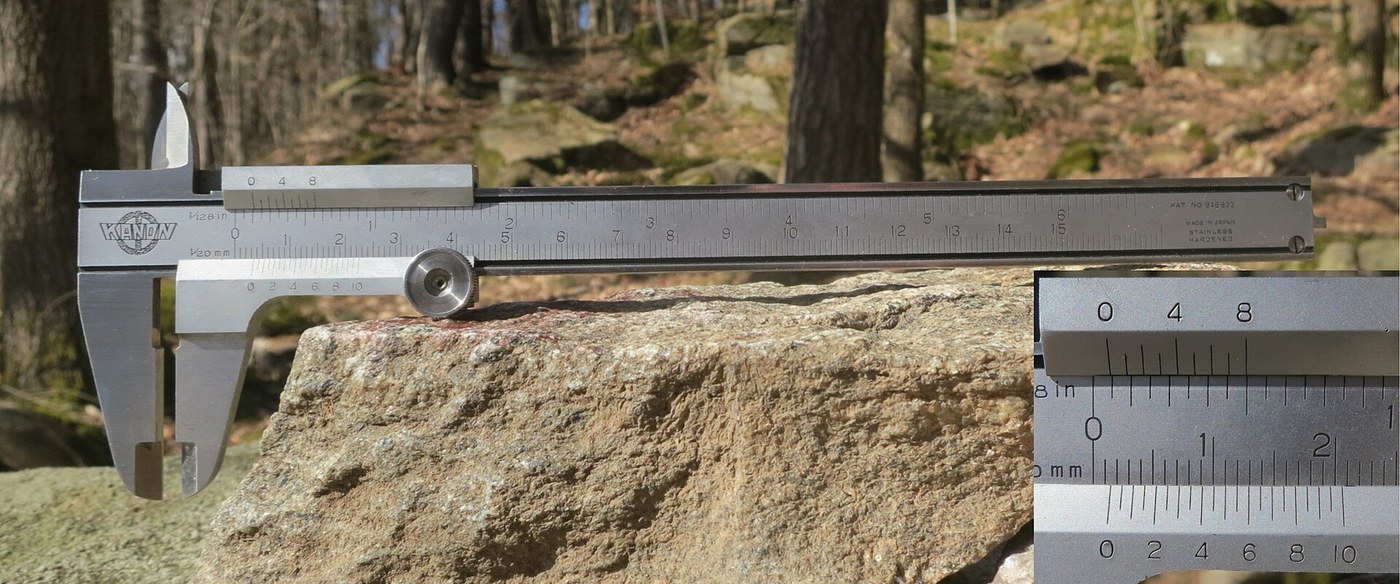


Vernier Scale
A ruler divided into millimetres cannot honestly read a tenth of a millimetre. You can guess, but a guess is not a measurement. The obvious fix — rule finer lines — fails: the marks blur together and the eye cannot separate them.
Pierre Vernier's answer sidesteps the whole problem. Put a second, sliding scale beside the first with its divisions very slightly shorter, and only one pair of lines on the two scales will ever align exactly. Which pair that is tells you the fraction. Instead of estimating a gap, you look for a coincidence — and the eye is superb at spotting when two lines are flush.
It turns a hard judgement into an easy yes-or-no, and it is still on every caliper sold.
Instruksi
Understand the target before you cut anything
Understand the target before you cut anything
You are building a scale that resolves 0.1 mm from a main scale marked only in millimetres. Nothing here is finer than a millimetre — that is the point.
Cut a main beam and mark it in millimetres
Cut a main beam and mark it in millimetres
Cut a straight strip 200 mm long and lay off millimetre divisions as accurately as you can. Every reading inherits this scale's errors.
Material untuk langkah ini:
 Pelat Kuningan 260 Ukuran 241 lembar
Alat yang dibutuhkan:
 Penggaris
Number the main scale every 10 mm
Number the main scale every 10 mm
Label the centimetre marks. You read the whole millimetres from this scale and only the fraction from the vernier.
Cut a sliding jaw that runs along the beam
Cut a sliding jaw that runs along the beam
Make a slider that moves smoothly without rocking. Any tilt lifts the vernier marks off the main scale and the coincidence becomes ambiguous.
Work out the vernier division length
Work out the vernier division length
For tenths, take 9 mm and divide it into 10 equal parts. Each vernier division is 0.9 mm — deliberately 0.1 mm short of a main division.
Mark 11 lines at 0.9 mm spacing on the slider
Mark 11 lines at 0.9 mm spacing on the slider
Lay off ten intervals of 0.9 mm, giving eleven lines from 0 to 10. Total span 9 mm, sitting against 9 mm of the main scale.
Number the vernier 0 to 10
Number the vernier 0 to 10
Label each vernier line. The number of the line that coincides is literally the number of tenths — no arithmetic required.
Set zero with the jaws closed
Set zero with the jaws closed
Close the jaws and check the vernier zero lines up with the main zero. If not, note the offset and subtract it from every reading — or re-cut.
Read the whole millimetres first
Read the whole millimetres first
Note the last main-scale mark the vernier zero has passed. That is your whole-millimetre figure, and the vernier never changes it.
Find the one vernier line that coincides
Find the one vernier line that coincides
Look along the vernier for the single line that sits exactly opposite a main-scale line. Its neighbours will visibly lean either side of coincidence.
Add its number as tenths
Add its number as tenths
Vernier line 4 coinciding means 0.4 mm. Add it to the whole millimetres: 23 mm plus 0.4 gives 23.4 mm.
Verify with known gauge blocks
Verify with known gauge blocks
Measure objects of known size — drill shanks, coins, feeler gauges. Errors reveal whether the fault lies in the main scale or the vernier.
Sight straight down to avoid parallax
Sight straight down to avoid parallax
View the scales perpendicular. Looking at an angle shifts the apparent coincidence and quietly costs you the precision you just built.
Try a 1/20 mm vernier
Try a 1/20 mm vernier
Divide 19 mm into 20 parts (0.95 mm each) for twentieths. The same principle, finer result — and now you can see why the pattern generalises.
Compendium — reading a coincidence instead of a gap
Compendium — reading a coincidence instead of a gap
The publication. Pierre Vernier, a Burgundian official and surveyor, described the scale in 1631 in La construction, l'usage, et les propriétés du quadrant nouveau de mathématiques. It was intended for angle measurement on surveying and astronomical quadrants, where fractions of a degree mattered and finer engraving was impossible.
It is not the nonius, though it is constantly called that. The Portuguese mathematician Pedro Nunes devised the nonius around 1542 — a set of many concentric scales with different numbers of divisions, so that one of them would happen to align with the pointer. It is a different and far more cumbersome device. Vernier's contribution is the single auxiliary scale with a deliberately offset division length. The name nonius stuck to Vernier's invention in several languages anyway, and Vernier himself acknowledged Nunes as inspiration — but they are not the same instrument.
Why offset divisions beat finer divisions. The eye is poor at judging what fraction of a gap a pointer sits at, and good at judging whether two lines are flush — an alignment task, not an estimation task. Making the vernier division 0.9 mm against a 1 mm main division means the mismatch accumulates at exactly 0.1 mm per division, so the position of the coinciding line encodes the fraction directly. Nothing has been measured more finely than a millimetre; the fine information was extracted from a difference.
Where the idea went. The same trick appears far beyond calipers: in the barometer and theodolite it was intended for, in micrometer thimbles, and conceptually in the beat frequency between two nearly equal tones, in moiré patterns, and in the stroboscopic vernier used to measure engine speed. Any time two nearly equal periodicities are compared, a small difference is amplified into something easy to see. Vernier found one of the first practical uses of that idea.
Cetak biru ini membuat
Blueprint terkait
Blueprint ini berbagi pengetahuan — teknik, bahan, atau prinsip

CC0 Domain Publik
Cetak biru ini dirilis di bawah CC0. Anda bebas untuk menyalin, memodifikasi, mendistribusikan, dan menggunakan karya ini untuk tujuan apa pun, termasuk komersial, tanpa meminta izin.
Dukung Maker dengan membeli produk melalui Cetak Biru mereka di mana mereka mendapatkan Komisi Pembuat yang ditetapkan oleh Penjual, atau buat iterasi baru dari Cetak Biru ini dan masukkan sebagai koneksi di milik Anda sendiri.