Kolaborasi
SENI
KECANTIKAN & KESEHATAN
KERAJINAN
BUDAYA & SEJARAH
HIBURAN
LINGKUNGAN
MAKANAN & MINUMAN
REKAYASA BALIK
ILMU PENGETAHUAN
OLAHRAGA
TEKNOLOGI
PERANGKAT PAKAI
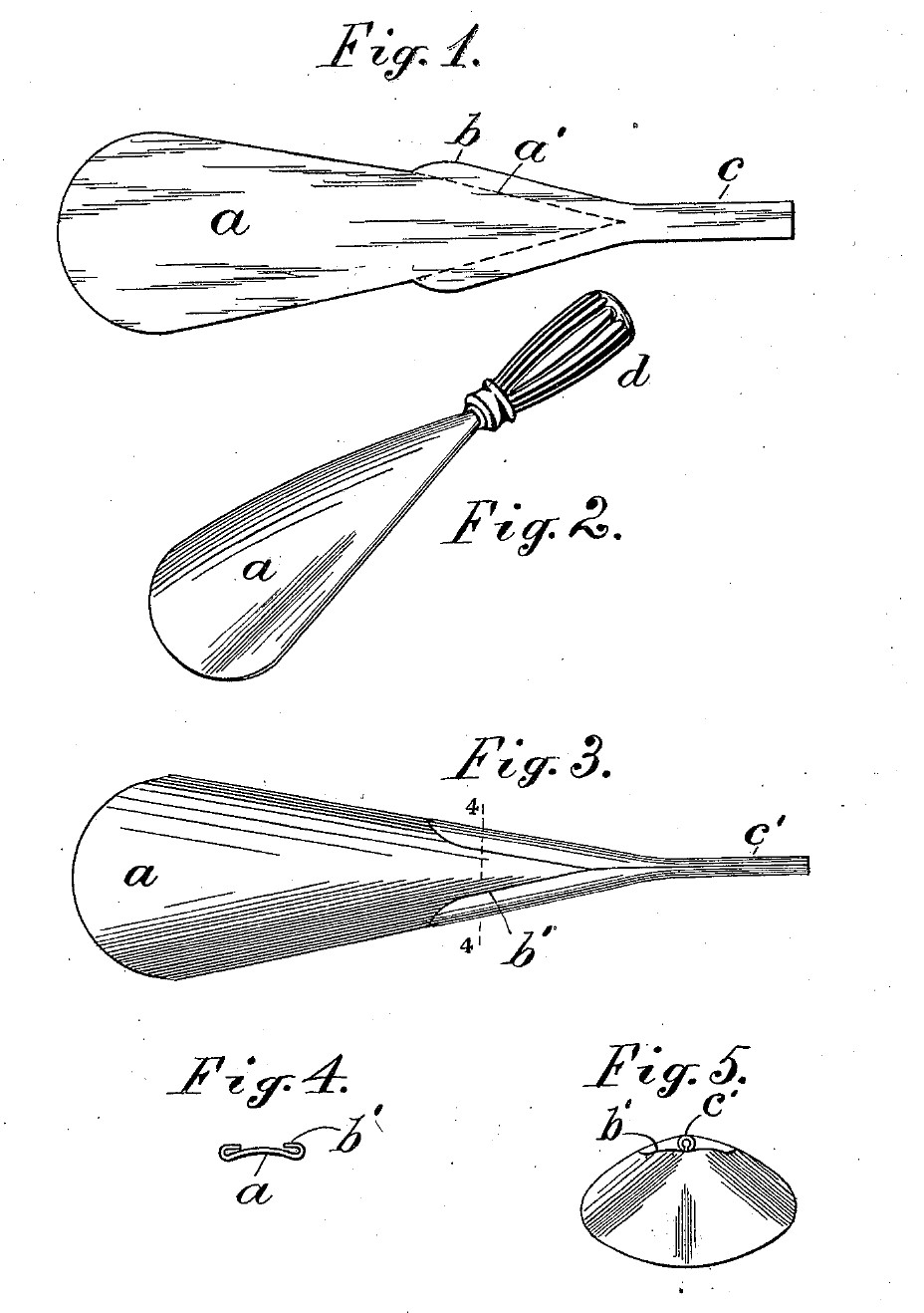


Shoe Horn With a Rolled Tubular Tang, Cut From One Sheet (Williams, 1901)
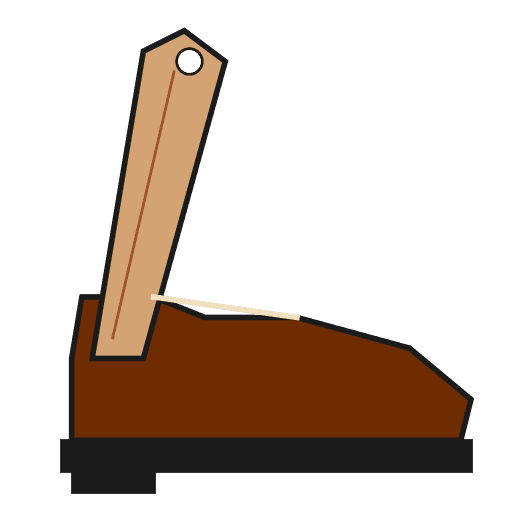
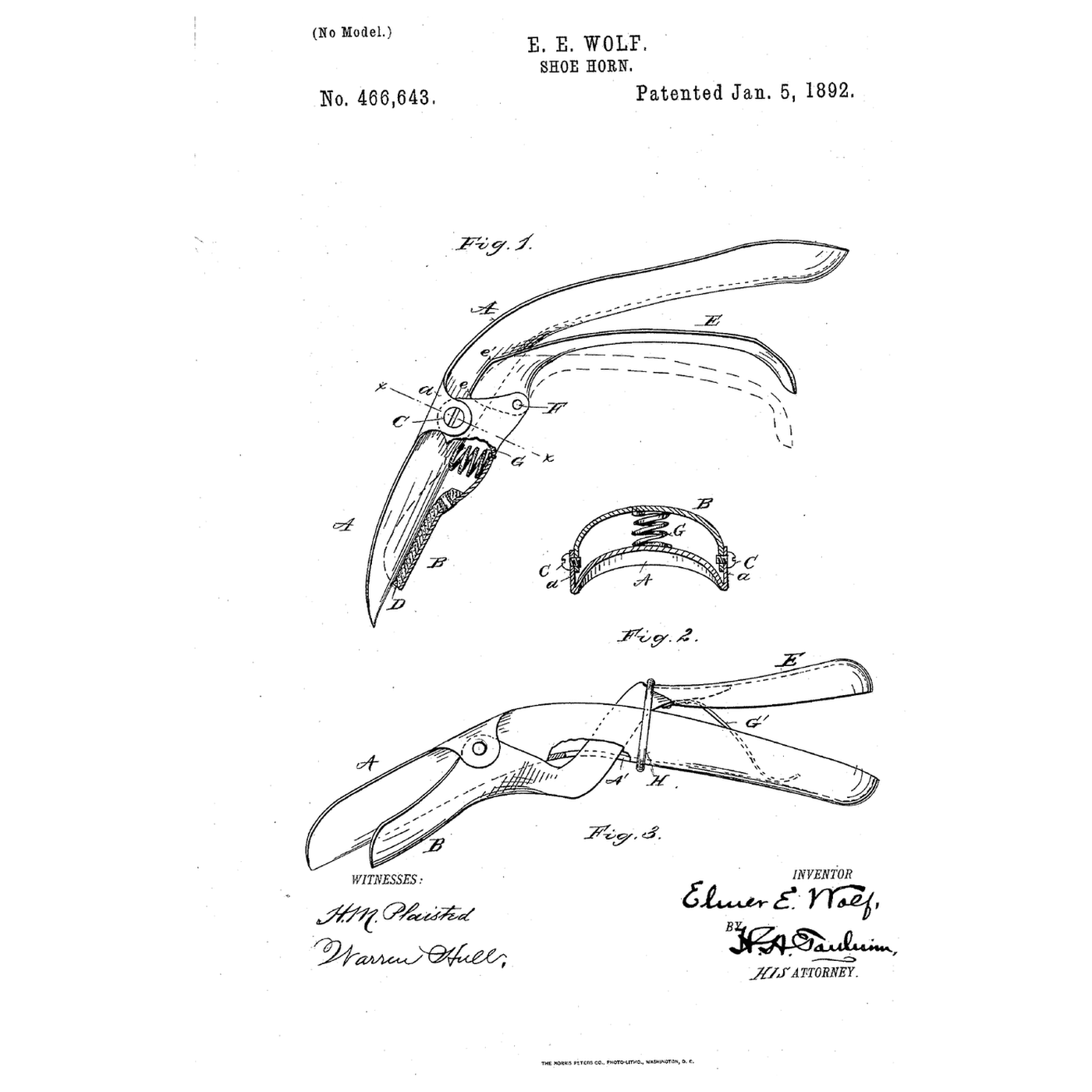
Alfred G. Williams of Newark received US 685,548, dated 29 October 1901, for a sheet-metal shoe horn whose handle tang is part of the same blank. A tongue at the narrow end is rolled into a close tube, and two wings beside it are folded over the edges of the horn, so the weak neck is stiffened where it meets the tang. A handle fits on the tang.
We cut it from brass sheet with a 1:1 template and fit a hardwood handle. All sizes are ours.
Pemula
About 3 hours
Instruksi
1
1
How wide to cut the tongue
How wide to cut the tongue
Memuat notebook Jupyter…
2
2
Read US 685,548
Read US 685,548
"I construct the tang by extending the sheet metal from the upper or smaller end of the horn in a tongue of suitable width to roll into a tubular tang and form integral with such tongue lateral wings or flanges upon the upper end of the horn, which can be folded or curved upon the edges of the horn to stiffen the same at its junction with the tang."
3
3
Print the template
Print the template
The blank at 1:1 as his Fig. 1: body a, wings b, tongue c, with the fold lines a' dashed: they run from where each wing starts in to the root of the tongue. print at 100 % (check the 50 mm bar).
4
4
Cut the blank
Cut the blank
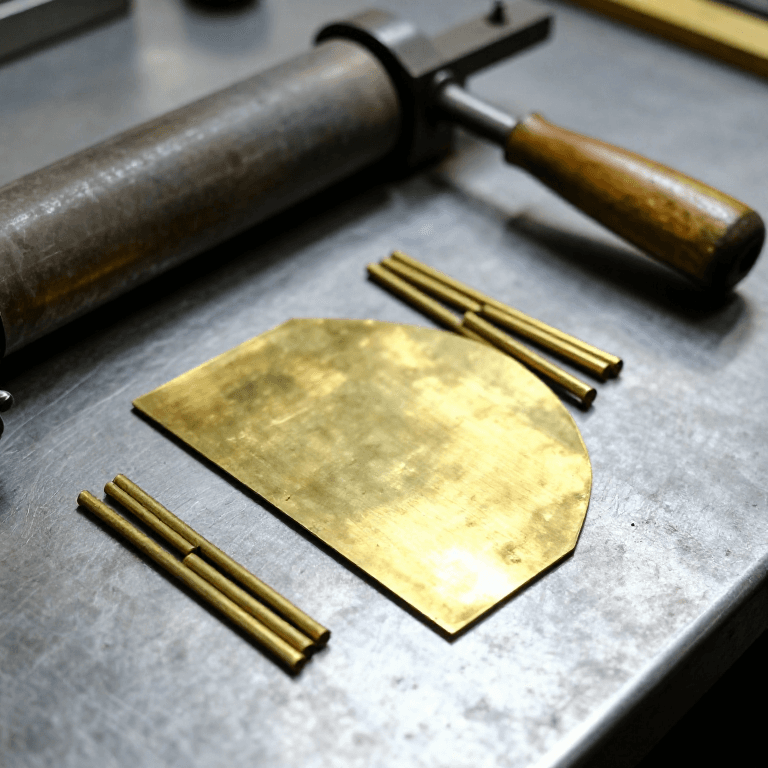
Cut the paper blank out and lay it on 0.8 mm brass sheet. Scribe round it. Cut just outside the line with tin snips, then file to the line. Keep the tongue an even 15 mm wide.
Material untuk langkah ini:
 Lembaran Kuningan1 buah
Alat yang dibutuhkan:
 Penggores
 Gunting seng
 Set Kikir
 Ragum Meja
5
5
Smooth the edges
Smooth the edges
Round every edge of the body with a file and sandpaper. The mouth slides against the heel and the sock, so it must be smooth all round.
Alat yang dibutuhkan:
Set Kikir Amplas
6
6
Roll the tang
Roll the tang
Lay a 4 mm rod along the middle of the tongue. With round-nose pliers, curl one edge of the tongue up round the rod, then the other, a little at a time along its length, until the edges meet: his "close-rolled cylindrical" tang c'. Slide the rod out.
Alat yang dibutuhkan:
 Tang berujung bulat
 Tang Berujung Rata
 Batang Baja Lunak
7
7
Fold the wings
Fold the wings
Fold each wing b along its dashed line a' over the edge of the horn, onto the underside, with the flat-nose pliers and then light taps of the rubber mallet, until it lies close. His Figs. 3 and 4 show the horn turned over, with the wings b' lying on the edges and running into the tang.
Alat yang dibutuhkan:
Tang Berujung Rata Palu karet
8
8
Dish the body
Dish the body
His body is "slightly concave transversely". Lay it, inside up, across a rod held in the vice and tap the edges down with the rubber mallet, working from the neck to the mouth, until it is evenly hollow across its width. Keep the curve slight; it should still lie nearly flat on the bench along its length.
Alat yang dibutuhkan:
Palu karet Batang bulat baja lunakRagum Meja
9
9
Make the handle
Make the handle
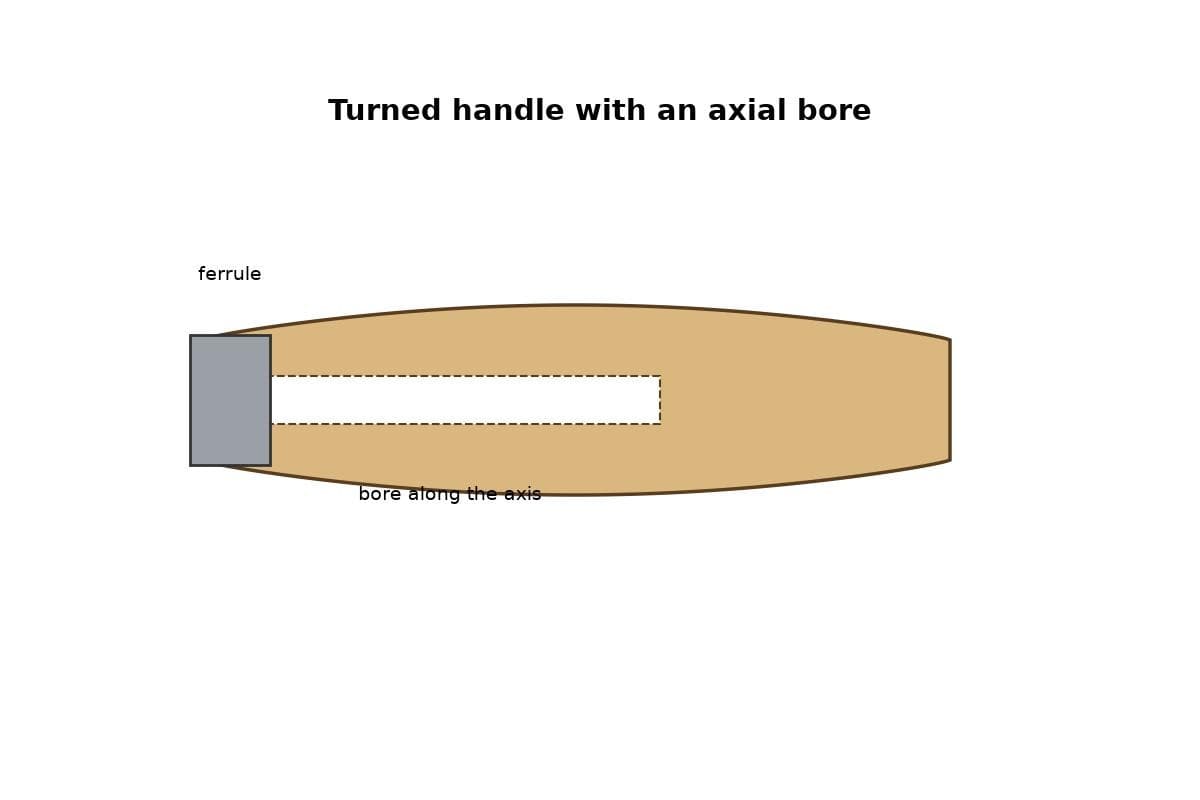
Saw 75 mm of hardwood handle stock (ours) and shape it with a rasp and sandpaper. Drill a 6 mm hole 40 mm deep in one end, straight down the middle, to take the tang. His handle is "more for ornament than for support", so any shape you like will do.
Material untuk langkah ini:
 Kayu Keras Bahan Gagang1 buah
Alat yang dibutuhkan:
 Gergaji Besi
 Kikir kasar kayuAmplas
 Bor tanganRagum Meja
10
10
Fit the handle
Fit the handle
Roughen the tang with sandpaper, mix the epoxy, fill the hole and push the handle onto the tang until it meets the wings. Line the handle up with the horn and leave it to set as the epoxy's label says.
Material untuk langkah ini:
 Epoksi dua komponen1 buah
Alat yang dibutuhkan:
Amplas11
11
Polish
Polish
Polish the horn with polishing compound on a soft cloth.
Alat yang dibutuhkan:
 Pasta poles
12
12
Troubleshooting
Troubleshooting
Tubular-tang shoe horn troubleshooting.
Flow
Loading...
13
13
History and honest limits
History and honest limits
**Alfred G. Williams** of Newark, New Jersey, assignor to Havell Manufacturing Company, US 685,548, dated 29 October 1901, filed 26 June 1901. He claimed "the shoe-horn having integral tang c', of close-rolled cylindrical form, with integral wings b' extended from such tang and folded over upon the edges of the horn". He meant it for "ornamented handles" in "mounted toilet sets". He gives no sizes, no metal and no way of fixing the handle: the brass, all sizes, the hardwood handle, the epoxy and the order of work are ours.
Bahan
3- 1 buahPlaceholder
- 1 buahPlaceholder
- 1 buahPlaceholder
Alat yang Diperlukan
14- Placeholder
- Placeholder
- Placeholder
- Placeholder
- Placeholder
- Placeholder
- Placeholder
- Placeholder
- Placeholder
- Placeholder
- Placeholder
- Placeholder
- Placeholder
- Placeholder
Berkas desain
1Cetak biru ini membuat
Blueprint terkait
Blueprint ini berbagi pengetahuan — teknik, bahan, atau prinsip
CC0 Domain Publik
Cetak biru ini dirilis di bawah CC0. Anda bebas untuk menyalin, memodifikasi, mendistribusikan, dan menggunakan karya ini untuk tujuan apa pun, termasuk komersial, tanpa meminta izin.
Dukung Maker dengan membeli produk melalui Cetak Biru mereka di mana mereka mendapatkan Komisi Pembuat yang ditetapkan oleh Penjual, atau buat iterasi baru dari Cetak Biru ini dan masukkan sebagai koneksi di milik Anda sendiri.