

Berliner Gramophone
Edison's phonograph records by pressing a stylus into tinfoil or wax — the louder the sound, the deeper the dent. That works, and it has a flaw built into the physics: the deeper the stylus goes, the harder the material pushes back, so loud passages meet more resistance than quiet ones and the recording distorts itself. The stylus is fighting the medium.
Berliner turns the cut sideways. His stylus rides in constant, barely-there contact with a surface coated in lamp-black and swings across it. Depth never changes, so friction never changes, so the medium stops arguing with the signal.
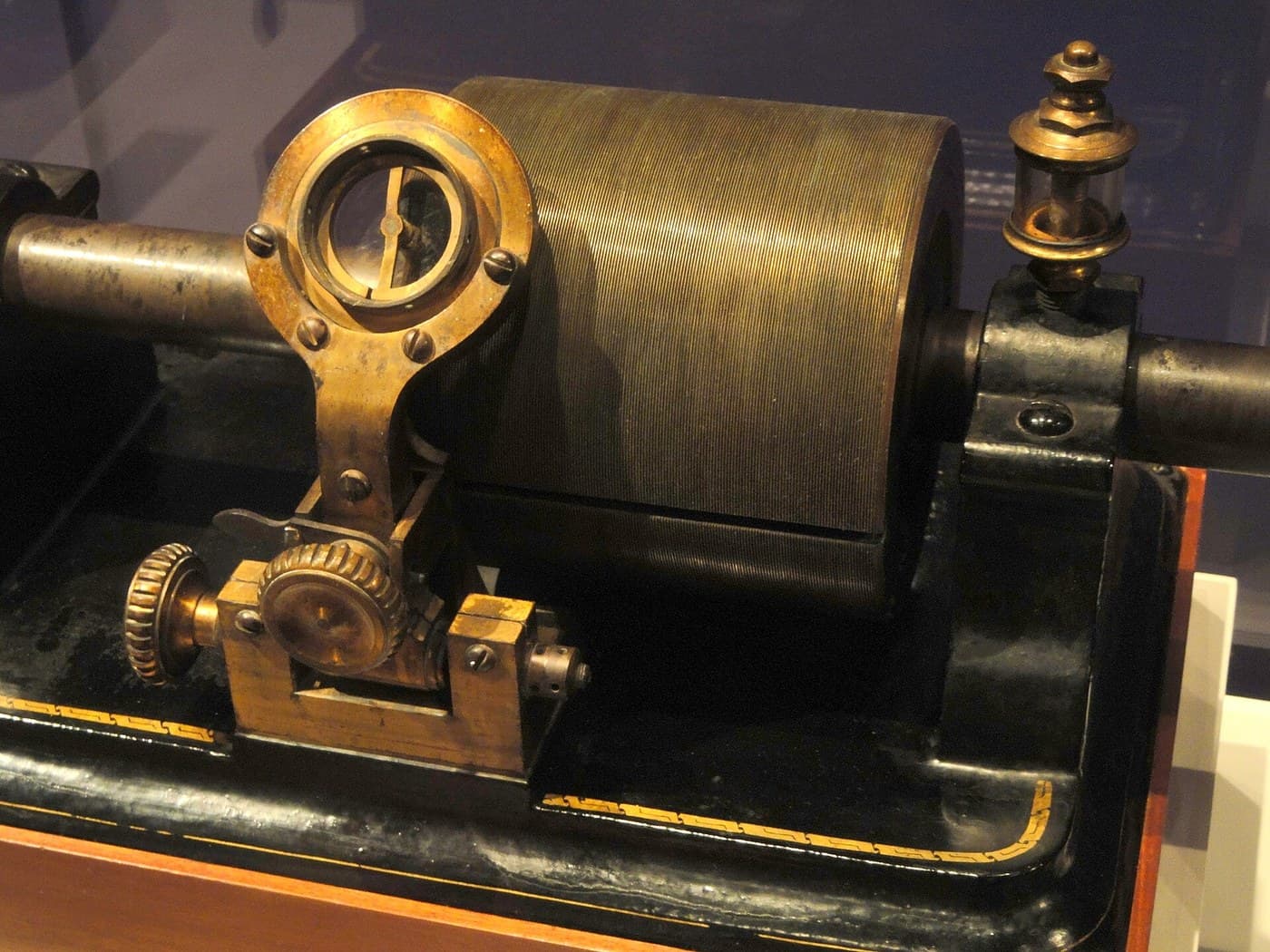
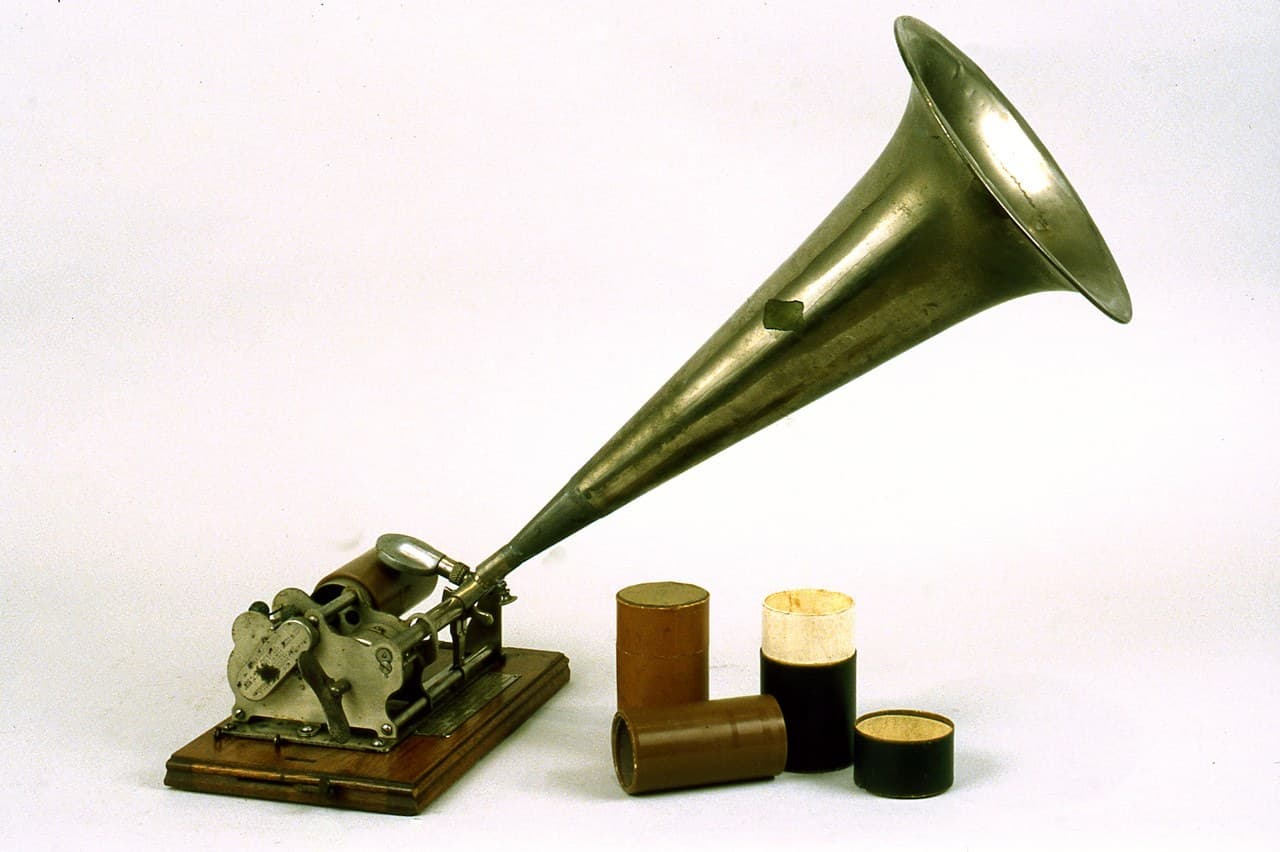
The second change is the one that built an industry. A flat disc can be photo-engraved into metal and used as a master to stamp copies — thousands of them, all identical. A wax cylinder had to be recorded again, or copied one at a time. Berliner did not just improve recording; he invented the record.
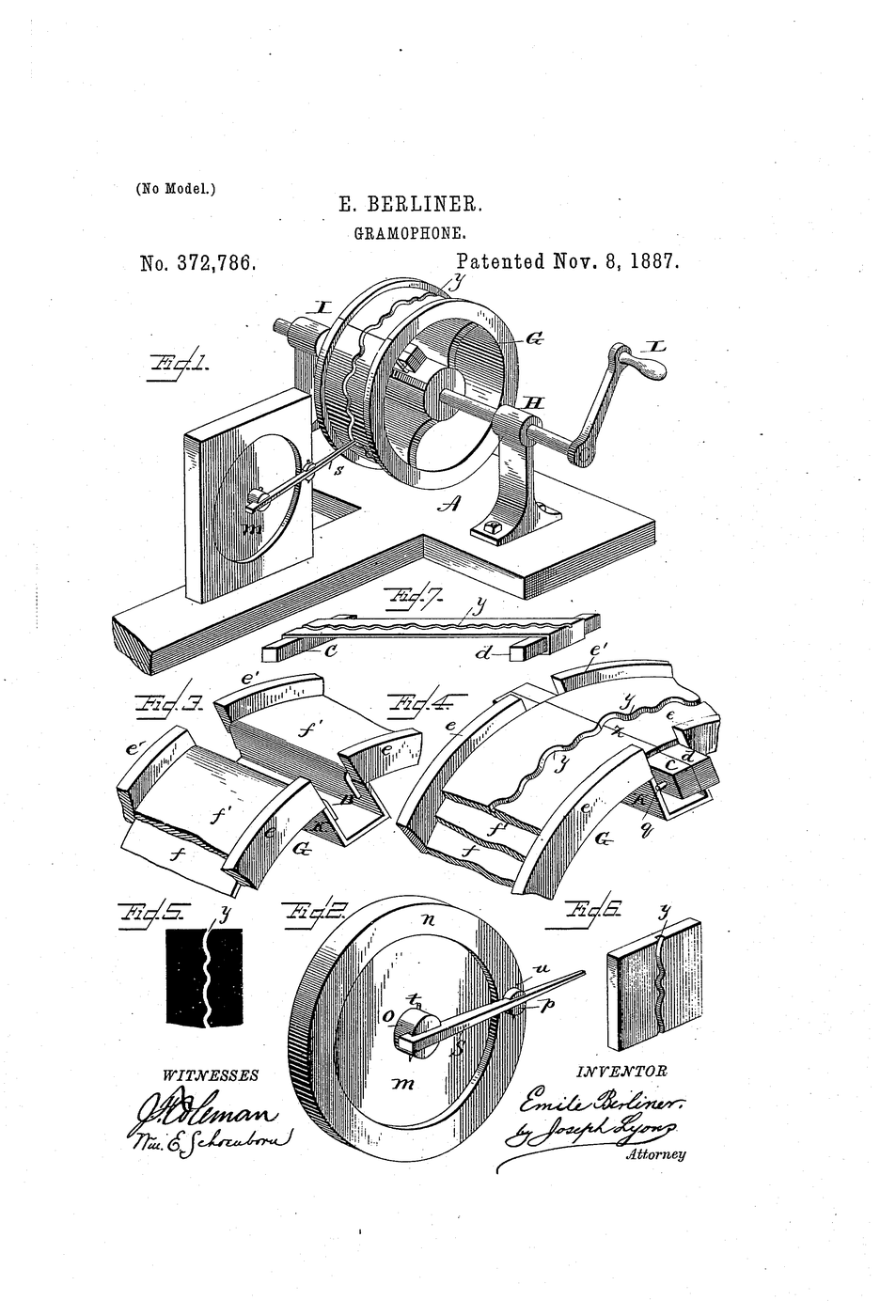
US Patent 372,786, "Gramophone", granted 8 November 1887 to Emile Berliner, from an original application of 26 September 1883.
निर्देश
Ventilate when you smoke the disc
Ventilate when you smoke the disc
Lamp-black is soot from a flame. Work in a ventilated space, keep the flame away from anything loose, and let the disc cool before handling.
Read US 372,786 and find the word parallel
Read US 372,786 and find the word parallel
Berliner's stylus moves "parallel with and barely in contact" with the surface. Not into it. That single word is the difference from the phonograph.
Press a stylus into soft wax and feel the resistance change
Press a stylus into soft wax and feel the resistance change
Push a needle gently, then hard, into a wax block. The force rises steeply with depth. That non-linearity is the distortion Berliner is removing.
Drag the same stylus sideways at fixed depth
Drag the same stylus sideways at fixed depth
Now scratch across the surface at constant, minimal depth. The force stays the same whatever the sideways swing. Record the contrast with step 3.
Cut and true a flat disc
Cut and true a flat disc
Cut a 150 mm disc from thin zinc or rigid plastic and mount it on a centred spindle. It must run flat — wobble writes itself into the groove.
Coat it with lamp-black
Coat it with lamp-black
Hold the spinning disc over a candle flame until it carries an even matt black film. This is the low-resistance layer the patent specifies.
Build the diaphragm and stylus arm
Build the diaphragm and stylus arm
Stretch a thin membrane over a short tube and fix a light needle to its centre, arranged to swing sideways across the disc, not up and down.
इस चरण के लिए सामग्री:
 जस्ती इस्पात तार1 मीटर
आवश्यक उपकरण:
 चपटे मुँह का प्लास
Set the stylus to barely touch
Set the stylus to barely touch
Adjust until the needle just marks the soot without reaching the metal. Too heavy and you are back to cutting a trench; too light and it skates.
Rotate steadily and speak into the horn
Rotate steadily and speak into the horn
Turn the disc at a constant speed while speaking or singing into the mouthpiece. A wavering spiral line appears in the soot.
Examine the trace under magnification
Examine the trace under magnification
Look at the line closely. It snakes from side to side, and its width is constant. The sound is stored as sideways displacement, not depth.
Compare loud and quiet passages
Compare loud and quiet passages
Record a quiet phrase then a loud one. The wiggle gets wider, not deeper. Amplitude and depth have been separated — that is the whole fix.
Play the trace back
Play the trace back
Fit a light replay needle in the groove and rotate at the same speed. The groove pushes the needle sideways in both directions — the patent's "positive bidirectional movement".
Etch the trace into the metal
Etch the trace into the metal
Where the soot was cleared, the metal is exposed. A brief acid etch bites only those lines, turning a fragile soot drawing into a durable metal groove.
Take an impression from the etched disc
Take an impression from the etched disc
Press a sheet of softened thermoplastic against the etched disc and lift it. You have made a copy without re-recording anything — this is the record industry in one step.
Make a second copy and compare
Make a second copy and compare
Press another. Both carry the same groove from the same master. A cylinder could not do this — that is why discs won.
History & Context — the disc beat the cylinder on manufacturing
History & Context — the disc beat the cylinder on manufacturing
The patent. US 372,786, "Gramophone", granted 8 November 1887 to Emile Berliner, a German-born inventor working in Washington, from an original application dated 26 September 1883.
Three separate changes, and they are usually collapsed into one. First, lateral instead of vertical: Edison's stylus indents the medium, so the recording force varies with loudness and the medium fights back non-linearly. Berliner's swings sideways at constant depth, so friction is constant. Second, disc instead of cylinder: a flat disc can be pressed between dies. ⚠ Be precise here — the 1887 drawing sheet shows BOTH forms, a hand-cranked cylinder machine in Fig. 1 and a disc in Fig. 2. The patent's claim is the lateral cut, not the disc as such; Berliner was still working in both geometries at this date and committed to discs afterwards. "Berliner invented the disc" is a fair summary of his career and a sloppy reading of this document. Third — the one that is genuinely his and is usually forgotten — the recording is made in soot and then photo-engraved into metal, producing a hard master from a soft original. Steps 13 to 15 are that sequence.
The industry came from the third change, not the first. Edison's cylinders sounded good, and for a long time arguably better. But every cylinder had to be recorded individually, or duplicated one at a time by pantograph, which meant performers recording the same song over and over into banks of horns. Berliner's master could stamp copies indefinitely at almost no cost per unit. Recorded music as a mass-market product — a thing you buy in a shop rather than a novelty you visit — exists because of stamping. It is a good example of a manufacturing advance defeating a technically respectable rival.
What it cost. Early gramophone discs played for around two minutes a side and sounded harsher than a good cylinder; the format won on price, convenience and catalogue rather than fidelity. Berliner also had to solve replay separately — his early machines were hand-cranked, and getting a constant speed took the spring motor developed with Eldridge Johnson, without which pitch wanders audibly. Step 9 will show you that problem immediately: turn unevenly and the playback warbles.
Where it ended up. Lateral-cut discs stamped from a metal master remained the dominant recording format for roughly a century, through shellac 78s to vinyl LPs, and the geometry in step 12 — a groove pushing a stylus sideways — is exactly what a record player does today. Berliner also gave the format its shape: a flat disc with a centre hole and a spiral groove running inward.
सामग्री
1- 1 मीटरप्लेसहोल्डर
आवश्यक उपकरण
1- प्लेसहोल्डर
संबंधित ब्लूप्रिंट
ये ब्लूप्रिंट ज्ञान साझा करते हैं — तकनीक, सामग्री या सिद्धांत


CC0 पब्लिक डोमेन
यह ब्लूप्रिंट CC0 के तहत जारी किया गया है। आप बिना अनुमति माँगे इस कार्य को किसी भी उद्देश्य के लिए कॉपी, संशोधित, वितरित और उपयोग करने के लिए स्वतंत्र हैं।
उनके ब्लूप्रिंट के माध्यम से उत्पाद खरीदकर मेकर का समर्थन करें जहाँ वे मेकर कमीशन कमाते हैं जो विक्रेताओं द्वारा निर्धारित होता है, या इस ब्लूप्रिंट का नया संस्करण बनाएँ और राजस्व साझा करने के लिए इसे अपने ब्लूप्रिंट में कनेक्शन के रूप में शामिल करें।