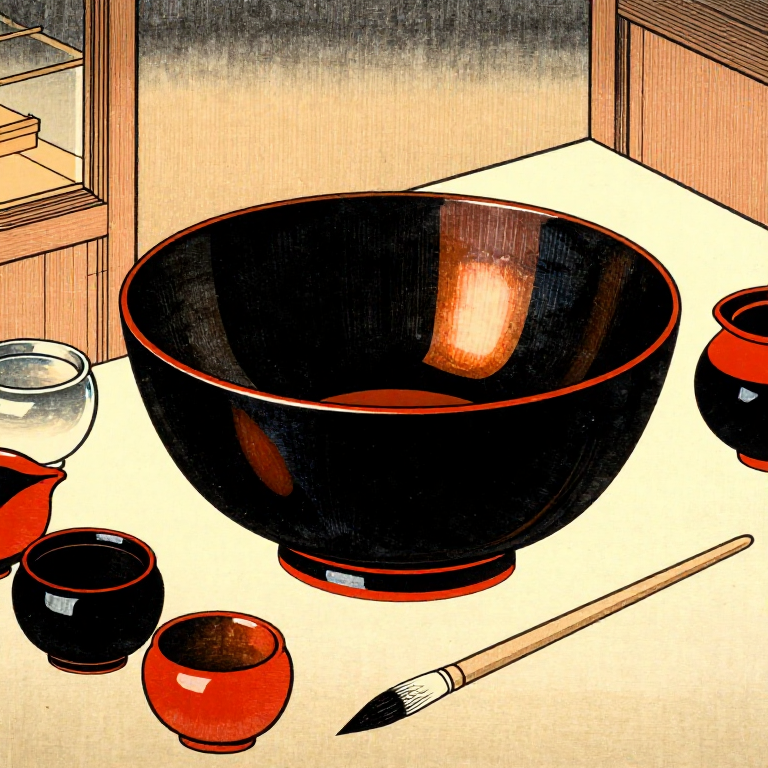


Applying Urushi Lacquer to a Wooden Bowl — Japanese Lacquerwork
निर्देश
Seal and Prime the Raw Wood
Seal and Prime the Raw Wood
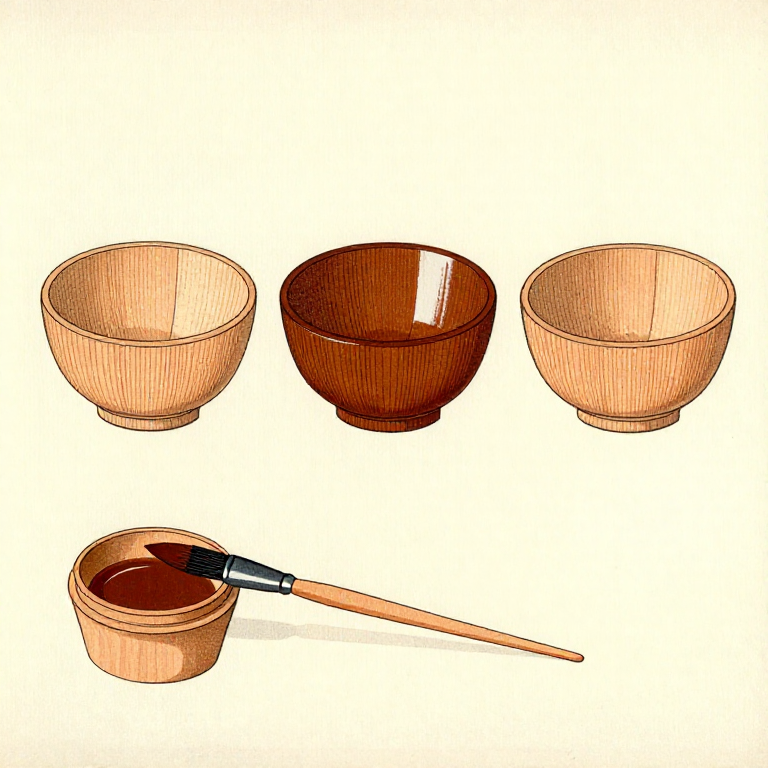
Sand the wooden bowl to 220 grit and remove all dust. Thin raw urushi lacquer (ki-urushi) with a small amount of camphor oil or turpentine to reduce viscosity, and brush a thin coat over the entire surface. This first coat (kiji-gatame) soaks into the wood pores, sealing them and providing a bond for subsequent layers. Wear nitrile gloves — urushi contains urushiol and causes severe contact dermatitis in most people. Place the coated bowl in a humidity cabinet (furo) at 70-80% relative humidity and 20-25 degrees C. Unlike conventional finishes, urushi cures by absorbing moisture from the air through an enzyme-catalyzed polymerization reaction. Curing takes 24-48 hours per coat.
इस चरण के लिए सामग्री:
 कच्चा उरुशी लाख50-100ml मिली
 परिष्कृत काला उरुशी30-50ml मिली
 तोनोको चूर्ण50g ग्रा
 वाशी काग़ज़1-2 sheets टुकड़ा
 खराद की लकड़ी का कटोरा गुटका1 टुकड़ा
 रेगमाल1 शीट
आवश्यक उपकरण:
 उरुशी कूचियाँ
 नमी की अलमारी
 गीले/सूखे रेगमाल का सेट
 नाइट्राइल दस्ताने
 पॉलिश का चूर्ण
Apply Foundation Layers
Apply Foundation Layers
After the primer has cured, sand lightly with 400-grit wet sandpaper and wipe clean. Mix raw urushi with tonoko powder to create a thick paste (sabi). Apply this paste to the entire surface using a spatula, filling any pores, grain, or imperfections. Cure in the furo. Sand smooth when cured. Apply 2-3 coats of sabi, sanding between each, until the surface is perfectly uniform with no visible wood grain. On areas prone to chipping (the rim and foot), reinforce with strips of thin washi paper embedded in urushi before applying sabi. These foundation layers create a smooth, dimensionally stable base that prevents the finished surface from telegraphing wood grain movement.
इस चरण के लिए सामग्री:
रेगमाल1 शीटApply Middle Coats (Naka-nuri)
Apply Middle Coats (Naka-nuri)
Apply 2-4 coats of filtered black urushi (naka-nuri urushi), each coat extremely thin — barely more than a film. Thick coats wrinkle during curing because the outer surface polymerizes before the interior, trapping uncured lacquer beneath. After each coat, place in the furo and cure for 48 hours. Sand each cured coat with progressively finer wet sandpaper (600, then 800 grit). The surface should feel glass-smooth after sanding, with no visible brush marks or orange peel texture. Wipe with a damp cloth between sanding and the next coat to remove all sanding residue. These middle coats build the colour depth and create a substrate for the final finishing coats.
इस चरण के लिए सामग्री:
रेगमाल1 शीटApply Final Coats (Uwanuri)
Apply Final Coats (Uwanuri)
The final coat (uwanuri) uses the highest-quality refined urushi (roiro-urushi for glossy black). Filter the urushi through fine-weave silk or paper to remove any particles or skin. Apply with a clean, dust-free hake brush in a dust-free environment — a single speck of dust trapped in the final coat is visible forever. Brush in one direction with even, overlapping strokes. The coat must be thin and uniform. Place in the furo and cure for 72 hours minimum. The uwanuri coat can be left as-is for a semi-gloss finish, or polished to a mirror finish in the next step. For red lacquer (shu-urushi), vermilion pigment (mercuric sulfide) is ground into the urushi before application.
Polish to Mirror Finish (Roiro)
Polish to Mirror Finish (Roiro)
For the highest gloss (roiro finish), wet-sand the cured final coat with 1200-grit then 2000-grit wet sandpaper until the surface is uniformly matte. Then polish progressively using tonoko powder mixed with water on a soft cloth, followed by deer-horn charcoal powder (tsunoko) on silk, and finally raw urushi rubbed by hand on silk (suri-urushi). Each polishing stage produces a finer surface finish. The final hand-rubbed urushi polish produces a depth and luminosity that synthetic lacquers cannot replicate — light appears to penetrate into the surface rather than reflecting off it. A properly finished urushi surface is waterproof, resistant to temperatures up to 80 degrees C, naturally antimicrobial, and will last for centuries with proper care.
इस चरण के लिए सामग्री:
रेगमाल1 शीटरेगमाल1 शीटसामग्री
10- 50-100ml मिलीप्लेसहोल्डर
- 30-50ml मिलीप्लेसहोल्डर
- 50g ग्राप्लेसहोल्डर
- 1-2 sheets टुकड़ाप्लेसहोल्डर
- 1 टुकड़ाप्लेसहोल्डर
- 1 शीटप्लेसहोल्डर
- 1 शीटप्लेसहोल्डर
- 1 शीटप्लेसहोल्डर
- 1 शीटप्लेसहोल्डर
- 1 शीटप्लेसहोल्डर
आवश्यक उपकरण
5- प्लेसहोल्डर
- प्लेसहोल्डर
- प्लेसहोल्डर
- प्लेसहोल्डर
- प्लेसहोल्डर
यह ब्लूप्रिंट बनाता है
CC0 पब्लिक डोमेन
यह ब्लूप्रिंट CC0 के तहत जारी किया गया है। आप बिना अनुमति माँगे इस कार्य को किसी भी उद्देश्य के लिए कॉपी, संशोधित, वितरित और उपयोग करने के लिए स्वतंत्र हैं।
उनके ब्लूप्रिंट के माध्यम से उत्पाद खरीदकर मेकर का समर्थन करें जहाँ वे मेकर कमीशन कमाते हैं जो विक्रेताओं द्वारा निर्धारित होता है, या इस ब्लूप्रिंट का नया संस्करण बनाएँ और राजस्व साझा करने के लिए इसे अपने ब्लूप्रिंट में कनेक्शन के रूप में शामिल करें।