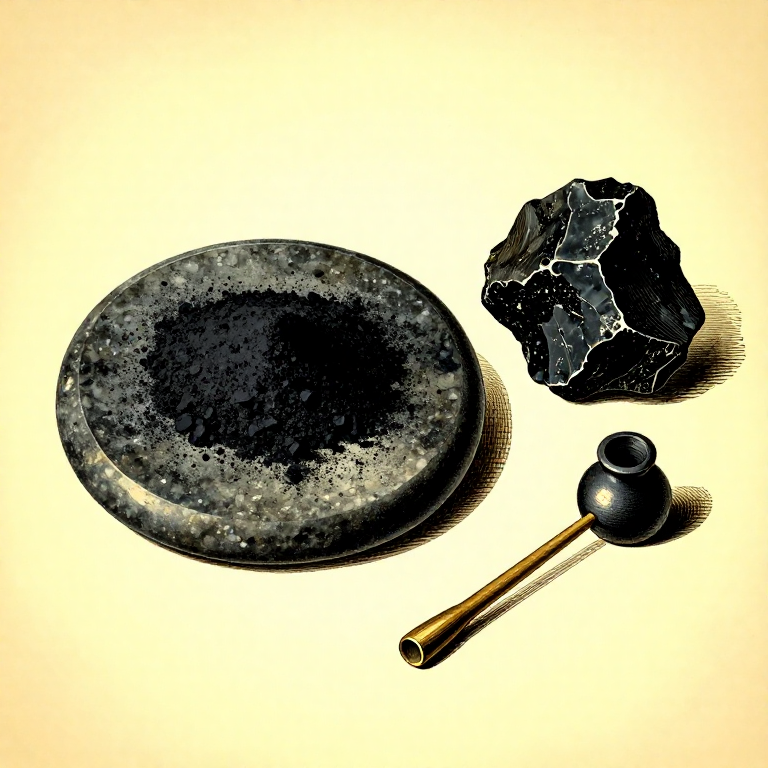
Egyptian Kohl Eyeliner — Preparing Kohl from Galena
Prepare traditional Egyptian kohl eyeliner by grinding galena (lead sulphide) into fine powder and mixing with carrier oil. Kohl was worn by all social classes for cosmetic enhancement and as protection against intense desert sun glare. Archaeological analysis confirms galena was the primary ingredient.
निर्देश
Select and Prepare the Galena
Select a piece of galena, a naturally occurring lead sulphide mineral (PbS) with distinctive metallic grey-silver luster and cubic crystal habit. Galena has a Mohs hardness of only 2.5, making it soft enough to grind on a stone palette. It was the most common kohl ingredient in ancient Egypt, identified through chemical analysis of cosmetic residues from Predynastic through Ptolemaic periods. SAFETY NOTE: Galena contains lead — use protective gloves and avoid inhaling dust. Work in a well-ventilated area. Ancient Egyptians were unaware of lead toxicity, though some researchers hypothesize the lead compounds may have provided antimicrobial protection against eye infections prevalent in the Nile environment.
Grind the Galena to Fine Powder
Place a small piece of galena on a flat stone palette and grind in circular motions with a smooth rubbing stone. The galena breaks down into a fine, dark grey to black powder. Continue until the powder is silky-smooth with no gritty texture. The cosmetic palette was among the most common artifacts of Predynastic Egypt, found in burials dating to 4000 BCE. The famous Narmer Palette is an oversized ceremonial version of this everyday grinding tool. The finest kohl required extended grinding of 20-30 minutes to achieve sufficiently fine particle size for smooth application around the eyes.

Mix with Oil or Fat Carrier
Transfer the finely ground galena powder to a mixing surface and add a few drops of animal fat, castor oil, or almond oil. Mix thoroughly until the powder and oil form a smooth, creamy paste with the consistency of modern eyeliner. The oil serves as a binder that adheres the powder to skin and makes it easier to apply in a smooth line. Analysis of ancient kohl samples has detected traces of animal fats, plant oils, and in some cases laurionite (PbOHCl) and phosgenite (Pb2Cl2CO3), which are synthetic lead compounds the Egyptians apparently manufactured deliberately. A small amount of dissolved gum arabic can be added for improved adhesion.
Store in a Kohl Container
Transfer the prepared kohl paste into a small pot or tube for storage. Ancient Egyptian kohl containers ranged from simple reed tubes to elaborately carved stone, ceramic, and faience vessels, often in decorative shapes such as columns, monkeys, or the god Bes. Some had multiple compartments for different colored cosmetics. Keep the kohl moist and creamy; if it dries, add more oil and remix. Store in a cool, dry place. The Egyptians also used green kohl from malachite (copper carbonate), more common during the Predynastic and Old Kingdom before black galena kohl became predominant.

Application Technique
Dip a thin applicator stick (traditionally wood, bone, or bronze) into the kohl paste and apply to the eyelids and around the eyes. The characteristic Egyptian eye decoration extended horizontally beyond the outer corner in a dramatic wing shape, as depicted on the funerary mask of Tutankhamun. Both upper and lower lids were lined, often with the line thickening toward the outer corner. The dark kohl reduced glare from the intense Egyptian sun by absorbing light around the eyes — the same principle used by modern athletes. Kohl was applied by men, women, and children of all social classes, making it perhaps the most universally used cosmetic in the ancient world.
सामग्री
- •Galena (lead sulphide, PbS) mineral specimen - 50-100 g piece
- •Animal fat, castor oil, or almond oil - small amount for binding pieceप्लेसहोल्डर
- •Gum arabic (optional, for adhesion) - small amount piece
आवश्यक उपकरण
- Stone cosmetic palette (slate or siltstone)
- Rubbing stone (small, smooth pebble)
- Small ceramic or stone kohl potप्लेसहोल्डर
- Thin stick or reed for application
CC0 पब्लिक डोमेन
यह ब्लूप्रिंट CC0 के तहत जारी किया गया है। आप बिना अनुमति माँगे इस कार्य को किसी भी उद्देश्य के लिए कॉपी, संशोधित, वितरित और उपयोग करने के लिए स्वतंत्र हैं।
उनके ब्लूप्रिंट के माध्यम से उत्पाद खरीदकर मेकर का समर्थन करें जहाँ वे मेकर कमीशन कमाते हैं जो विक्रेताओं द्वारा निर्धारित होता है, या इस ब्लूप्रिंट का नया संस्करण बनाएँ और राजस्व साझा करने के लिए इसे अपने ब्लूप्रिंट में कनेक्शन के रूप में शामिल करें।